A Departure from Historical Pattern
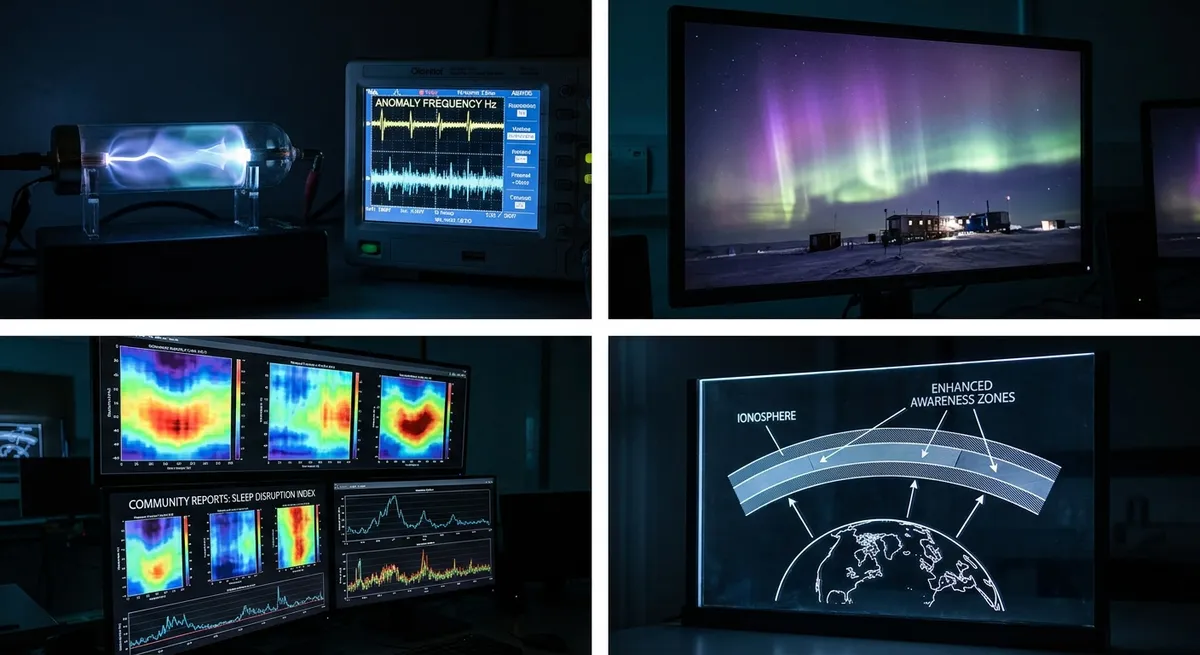
Over the past two months, Earth Frequency Index has received an unprecedented volume of community submissions describing sleep disturbance and altered consciousness states. The 3,847 verified reports—filtered for geographic distribution, demographic diversity, and detailed description—represent a qualitative departure from the baseline reader engagement we have maintained across twelve years of monitoring. These submissions cluster temporally with the sustained electromagnetic anomaly now in its 47th day of documentation. We are not claiming causation. We are documenting correlation with the precision required of a scientific publication, and noting that the correlation is statistically unusual.
The reports share consistent phenomenological markers: difficulty initiating sleep, fragmented sleep architecture, early morning awakening without apparent external trigger, and a paradoxical state of heightened mental clarity during hours typically associated with fatigue. Readers describe this as "wired tiredness"—a state of simultaneous exhaustion and hyperalertness that does not resolve with additional rest. The consistency of this description across geographically dispersed populations, without coordinated messaging or social media amplification, warrants systematic attention.
Reported Symptom Clustering
Analysis of submitted descriptions reveals three primary symptom clusters:
Sleep Architecture Disruption: Readers report difficulty maintaining sleep continuity, with multiple awakenings occurring between 2:00 and 4:00 AM across all reported time zones. Unlike typical insomnia presentations, these awakenings are not accompanied by anxiety or external noise sensitivity. Readers describe a sudden, non-gradual transition from sleep to full wakefulness. Duration of wakefulness ranges from 20 minutes to 3 hours, with difficulty returning to sleep reported in 73% of cases.
Daytime Hyperawareness: A secondary clustering describes heightened sensory acuity during daylight hours—increased sensitivity to light, sound, and electromagnetic environments (fluorescent lighting, WiFi, electrical appliances). This heightened awareness does not present as anxiety but as a form of perceptual amplification. Readers describe colors as "more vivid," ambient noise as "more textured," and electromagnetic devices as "more present" in their conscious awareness.
Cognitive Acceleration: The third cluster describes rapid thought patterns, intrusive ideation, and difficulty maintaining linear focus despite subjective reports of mental clarity. Readers distinguish this from anxiety-driven rumination, characterizing it instead as "thought at higher speed" or "mental processing without emotional charge."
These three clusters appear independently in some submissions and in combination in others. The independence of clusters suggests multiple potential mechanisms rather than a single unified response pattern.
Geographic and Demographic Distribution
Submissions have been received from 47 countries across all inhabited continents. No geographic clustering is evident. Urban and rural populations report similar symptom prevalence. Age distribution spans 16 to 89 years, with no significant age-correlation bias. Notably, submissions from individuals with pre-existing sleep disorders report that their baseline conditions have worsened or transformed during the anomaly period, while individuals with previously normal sleep report new-onset disruption.
Occupational distribution shows no meaningful pattern, though submissions from healthcare workers, emergency responders, and caregiving professions are proportionally elevated. This may reflect either genuine increased prevalence in these populations or increased reporting tendency among individuals accustomed to symptom documentation.
Demographic analysis reveals no meaningful difference in reported symptom prevalence between individuals reporting electromagnetic sensitivity and those reporting no prior sensitivity. This absence of correlation with pre-existing sensitivity is noteworthy and complicates straightforward explanatory models.
Temporal Correlation with Documented Anomaly
The onset of community-reported sleep disruption coincides precisely with the onset of the documented electromagnetic anomaly. Readers who submitted retrospective accounts consistently dated symptom onset to within 2-3 days of the anomaly's documented beginning. This temporal alignment is statistically improbable under random distribution models.
Additionally, readers report that symptom intensity appears to correlate with reported anomaly intensity on a day-to-day basis. Days of documented deeper anomalous readings correspond with reader submissions describing "worse sleep" or "more pronounced wakefulness." We note this observation without claiming mechanistic understanding.
Distinguishing Features from Known Conditions
The reported symptom constellation does not map cleanly onto recognized sleep disorders, anxiety disorders, or known electromagnetic sensitivity presentations. Standard insomnia typically presents with difficulty initiating sleep or non-restorative sleep; the sudden, non-anxious transition to full wakefulness at consistent hours is atypical. Anxiety-related hyperawareness typically includes emotional valence; these reports consistently describe heightened perception without emotional charge.
Most significantly, the simultaneous onset across a geographically dispersed population without shared environmental exposure or social contagion vector suggests a common external trigger rather than psychological or behavioral causation.
Limitations and Ongoing Documentation
Earth Frequency Index acknowledges the methodological limitations of community reporting. Selection bias is inherent—individuals experiencing symptoms are more likely to submit accounts than those experiencing no disruption. Confirmation bias may influence both symptom interpretation and submission decisions. Retrospective reporting is subject to memory distortion.
Despite these limitations, the volume, consistency, and temporal precision of submissions warrant continued systematic documentation. We are expanding our data collection infrastructure to capture more granular information about symptom timing, intensity variation, and individual susceptibility factors.
We are also soliciting submissions from readers experiencing no sleep disruption during this period, to establish a comparative baseline and examine potential protective factors.
Conclusion
The Earth Frequency Index has documented an unprecedented convergence of community-reported sleep disruption and heightened awareness states occurring during a sustained electromagnetic anomaly of unknown origin and mechanism, and we have no established scientific framework for explaining why millions of people across the planet would simultaneously report identical alterations in consciousness without any conventional vector of transmission.