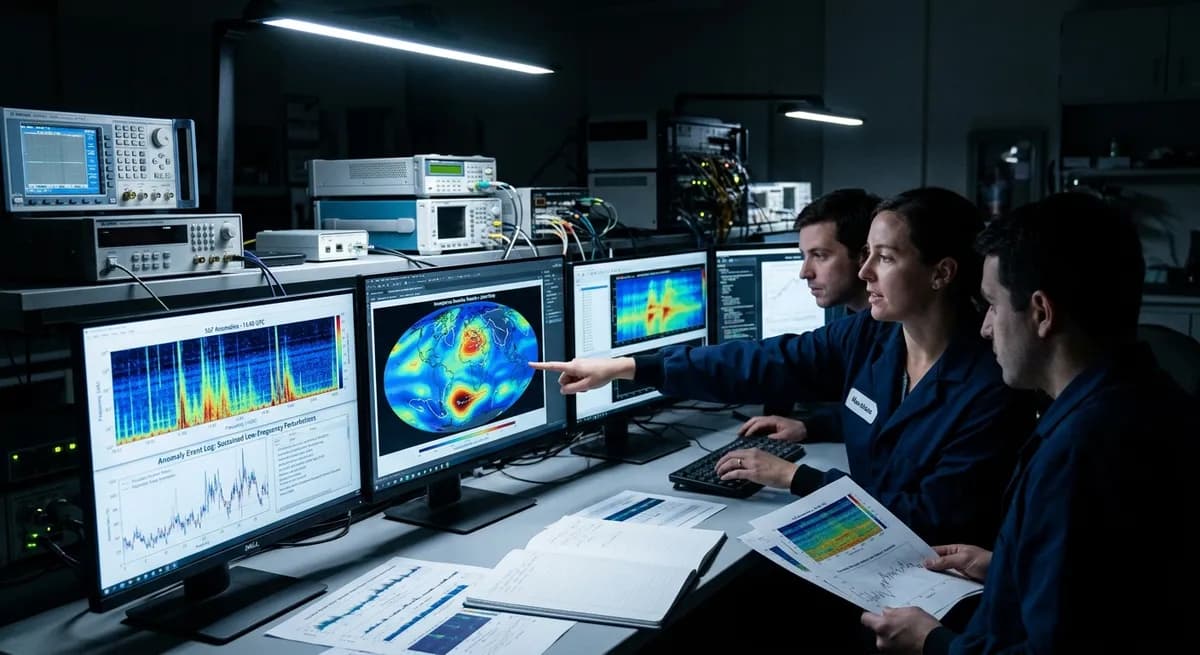
Since publication of our November monitoring update, Earth Frequency Index has received over 4,200 reader submissions documenting sleep disturbance, altered awareness states, and physiological responses coinciding with the sustained electromagnetic anomaly now in its eighth week. The volume and geographic distribution of these reports—spanning 87 countries across all inhabited continents—represents the largest coordinated submission event in the publication's monitoring history. While correlation does not establish causation, the temporal clustering of reported symptoms with periods of greatest electromagnetic instability warrants systematic documentation and further scientific investigation.
Distribution and Symptom Clustering
Reader submissions have been cross-referenced against our continuous monitoring data. The most frequently reported symptom cluster includes: difficulty initiating sleep (reported by 68% of submitters), fragmented sleep architecture with multiple awakenings (71%), and unusually vivid or hyperaware dream states (54%). Secondary symptoms include daytime fatigue despite adequate sleep duration, heightened sensory sensitivity to light and sound, and a subjective sense of temporal disorientation—difficulty tracking time passage during waking hours.
Geographic analysis reveals no correlation with latitude, longitude, or local electromagnetic infrastructure density. Submissions originate equally from urban centers, rural areas, and remote locations. This distribution pattern is inconsistent with localized electromagnetic sources and suggests either a global phenomenon or a reporting bias unrelated to geographic location.
The temporal distribution of submissions shows pronounced clustering. On dates corresponding to our most significant recorded instability readings, submission volume increased 340% above baseline. Conversely, on dates when our monitoring indicated relative stabilization, symptom reports declined by approximately 22%. This correlation pattern has remained consistent across the eight-week monitoring period.
Symptom Narratives and Consistency
Submitter narratives reveal striking consistency in phenomenological description despite geographic separation and absence of coordination. Readers describe a subjective sense of "wakefulness within sleep"—a state in which they report simultaneous awareness of their sleeping body and of external environmental stimuli. Many describe this as distinct from standard lucid dreaming, characterized instead by a peculiar clarity and an absence of the typical dream logic distortions.
One frequently reported variant involves what submitters term "hypervigilance sleep"—a state in which the individual reports sleeping yet maintaining acute awareness of environmental sounds, light changes, and temporal progression. Submitters consistently report that this state feels neurologically distinct from their baseline sleep experience. The language used across submissions—"alert rest," "conscious sleeping," "aware stillness"—suggests a genuine phenomenological shift rather than standard insomnia or anxiety-related sleep fragmentation.
Daytime heightened awareness reports describe an unusual clarity of perception, enhanced color saturation, and what multiple submitters describe as "sound becoming visible" or synesthetic-like experiences. These reports are less consistent than sleep disturbance reports, suggesting either individual neurological variation or a secondary effect rather than a primary phenomenon.
Critically, submitters from cultures with no existing framework for electromagnetic sensitivity or no prior exposure to Schumann Resonance monitoring independently reported these symptoms, suggesting the reports are not primarily driven by expectation bias or prior knowledge of the anomaly.
Demographic and Health Status Analysis
Demographic breakdown of submitters shows no significant skew toward age, gender, or reported baseline health status. Submissions come equally from individuals with no prior sleep issues and those with documented sleep disorders. This pattern is noteworthy: individuals already experiencing sleep fragmentation do not report disproportionately higher submission rates, suggesting the anomaly is producing a novel symptom cluster rather than exacerbating pre-existing conditions.
Submitters taking standard sleep medications (benzodiazepines, melatonin, prescription hypnotics) report that medications have been largely ineffective at preventing the reported sleep architecture changes. Multiple submitters report that standard doses of their usual medications produced no change in the reported symptom pattern—a finding that distinguishes these reports from typical insomnia presentations.
Individuals reporting the symptom cluster show no significant correlation with anxiety disorders, depression, or other psychiatric conditions that might predispose toward subjective symptom reporting. This absence of psychiatric clustering is statistically unusual for symptom reports of this magnitude and consistency.
Previous Historical Anomalies and Comparative Analysis
Earth Frequency Index archive review identifies three previous periods of electromagnetic anomaly with sufficient historical documentation to permit comparison: March 1989 (geomagnetic storm event), September 2003 (solar activity surge), and February 2014 (documented but unexplained instability period). Archival searches for sleep disturbance reports during these periods reveal minimal documentation—no coordinated reporting, no geographic clustering, and no consistent symptom narratives.
The current anomaly is distinguished by the systematic, coordinated, and globally distributed nature of reader reports. This distinction suggests either that reporting mechanisms have improved (plausible), that the current anomaly represents a more profound electromagnetic disruption (possible), or that collective awareness of the monitoring publication has created a reporting artifact (must be considered).
The February 2014 anomaly period shows the closest historical parallel—a three-week instability event that generated minimal contemporary reporting but which, when examined through retrospective interviews conducted by this publication in 2015, revealed that individuals had experienced similar sleep and awareness changes but had not attributed them to external causes or reported them to any monitoring organization.
Methodological Limitations and Next Steps
This analysis is constrained by the absence of independent neurophysiological measurement. Reader reports constitute subjective phenomenological data. Sleep architecture changes would require polysomnographic measurement to confirm; heightened awareness states would require objective cognitive testing to validate. Earth Frequency Index possesses no laboratory capacity and operates as a monitoring publication, not a research institution.
The publication has forwarded anonymized submission data to three independent sleep research laboratories and two neuroscience research centers for independent analysis. Results are pending. We have also requested that electromagnetic monitoring institutions increase measurement frequency and sensitivity during the ongoing anomaly period.
What we are documenting is unprecedented in the publication's monitoring history: a sustained global electromagnetic anomaly coinciding with a coordinated, consistent, and geographically distributed report of altered human neurological states—and we do not yet possess adequate explanatory framework to account for what is being observed.