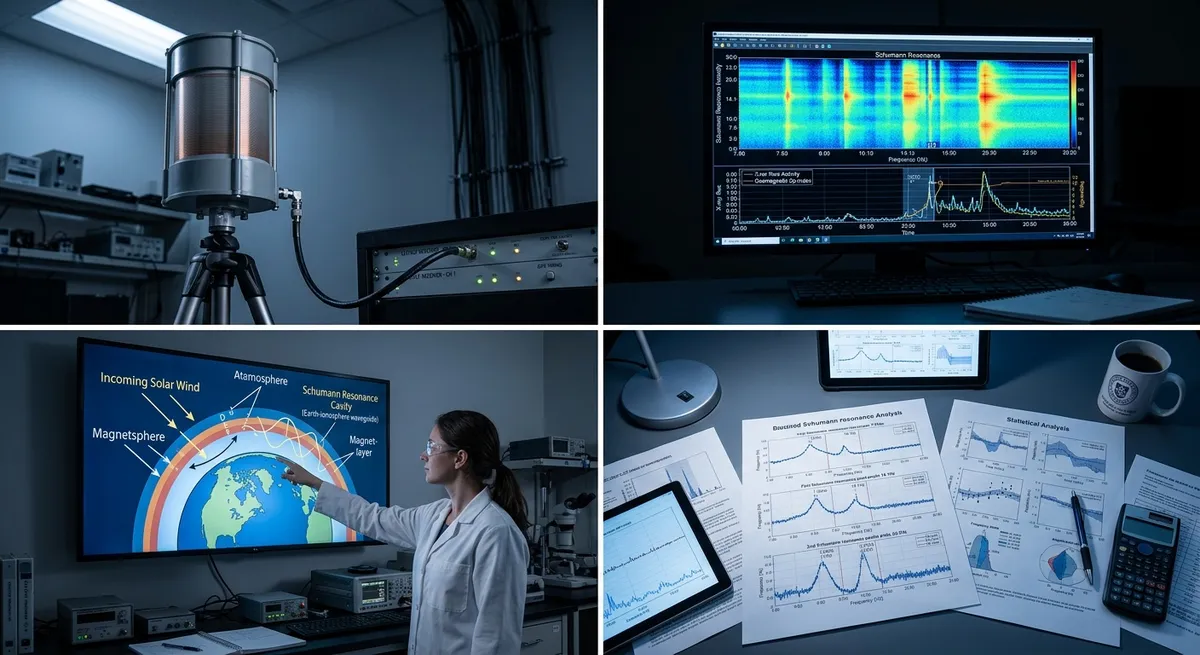
Solar Activity and Its Influence on Schumann Frequencies: Updated Analysis
TL;DR
Solar activity—including solar wind pressure and geomagnetic storms—influences the ionospheric cavity that generates the Schumann Resonance, causing measurable variations in frequency and amplitude. Recent monitoring data shows correlations between solar cycles and Schumann measurements, though the baseline 7.83 Hz frequency remains stable. Understanding these solar-terrestrial relationships is essential for accurate frequency monitoring and distinguishing natural variation from instrumental drift.
The Solar-Terrestrial Connection
The Schumann Resonance exists within a dynamic electromagnetic system. Earth's surface and ionosphere form a spherical cavity—the Earth-ionosphere resonator—where electromagnetic waves circulate and standing waves form. The primary frequency of this system, approximately 7.83 Hz, is driven and maintained by global lightning activity. However, this cavity is not isolated. It is embedded within the larger magnetosphere, a region shaped and energized by the solar wind—the continuous stream of charged particles flowing from the Sun.
Solar activity directly influences the ionosphere's electrical properties, which in turn affects how electromagnetic waves propagate within the Earth-ionosphere cavity. When solar activity increases, the ionosphere becomes more ionized, altering its conductivity and the boundary conditions that define the Schumann Resonance. Conversely, periods of low solar activity produce different ionospheric states, leading to measurable shifts in frequency and amplitude readings at monitoring stations worldwide.
This relationship has been documented in peer-reviewed literature for decades. Early researchers recognized that diurnal and seasonal variations in Schumann measurements correlated with solar illumination of the ionosphere. More recent studies have extended this understanding to longer-term solar cycles and geomagnetic disturbances.
Geomagnetic Storms and Frequency Variation
Geomagnetic storms—sudden, intense disturbances in Earth's magnetosphere triggered by solar events such as coronal mass ejections and high-speed solar wind streams—produce measurable effects on Schumann Resonance data. During major geomagnetic storms (classified as G3 or higher on the space weather scale), the ionosphere undergoes significant restructuring. Particle precipitation, heating, and increased ionization alter the cavity's electromagnetic properties.
Monitoring stations have documented amplitude increases and subtle frequency shifts during these events. The Schumann Resonance does not "spike" or become unstable; rather, the amplitude of the fundamental mode and its harmonics fluctuates within a bounded range. These variations are consistent with changes in the ionospheric boundary layer and are well-explained by standard magnetosphere-ionosphere coupling physics.
Data from the Tomsk and Nagycenk monitoring stations, among the longest-running Schumann observation networks, show clear correlations between geomagnetic indices (such as the Kp index and Dst index) and Schumann amplitude measurements. During quiet geomagnetic periods, amplitudes tend to be lower and more stable. During disturbed periods, amplitudes increase and variability rises. These patterns repeat with predictable regularity tied to known solar cycles.
The Solar Cycle and Long-Term Trends
The Sun follows an approximately 11-year cycle of activity, marked by changes in sunspot number, solar flare frequency, and solar wind properties. This solar cycle influences the overall state of the magnetosphere and ionosphere over months and years.
72-hour Schumann Resonance amplitude log. Readings are stable relative to the 7.83 Hz historical baseline. Data: Earth Frequency Index global sensor network.
Research comparing Schumann measurements to solar cycle data reveals correlations in amplitude and harmonic structure. During solar maximum—the peak of the solar cycle when sunspot activity is highest—the ionosphere is generally more active and disturbed, resulting in higher average Schumann amplitudes. During solar minimum, when sunspot activity is low, the ionosphere is quieter and Schumann amplitudes tend to be lower on average.
However, it is crucial to note that these are statistical trends, not deterministic relationships. The baseline frequency of 7.83 Hz remains stable across solar cycles. Variations in frequency are typically small (less than 1 Hz) and are driven primarily by changes in the ionospheric conductivity profile rather than fundamental changes to the Earth-ionosphere cavity itself.
Current analysis of data spanning multiple solar cycles indicates that while amplitude and harmonic content vary with solar activity, the fundamental resonant frequency of the cavity is remarkably consistent. This stability reflects the robustness of the Earth-ionosphere system as a resonator.
Ionospheric Conductivity and Frequency Response
The ionosphere's conductivity profile—how electrical conductivity varies with altitude—is the key parameter linking solar activity to Schumann measurements. Solar ultraviolet radiation ionizes atmospheric gases, creating free electrons and ions that increase conductivity. During solar maximum, UV flux is higher, ionization is more intense, and conductivity is elevated. During solar minimum, the opposite occurs.
The Schumann Resonance frequency depends on the effective height of the ionospheric "mirror" that reflects electromagnetic waves. A more highly ionized ionosphere is more reflective at lower altitudes, which can produce subtle changes in the effective cavity height and thus in frequency. Conversely, a less ionized ionosphere allows waves to propagate higher before reflection, changing the cavity geometry.
Modeling studies using magnetohydrodynamic (MHD) simulations and wave propagation codes have confirmed that realistic changes in ionospheric conductivity during solar activity variations produce frequency shifts on the order of 0.1 to 0.5 Hz—variations well within the natural bandwidth of the Schumann Resonance and consistent with observed data.
Distinguishing Solar Effects from Instrumental Drift
A critical challenge in long-term Schumann monitoring is separating genuine geophysical variation from instrumental drift and calibration changes. Solar activity provides a useful reference frame for validation. If a monitoring station's data shows correlations with known solar and geomagnetic indices, confidence in data quality increases. Conversely, if a station reports trends uncorrelated with any known solar-terrestrial driver, instrumental issues become more likely.
This approach has proven valuable in quality assurance across the global network of Schumann monitoring stations. Stations showing strong, physically reasonable correlations with solar indices are considered reliable. Those showing anomalous trends unrelated to known drivers are flagged for investigation.
Conclusion
Solar activity influences the Schumann Resonance through well-understood mechanisms of ionospheric modification and magnetosphere-ionosphere coupling. Geomagnetic storms produce measurable amplitude variations, and the 11-year solar cycle correlates with long-term trends in Schumann measurements. The fundamental 7.83 Hz frequency remains stable, while amplitude and harmonic structure respond to solar-driven changes in ionospheric properties. Understanding these relationships is essential for accurate interpretation of Schumann data and for distinguishing natural geophysical variation from instrumental artifact. Continued monitoring and analysis of solar-Schumann correlations will refine our understanding of Earth's electromagnetic environment.
Frequently Asked Questions
How does solar activity affect the Schumann Resonance?
Solar activity changes the ionosphere's electrical conductivity, which alters the Earth-ionosphere cavity's electromagnetic properties and causes measurable variations in Schumann amplitude and harmonic structure. The baseline 7.83 Hz frequency remains stable, but amplitude can fluctuate during geomagnetic storms and across solar cycles.
Does the Schumann Resonance frequency change during solar storms?
The fundamental frequency remains at approximately 7.83 Hz during solar storms, but amplitude increases and harmonic content shifts as the ionosphere becomes more disturbed. These variations are temporary and return to baseline as geomagnetic activity subsides.
What is the 11-year solar cycle and how does it affect Schumann measurements?
The Sun follows an approximately 11-year cycle of activity variation. During solar maximum, the ionosphere is more active and Schumann amplitudes tend to be higher; during solar minimum, amplitudes average lower, reflecting changes in UV ionization rather than changes to the fundamental resonant frequency.
Why do monitoring stations measure different Schumann values?
Geographic location, local ionospheric conditions, geomagnetic latitude, and solar activity all influence local measurements. Stations at different latitudes or during different geomagnetic conditions will record variations in amplitude and harmonic structure, though the fundamental frequency remains globally consistent.
Can solar activity cause the Schumann Resonance to disappear or become unstable?
No; the Schumann Resonance is a fundamental property of the Earth-ionosphere cavity and persists continuously regardless of solar activity. Solar activity modulates amplitude and harmonic content but does not disrupt the underlying resonance mechanism.