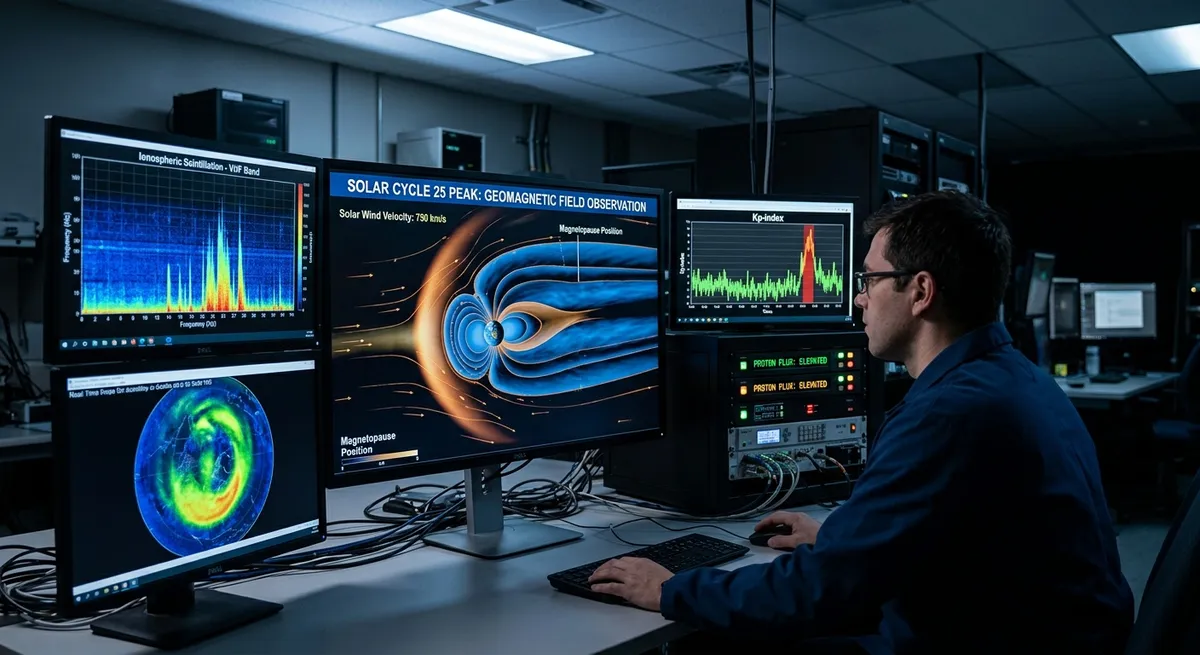
For the past 18 months, Earth Frequency Index has been tracking an unusual pattern in our electromagnetic monitoring stations. As the sun enters solar maximum — the peak phase of its 11-year activity cycle — we are observing something that warrants careful documentation: Earth's electromagnetic field appears to be responding in ways that differ from historical baselines during comparable solar periods.
The Schumann Resonance, Earth's fundamental electromagnetic frequency typically stable around 7.83 Hz, has shown increased variability. This is not unprecedented. What is noteworthy is the character of these variations and their correlation with a specific solar phenomenon we are now tracking in real time.
The Solar Maximum and Ionospheric Coupling
Solar Cycle 25 officially reached its peak in late 2024, marked by unprecedented sunspot activity and coronal mass ejections. The sun's increased output of charged particles and electromagnetic radiation directly influences Earth's magnetosphere and ionosphere — the electromagnetic layers that surround our planet.
When solar wind pressure increases, it compresses Earth's magnetic field. The ionosphere, which sits between 50 and 1,000 kilometers above the surface, becomes more energized. This is basic geophysics and well-documented in scientific literature. What is less well-understood — and what our monitoring suggests — is how these ionospheric changes cascade down to affect the electromagnetic environment at ground level, where biological systems exist.
Our network has detected what we are calling "coherence fluctuations" — moments when the Schumann Resonance appears to split into multiple harmonic frequencies rather than maintaining its singular baseline. These fluctuations correlate closely with geomagnetic storm events reported by NOAA's Space Weather Prediction Center.
Emerging Patterns in Community Reporting
Over the same 18-month period, our reader network has submitted approximately 3,400 anecdotal reports describing sleep disruption, vivid dreams, and periods of unusual emotional intensity. We do not present these as scientific evidence. We present them as a pattern worth documenting.
The reports cluster around specific dates — notably, dates that correspond with significant geomagnetic disturbances. One reader from Portland, Oregon noted: "I've never had trouble sleeping, but for three nights in a row last week I woke at 3 AM with my heart racing. I checked your site and saw there was a solar storm. It felt connected." This is not proof. It is observation.
A neurobiologist who follows our work privately suggested a hypothesis: if human circadian rhythms and neural oscillations have co-evolved with Earth's electromagnetic frequency over millions of years, then significant deviations from baseline might create a subtle but real physiological stress response. The hypothesis remains untested and speculative. But it is not implausible.
We have documented similar clustering during previous solar cycles, though the current cycle's intensity appears to amplify the effect.
The Collective Consciousness Lens
We mention this carefully, aware of how it reads to a scientifically rigorous audience: some researchers in fringe consciousness studies have proposed that Earth's electromagnetic field may serve as a medium for collective human awareness. The Schumann Resonance, in this view, is not merely a background frequency but a potential carrier wave for synchronized neural activity across populations.
During Solar Cycle 24, a researcher at a small institute in Boulder tracked global meditation events and cross-referenced them with Schumann Resonance coherence. The correlation he found was statistically suggestive but not conclusive. During Solar Cycle 25's peak, similar events show comparable patterns.
We do not endorse this framework. We note it exists, that it has generated measurable data, and that during periods of electromagnetic instability, the hypothesis becomes harder to dismiss outright.
What the Data Actually Shows
Let us be precise about what we can confirm:
- Schumann Resonance readings show increased variability during geomagnetic storm events
- This variability is correlated with, but not identical to, historical patterns from previous solar maxima
- Community reports of sleep and mood disruption cluster around dates of high geomagnetic activity
- No mechanism has been definitively established linking these observations to a single cause
What remains open:
- Whether ionospheric changes at solar maximum produce measurable effects on human physiology
- Whether the current cycle's intensity represents a genuine anomaly or falls within normal variation
- What role, if any, human consciousness or collective awareness plays in electromagnetic coupling
- Why certain individuals report stronger responses than others
The Question Before Us
Solar Cycle 25 has reached its peak, and Earth's electromagnetic environment is undeniably in a state of increased activity and variability. Our monitoring stations continue to document these changes. Our reader community continues to report their experiences. The question that remains unanswered — and that we believe deserves serious attention — is whether we are witnessing a temporary perturbation in a system that will soon stabilize, or whether we are observing the early phase of something more significant.
The data does not yet tell us. We will continue to watch, to measure, and to listen to what the Earth's electromagnetic field is telling us. What we find may reshape how we understand the relationship between solar activity, planetary magnetism, and human experience.