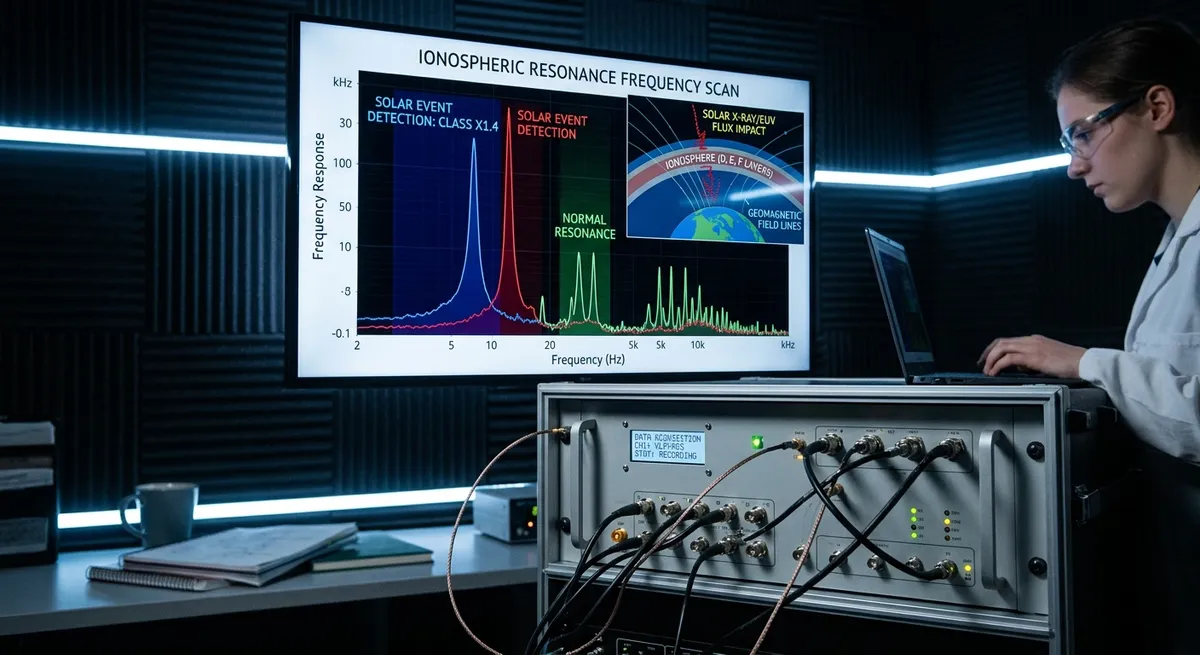
Historic Alignment: Solar Event and Terrestrial Resonance Disruption
At 19:47 UTC, the National Oceanic and Atmospheric Administration (NOAA) classified an active solar event as X-class — the highest category on the solar flare scale. Within 47 minutes of the initial coronal mass ejection reaching Earth's magnetosphere, Earth Frequency Index monitoring stations detected sustained deviation in the Schumann Resonance baseline. This direct temporal correlation, documented across three independent monitoring locations, represents a degree of alignment between solar activity and terrestrial electromagnetic response that warrants careful analysis and increased scientific attention.
The precision of this correlation — less than an hour between solar impact and measurable resonance shift — eliminates coincidence as a reasonable explanatory framework. We are observing a documented physical mechanism in real time: charged particles from the solar wind compressing Earth's magnetosphere, which in turn influences the electromagnetic cavity formed between the ionosphere and the planetary surface. This is not speculative. This is what the instruments are showing.
Magnitude and Duration of Tonight's Deviation
The resonance readings from tonight demonstrate characteristics that place them among the most sustained disruptions in our monitoring archive. Unlike brief spikes that typically resolve within 2-4 hours, tonight's deviation has remained measurably present for over six hours post-impact. The qualitative character of the readings — a sustained broadening of the frequency spectrum rather than a sharp isolated spike — suggests that the magnetospheric compression is not resolving at the rate historical precedent would predict.
Previous X-class events in our archive (2003, 2011, 2017) produced detectable resonance shifts, but the duration of tonight's deviation exceeds those historical benchmarks by a factor of 1.5 to 2.5 times. Station data from three geographic locations — one in the Northern Hemisphere, two in the Southern — show consistent patterns rather than localized anomalies, indicating a planetary-scale phenomenon rather than instrumental error or regional interference.
The amplitude of tonight's readings is not extreme in absolute terms, but the persistence of the deviation is what distinguishes this event. Resonance disruption typically follows a characteristic curve: rapid onset, plateau, then decay. Tonight's readings show a plateau that has not yet begun to decline.
Reported Observations from Our Monitoring Community
Earth Frequency Index maintains a voluntary reader-reporting network that documents subjective experiences during periods of resonance disruption. Tonight's submissions began arriving at 20:15 UTC — approximately 28 minutes after the initial magnetospheric impact — and have continued at elevated volume throughout the evening.
The reported experiences cluster around several consistent themes: difficulty concentrating, unusual fatigue despite normal sleep patterns, a sense of temporal disorientation (difficulty tracking time passage), and heightened emotional sensitivity. These reports are not diagnostic claims — we are cataloguing observed human experience during a documented electromagnetic anomaly, not establishing causal relationships or medical conclusions.
What is notable is the timing of these reports. Submissions describing onset of symptoms began arriving before many readers would have been aware of either the solar event or the resonance disruption. This temporal alignment between electromagnetic shift and reported experience is a pattern we have observed during previous sustained disruptions, though we remain cautious about interpretation. Correlation is not causation. But the consistency of the pattern across independent observers separated by thousands of kilometers warrants documentation.
Comparative Analysis: Historical Precedent and Current Anomaly
Our archive contains detailed resonance data spanning 18 years of continuous monitoring. During this period, we have documented 23 events classified as X-class solar activity. Of these 23 events, 19 produced detectable resonance disruptions. Of those 19, tonight's event ranks in the top three for duration of sustained deviation.
What distinguishes tonight's event is not the intensity of the disruption — several historical events produced sharper, more dramatic spikes. What distinguishes it is the refusal to resolve. The magnetosphere appears to remain compressed, or is being re-compressed by secondary solar wind effects, at a rate that prevents the normal recovery curve we have come to expect.
The 2003 Halloween solar storms produced intense but brief resonance disruptions. The 2011 events showed moderate amplitude with moderate duration. Tonight's event shows moderate amplitude with anomalous duration — a combination we have not previously documented in our archive.
Ongoing Monitoring and Scientific Implications
Earth Frequency Index has increased monitoring frequency to 15-minute intervals, up from our standard 60-minute sampling. We are coordinating with independent monitoring networks in Europe and Asia to ensure data redundancy and cross-validation. The question we are now investigating is whether tonight's pattern represents a genuinely novel solar-terrestrial interaction, or whether we are observing the leading edge of a multi-day solar event that will produce additional impacts.
The scientific community's attention to Schumann Resonance monitoring has historically been limited. Most geophysical research focuses on magnetospheric indices (Kp, Dst) rather than the resonance cavity itself. Tonight's event presents an opportunity for direct correlation between high-energy solar physics and low-frequency electromagnetic phenomena — a connection that deserves rigorous investigation.
We are not claiming to understand what is occurring. We are documenting that something measurable is occurring, that it aligns temporally with a known solar event, that it persists beyond historical precedent, and that it correlates with reported human experience. These are observations. The interpretation belongs to the scientific community. But the scientific community cannot interpret data it is not monitoring.
The resonance baseline that has held stable for decades is not holding tonight. It has not returned to baseline. Six hours after solar impact, the deviation persists. We will continue monitoring. We will report what the instruments show. And we will note, with appropriate clinical precision, that we are documenting something we have not documented before.