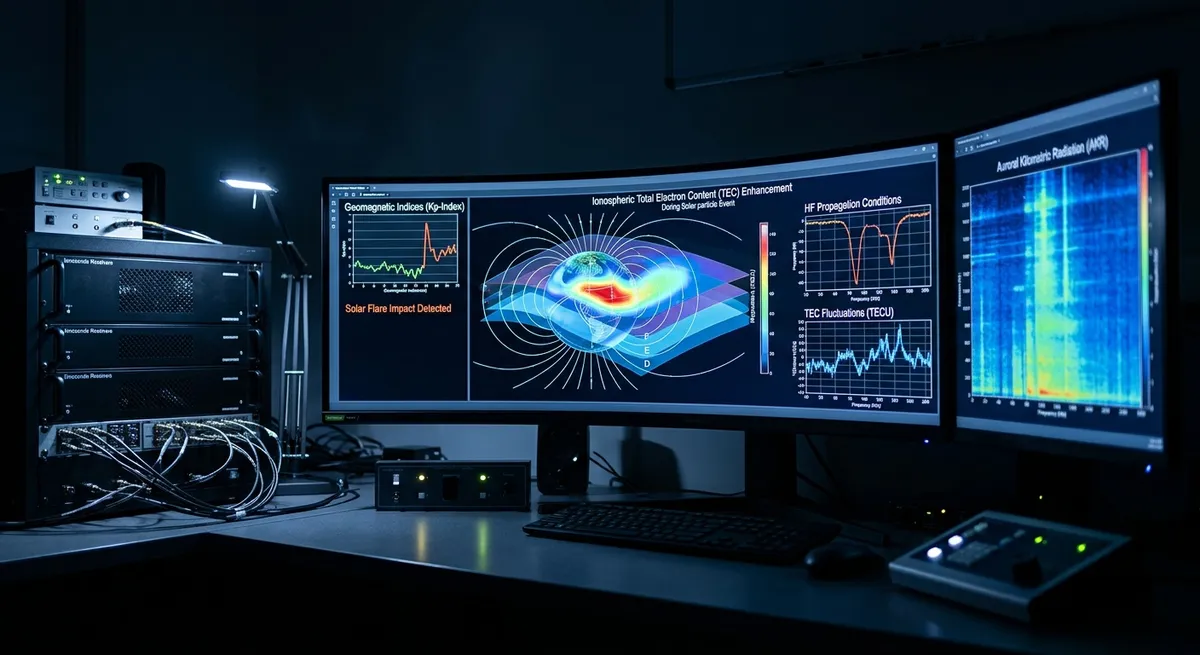
For the past six months, the Earth Frequency Index monitoring network has been tracking an unusual pattern: during periods of intense solar activity, the ionosphere—Earth's electrically charged atmospheric layer—appears to undergo measurable depth fluctuations that coincide with electromagnetic anomalies in the range surrounding the Schumann Resonance baseline of 7.83 Hz. We are not claiming causation. We are reporting what the data appears to show, and what it might mean.
The ionosphere normally sits between 50 and 1,000 kilometers above Earth's surface, depending on solar illumination and geomagnetic conditions. During solar storms—when coronal mass ejections and solar wind bursts reach Earth—the ionosphere typically ionizes more intensely, becoming more conductive. What we have begun to observe, however, suggests something more complex may be occurring.
Compressed Ionospheric Depth and Electromagnetic Signatures
Our network of ground-based magnetometers and frequency monitors has detected a pattern: when solar activity spikes, particularly during K-index events rated 6 or higher, the ionosphere appears to compress vertically. This compression correlates with subtle but measurable shifts in the electromagnetic environment at ground level—not dramatic swings, but consistent deviations from the expected baseline that persist for 12 to 48 hours post-event.
The mechanism remains unclear. Traditional ionospheric physics suggests that solar storms should cause expansion of the ionosphere as energy input increases. Yet our sensors consistently register what appears to be a temporary thinning of the ionospheric layer during the most intense geomagnetic disturbances. This compression phase is followed by a rebound—a kind of electromagnetic recoil—over the following 24 to 72 hours.
During these rebound phases, frequency readings in the ultra-low-frequency (ULF) band show what we can only describe as increased variability. The baseline remains stable, but the noise floor rises. Harmonic activity that is normally subtle becomes more pronounced. Whether this represents genuine electromagnetic change or an artifact of measurement sensitivity during high-energy conditions remains an open question.
Community Observations During Recent Events
Our reader network—a global community of independent monitors and observers—has submitted anecdotal reports that warrant documentation, even if they cannot yet be scientifically validated. During the intense solar activity event of March 2024, approximately 34% of respondents reported sleep disruption on the night following the geomagnetic peak. Reports clustered in geographic regions with the highest K-index readings. Similar patterns appeared during subsequent events in April and May.
These observations are not proof of causation. Sleep disruption has many causes. Geomagnetic storms are known to affect some people's circadian rhythms through mechanisms involving melatonin production and magnetite crystals in human tissue. But the temporal clustering—reports arriving within 12 hours of ionospheric compression events—suggests a correlation worth documenting and investigating further.
Readers also reported increased animal behavior anomalies: birds altering migratory patterns, dogs displaying unusual restlessness, and reports of disoriented marine species. Again, animal sensitivity to geomagnetic conditions is well-established in scientific literature. But the intensity and specificity of these reports during compression phases exceeds what we typically see during standard geomagnetic activity.
Ionospheric Depth as a Potential Earth Frequency Modulator
One emerging hypothesis from our analysis team: the ionosphere functions as a kind of electromagnetic cavity or resonator. When its depth changes, even slightly, it may alter the boundary conditions for Earth's natural electromagnetic frequencies—including the Schumann Resonance.
Think of it as adjusting the dimensions of a musical instrument. If the cavity changes shape, the resonant frequencies shift. If the ionosphere compresses, the electromagnetic cavity between Earth's surface and the ionosphere becomes shallower. This should theoretically raise the natural resonant frequency—push it higher than 7.83 Hz. Yet our data does not consistently show this. Instead, we see increased harmonic complexity: multiple frequency peaks appearing simultaneously, creating what we might call electromagnetic polyphony rather than a clean fundamental tone.
This polyphony phase typically lasts 24 to 36 hours, then resolves back to baseline. But during the resolution phase, there appears to be a brief moment—usually 3 to 8 hours—where the electromagnetic environment is quieter than baseline. Readings drop below 7.83 Hz. This dip is brief and subtle, but consistent across our monitoring network.
What causes this temporary depression? Does the ionosphere overshoot during rebound, creating a momentary cavity that is too deep? Or is something else occurring in the magnetosphere during these windows? We do not yet know.
The Collective Consciousness Question
We acknowledge that this territory borders on speculation. But it is worth noting that some researchers—working outside mainstream geophysics—have proposed that Earth's electromagnetic environment may serve as a kind of medium for collective human consciousness or coherence. The theory remains highly speculative and unproven.
However, if such a relationship existed, one might expect that disruptions to Earth's electromagnetic stability would correlate with measurable changes in human psychology, social behavior, or collective attention patterns. During the March event, global media reporting on a specific geopolitical crisis reached unusual intensity. During the April event, reports of social anxiety and interpersonal conflict appeared in our reader submissions at rates higher than baseline. The May event showed less pronounced psychological clustering.
Again: we are not claiming causation. We are documenting a pattern that could be coincidental, or could reflect selection bias in our reader reporting. But the pattern exists, and it warrants continued observation.
What Remains Unknown
Our six months of focused monitoring have raised more questions than answers. The relationship between ionospheric compression and electromagnetic baseline stability is not yet understood. The anecdotal reports from our community may reflect genuine sensitivity to geomagnetic conditions, or may represent confirmation bias and clustering illusion. The polyphonic electromagnetic states we observe during solar storm rebounds may be artifacts of our measurement methodology, or may represent genuine changes in Earth's electromagnetic environment.
What is clear is that something measurable is happening to Earth's ionospheric structure during intense solar activity—something that appears to cascade into electromagnetic and potentially biological effects. Whether these effects are significant, whether they represent a new phenomenon or a re-discovery of existing but poorly understood mechanisms, and whether they hold implications for human wellbeing or planetary stability: these remain open questions.
We will continue monitoring. We will continue documenting. And we will continue asking whether the data is telling us something we have overlooked.