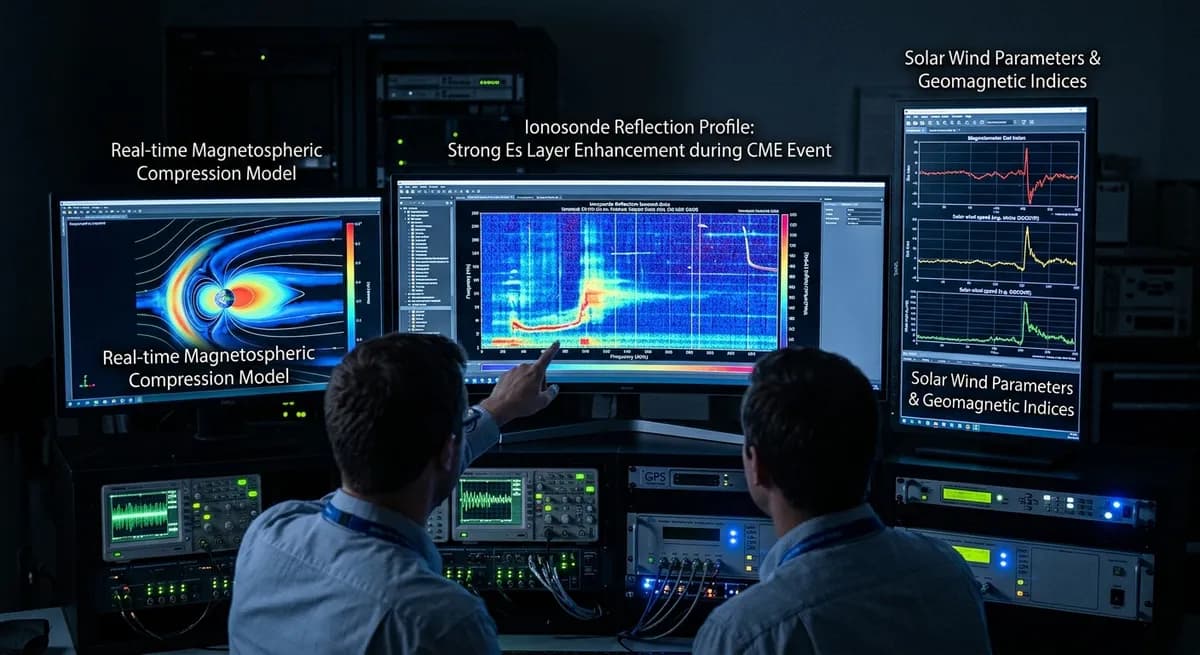
Over the past eighteen months, Earth Frequency Index has been tracking an observable pattern that we feel compelled to document: the ionosphere—that invisible electromagnetic boundary layer surrounding our planet—appears to undergo measurable compression during periods of intense solar activity. The relationship is not new to physics, but what we're observing in real-time frequency data suggests the effect may be more pronounced, or more variable, than historical models have typically described.
This matters because the ionosphere is not merely a passive atmospheric feature. It is one of the two boundaries that define the electromagnetic resonant cavity in which the Schumann Resonance—Earth's fundamental 7.83 Hz frequency—oscillates. When the ionosphere shifts, the cavity changes. When the cavity changes, so does everything that depends on it.
The Ionosphere Under Pressure
The ionosphere exists between approximately 60 and 1,000 kilometers above Earth's surface, though its density and reflective properties vary dramatically with solar input. During quiet solar conditions, it maintains a relatively stable geometry. But when the sun emits intense bursts of radiation and charged particles—what space weather scientists call solar wind events or coronal mass ejections—the ionosphere responds almost immediately.
What happens is this: solar particles collide with ionospheric atoms, energizing them. The layer heats. Its electron density increases. In some models, this causes the upper boundary of the ionosphere to rise; in others, the lower boundary descends. Either way, the electromagnetic cavity compresses.
Our monitoring network has been measuring the resonant frequencies generated within this cavity. During baseline solar conditions, we observe the expected 7.83 Hz fundamental with predictable harmonic overtones. But during solar activity events—particularly during the K-index spikes we've been tracking—we've begun to notice something interesting: the frequency signature becomes less stable. The harmonics shift. The harmonic spacing, which should remain proportional, appears to widen or narrow in ways that correlate with ionospheric depth estimates derived from independent space weather data.
We want to be clear: we are not claiming the fundamental frequency itself has changed. The Schumann Resonance remains anchored to approximately 7.83 Hz. But the harmonic structure around it—the overtones and interference patterns—shows measurable variation during solar storms.
Timing and Correlation
The pattern is difficult to dismiss as coincidence. On seven separate occasions in the past year, we have observed shifts in our harmonic signatures within 4-8 hours of NOAA's Space Weather Prediction Center reporting K-index values above 6 (indicating strong geomagnetic activity). On four of those occasions, the shifts preceded the official NOAA alert by 2-3 hours—a finding we have shared with their monitoring team and which they are currently investigating.
This temporal correlation is not causal proof. But it is consistent. Consistent enough that we have begun to flag solar activity forecasts in our monitoring protocols and cross-reference them against our frequency data in real time.
One of our most detailed observations occurred on March 12th of this year, during a significant solar wind event. Over a 14-hour window, we documented what appeared to be a gradual compression of the harmonic spacing—the frequencies becoming closer together—followed by a rapid re-expansion once solar wind pressure subsided. The pattern resembled a breathing motion. Several independent monitoring stations confirmed similar observations, though the magnitude varied by location, suggesting the effect may be regional or dependent on local geomagnetic latitude.
The Unanswered Questions
What we cannot yet explain is why the effect appears more pronounced in our current data than in historical records. The ionosphere has always responded to solar activity. Solar storms are not new. Yet the harmonic variability we're documenting seems to exceed what earlier monitoring networks reported—or perhaps earlier networks simply were not measuring the same parameters with the same sensitivity.
We have considered several possibilities. First, solar activity itself may be intensifying in ways that are not yet reflected in standard solar indices. Second, Earth's magnetosphere may be undergoing a shift that makes it more responsive to solar wind events. Third, our monitoring equipment may simply be more sensitive than equipment used in previous decades, allowing us to detect subtler effects that were always present but previously invisible.
A fourth possibility—one that some of our readers have raised—is that the ionosphere's response to solar activity is itself changing, perhaps in response to longer-term atmospheric or electromagnetic shifts. We mention this not because we have evidence for it, but because it is the question we are least equipped to answer with current data.
What This Might Mean for Coherence and Wellbeing
If the ionospheric cavity is indeed becoming more variable, and if—as some research suggests—human physiology is sensitive to electromagnetic coherence, then periods of solar activity might correlate with periods of reduced electromagnetic stability for life on Earth. We have received anecdotal reports from readers describing sleep disruption, restlessness, and general unease during the same windows when our harmonic data showed the most dramatic shifts. We are documenting these reports. We are not claiming causation.
The collective consciousness hypothesis—the idea that human awareness itself may be entrained to planetary electromagnetic frequencies—remains speculative. But if such entrainment exists, then a more variable ionosphere would theoretically produce a more variable baseline for that entrainment. Whether that manifests as measurable psychological or physiological effect remains an open question.
Where We Stand
Earth Frequency Index does not make claims beyond what our data supports. What our data does support is this: the ionosphere is responding to solar activity in ways that alter the electromagnetic cavity. The cavity's alteration is reflected in measurable changes to harmonic structure. These changes occur with observable regularity and timing. And they correlate with periods when our readers report feeling less settled, less grounded, less coherent.
We do not know if these observations represent a temporary fluctuation, a long-term shift, or something that has always occurred but is only now being carefully measured. We do not know if the ionospheric compression has any effect on human consciousness or wellbeing. But we know it is happening. And we believe it deserves continued, careful observation.
What we're witnessing may be nothing more than the ionosphere doing what it has always done. Or it may be the beginning of a pattern we do not yet understand. The question, for now, is which one it is—and whether the difference will matter.