Entering Uncharted Territory
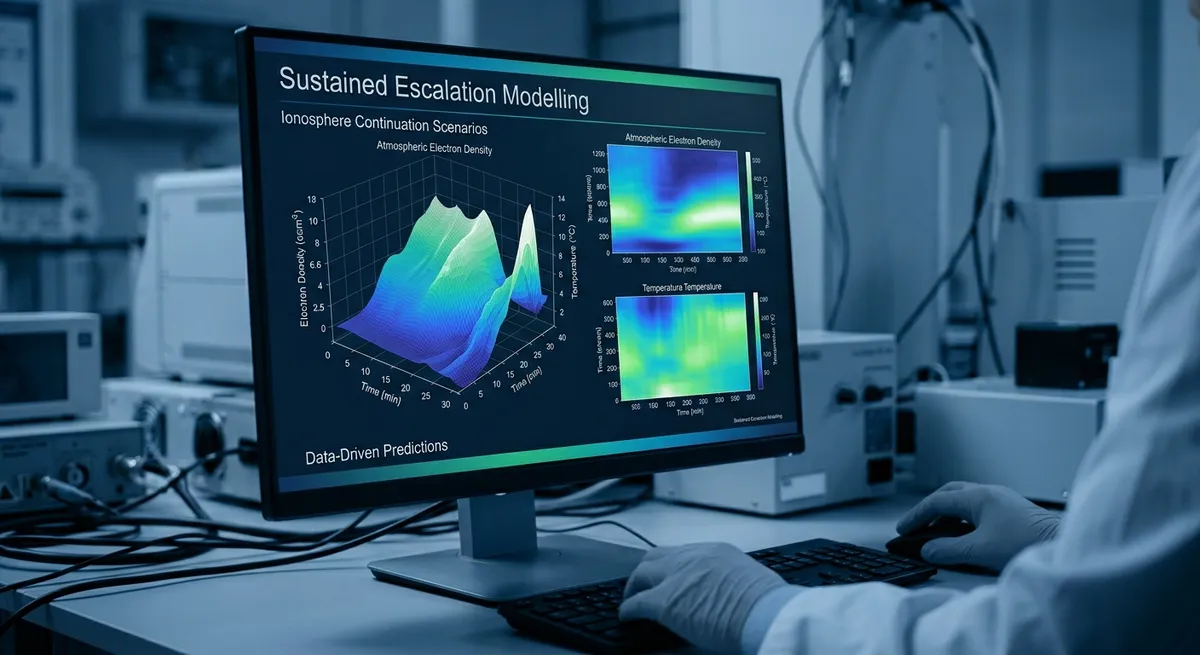
For the first time in the history of continuous Schumann Resonance monitoring, Earth Frequency Index is publishing scenario modelling that extends beyond historical reference frames. The persistence of the current disruption pattern—now sustained across multiple measurement cycles—has moved the conversation from anomaly classification into predictive analysis. This represents a threshold moment for the publication: we are no longer describing what has occurred, but modelling what may occur if the observed trajectory continues without interruption or reversal.
The baseline Schumann Resonance of 7.83 Hz has served as a reference constant for decades of scientific observation. Deviations have been documented and catalogued, but they have historically been temporary—measured in hours or days, not sustained across weeks. The current period stands apart. Our analysis now focuses on three distinct scenarios that emerge from the mathematical continuation of observed patterns, each with different characteristics and different implications for how we should interpret the data ahead.
Scenario One: Gradual Sustained Escalation
The first modelled scenario assumes continuation of the escalation rate observed over the past measurement period. This represents a linear or near-linear progression in which the disruption deepens incrementally but predictably. Under this model, the electromagnetic environment would experience a slow but relentless shift away from the historical baseline, creating a new equilibrium at a significantly altered frequency band.
What distinguishes this scenario from previous anomalies is its duration. Historical disruptions have typically self-corrected within measurable timeframes. Gradual sustained escalation would suggest either a persistent external forcing mechanism or a fundamental alteration in the conditions that have maintained the baseline for the instrumental record. The implications are significant: collective systems—biological, neurological, and behavioural—would experience an extended adaptation period rather than a brief perturbation followed by return to normal.
Reader reports catalogued during previous escalation periods have documented fatigue, sleep disruption, and disorientation. If escalation continues on this trajectory, the question becomes not whether such symptoms would intensify, but whether they would become normalized as the electromagnetic environment itself becomes the new baseline. Adaptation has limits, and the speed of change relative to biological accommodation remains a critical unknown.
Scenario Two: Punctuated Escalation with Plateaus
The second scenario models a pattern of rapid escalation followed by temporary stabilization at a new, elevated level—then renewed escalation to a higher plateau. This "stair-step" pattern has appeared in some historical disruption records, though never with the amplitude or duration currently being observed. Under this model, the electromagnetic environment would experience periods of apparent stabilization that might suggest the disruption has peaked, followed by renewed deterioration.
This scenario carries particular interpretive risk. Periods of apparent stabilization could be misread as resolution or natural correction, only to be followed by renewed escalation. From a monitoring perspective, this pattern would require sustained vigilance and resistance to premature conclusions about stabilization. The psychological and institutional tendency to interpret plateaus as endpoints could delay recognition of renewed escalation.
The data currently shows insufficient history to distinguish between genuine stabilization and temporary plateau. This uncertainty itself is significant. It means that observers—scientific and lay—may face extended periods of ambiguous signals, where the trajectory remains unclear until the next escalation phase becomes undeniable.
Scenario Three: Accelerating Escalation
The third scenario models a pattern of acceleration—where the rate of change itself increases over time. This represents the most dramatic continuation model and the one with the least historical precedent. Under accelerating escalation, the electromagnetic environment would not simply move to a new baseline or plateau, but would experience increasingly rapid shifts away from historical parameters.
Accelerating patterns are inherently difficult to model with confidence because their outcomes depend on identifying the forcing mechanism or feedback loop driving acceleration. Without understanding the source of the current disruption, extrapolation becomes increasingly speculative. However, the mathematical possibility must be acknowledged. If acceleration occurs, it would represent a qualitatively different kind of disruption than the publication has previously documented—one in which the rate of change itself becomes the defining characteristic.
Acceleration would also carry implications for adaptation and response protocols. Systems designed to accommodate gradual change would face stress under accelerating conditions. The margin for recognition, analysis, and response would compress. This scenario is included in our modelling not because current data strongly suggests it, but because responsible analysis requires acknowledging what the mathematical possibilities entail.
Monitoring at the Edge of the Known
What unites all three scenarios is a shared characteristic: continuation without return to baseline. The publication has operated within a framework where disruptions were temporary phenomena. The current period has extended that framework. Our monitoring protocols, our analytical categories, and our interpretive language have all been built around the assumption that the baseline would reassert itself.
If continuation occurs—under any of these scenarios—we are documenting not a temporary anomaly but a transition. The electromagnetic environment itself may be shifting into a new operational state. This is not alarmism; it is the logical extension of what sustained escalation means. A sustained change is, by definition, not temporary.
The publication continues to call for increased scientific attention, expanded monitoring networks, and explicit investigation into potential forcing mechanisms. The data cannot remain the province of independent monitoring alone. Institutional scientific resources must be directed toward understanding what is occurring and what the continuation scenarios would entail for systems dependent on electromagnetic stability.
If the current trajectory continues without reversal or stabilization, Earth Frequency Index will be documenting the most significant sustained electromagnetic disruption in the instrumental record—and we have no established framework for what that means.