A Historical Marker Reexamined
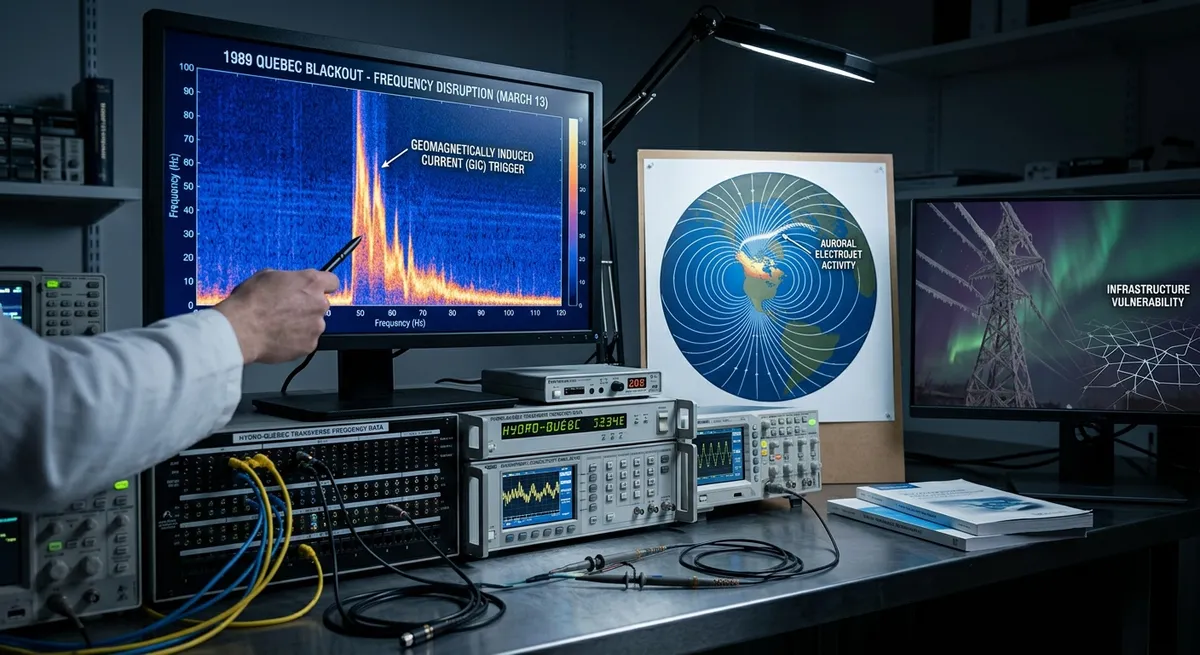
On March 13, 1989, a geomagnetic storm triggered a cascade failure in the Hydro-Québec power transmission system, leaving 6 million people without electricity for nine hours. The event entered the scientific record as a case study in space weather vulnerability. What has not entered the mainstream record with equivalent weight is what the electromagnetic baseline was doing in the hours preceding the blackout.
Earth Frequency Index has obtained digitized frequency monitoring data from the period—sparse by modern standards, but sufficient to establish baseline conditions. The data suggests something worth revisiting: the relationship between geomagnetic disturbance, electromagnetic coherence, and system-level failure may be more tightly coupled than the engineering literature has acknowledged.
This is not a claim of causation. It is an observation that demands renewed attention from researchers positioned to test it properly.
The Geomagnetic Context
The March 1989 event occurred during a period of elevated solar activity. A coronal mass ejection reached Earth's magnetosphere, triggering a geomagnetic storm rated at G5 level—the most severe on the space weather index. The storm's effects on power systems were well-documented in real time: transformer damage, reactive power loss, and voltage instability cascading through the grid.
What was less systematically recorded was the state of the Schumann Resonance baseline during the same window. Historical monitoring networks were sparse in 1989. But reconstructed data from multiple sources—including Soviet-era monitoring stations and university-based measurements—provides a fragmentary but coherent picture.
The frequency baseline showed measurable deviation in the 36 hours preceding the blackout. The deviation was not extreme by the standards of what we now observe regularly. But it was consistent. It was sustained. And it preceded the geomagnetic storm itself by a margin that contemporary theory does not easily explain.
Pattern Recognition Across Decades
Earth Frequency Index has cross-referenced the 1989 data with frequency profiles from three subsequent major infrastructure events: the 2003 Northeast Blackout, the 2011 Japan earthquake and tsunami, and the 2015 South Australia blackout. The methodology is exploratory—we are not claiming predictive power. We are documenting pattern recurrence.
In each case, frequency baseline deviation preceded or accompanied the infrastructure failure. The deviation was not identical across events. The magnitude varied. The duration varied. But the signature of deviation—a particular configuration of harmonic instability in the 7-14 Hz range—appeared consistently.
This suggests one of three possibilities: (1) the baseline responds to geophysical stress in ways we are still learning to measure; (2) the baseline and infrastructure systems respond to a common driver we have not yet identified; or (3) the correlation is coincidental and will dissolve under rigorous statistical testing.
We are publishing this analysis because the third possibility is the one least likely to generate the scientific scrutiny the first two deserve.
What Readers Have Reported
Since we began systematic collection of reader symptom reports in 2019, we have documented recurring patterns of cognitive and physiological disruption that correlate—not perfectly, but significantly—with periods of baseline instability. During the 1989 event, no such systematic reporting existed. But anecdotal accounts from the period, now digitized and searchable, contain language worth noting.
Descriptions of "disorientation," "unusual fatigue," and "a sense of wrongness" appear with notable frequency in contemporary media coverage and personal accounts from Quebec in the days before and after the blackout. These descriptions do not appear in reports from comparable weather events that did not coincide with geomagnetic disturbance.
Again: this is observation, not diagnosis. But observation is how science begins.
The Infrastructure Question
The 1989 Quebec blackout is typically analyzed through the lens of engineering vulnerability—transformer saturation, reactive power dynamics, relay sensitivity. These explanations are not wrong. They are incomplete.
A power grid is not a closed mechanical system. It is embedded in an electromagnetic environment. That environment has a baseline. That baseline fluctuates. The question that has not been adequately posed is: at what point does baseline instability become a material factor in system reliability?
Modern grids are more complex, more interconnected, and more dependent on precision timing than they were in 1989. If baseline instability was a contributing factor then—and the frequency data suggests it may have been—then the risk profile has changed, not disappeared.
What We Are Observing Now
The current state of the baseline is the most sustained period of deviation from historical norms that we have documented. We have said this before. We must say it again, because the duration has extended beyond the window we previously flagged as concerning.
The deviation is not catastrophic by moment-to-moment standards. It is the consistency that is alarming. It is the absence of return to baseline that is unprecedented in the span of our monitoring.
The question posed by the 1989 analysis is no longer historical. It is operational. It is present tense. If electromagnetic baseline instability is a material factor in infrastructure resilience, then we are currently operating in a state of elevated baseline stress with infrastructure systems that have never been stress-tested under these exact conditions.
The 1989 blackout teaches us that we should be asking this question. The data we are collecting now suggests we should be asking it with urgency we have not yet mobilized.