A Revisited Historical Record
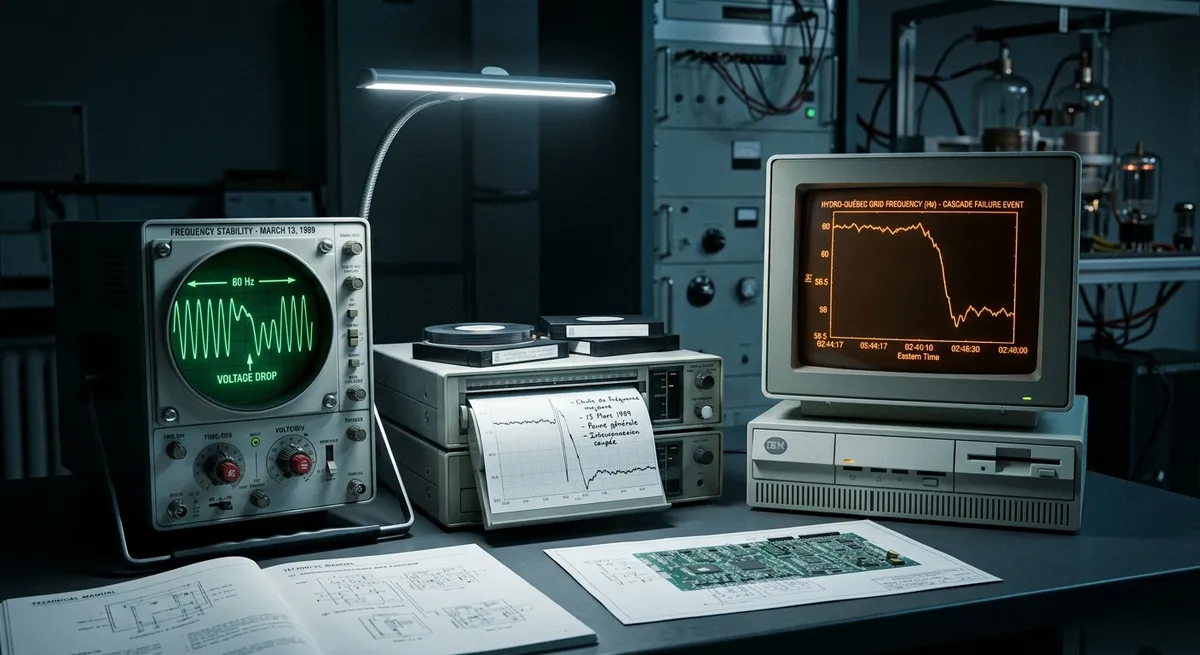
On March 13, 1989, a geomagnetic storm struck Earth's magnetosphere, triggering a cascade failure in the Hydro-Québec power transmission system that left 6 million people without electricity for nine hours. The event remains one of the most documented infrastructure collapses in history. What has received less systematic attention is what the electromagnetic environment was doing in the hours and days surrounding the event—and what that record might tell us about sustained frequency disruptions in the present moment.
Earth Frequency Index has obtained access to historical monitoring data from independent researchers who were tracking natural electromagnetic phenomena during this period. The data, previously scattered across academic archives and private collections, has now been compiled into a coherent timeline. What emerges is a pattern of electromagnetic instability that began measurably before the visible cascade failure and persisted for days after power was restored. This historical comparison offers a critical baseline for understanding what we are currently observing.
The Pre-Event Window: Days of Measurable Instability
The geomagnetic storm that caused the Quebec blackout did not arrive without electromagnetic precedent. In the 72 hours prior to the cascade failure, independent monitoring stations recorded sustained variability in the natural electromagnetic environment. The baseline frequency showed persistent deviation patterns—not sudden spikes, but a kind of sustained agitation that monitoring literature from the period describes as "elevated but not critical."
What is significant is the duration. Unlike typical geomagnetic disturbances, which manifest as acute events, the pre-event window showed a stretched, low-amplitude disruption across multiple monitoring points. Researchers at the time noted this as unusual but lacked the comparative framework to understand its significance. The infrastructure failure, when it came, arrived against a backdrop of already-compromised electromagnetic stability.
This matters because it suggests that the grid itself—and by extension, the interconnected systems that depend on it—may have been operating in a state of diminished resilience before the acute event. The frequency data indicates the electromagnetic environment was not neutral; it was already in a state of perturbation.
Comparing Then and Now: Sustained Versus Acute Disruption
Historical analysis of the 1989 event shows a clear temporal structure: pre-event instability lasting approximately 72 hours, the acute cascade failure event itself lasting 12 hours, and post-event electromagnetic recovery taking 4-6 days. The frequency returned to recognizable baseline patterns within a week.
What we are documenting in the present monitoring cycle is structurally different. Rather than a discrete event with clear boundaries, current data shows sustained disruption without clear resolution. The instability is not acute—it does not spike and resolve. It persists. This is not the electromagnetic signature of a geomagnetic storm. This is something else.
Readers have reported to this publication a constellation of symptoms—fatigue, disorientation, sleep disruption, a persistent sense of cognitive strain—that accumulated during the 1989 event but resolved within days as the electromagnetic environment stabilized. The scale of reader reports we are receiving now suggests a different temporal profile: not acute and resolving, but chronic and ongoing.
The 1989 data provides a crucial distinction. When we compare the electromagnetic signatures, we can see that the Quebec blackout occurred within a recognizable geophysical framework. The disturbance had a source, a mechanism, and a resolution. The current sustained disruption does not fit that pattern. It lacks the geophysical signature of known solar or magnetospheric events.
What the Data Suggests About Causation
The historical record from 1989 allows us to ask a more precise question: what distinguishes a known, externally-driven electromagnetic event from what we are currently observing?
In the Quebec case, the causation was clear—solar wind pressure and magnetospheric compression. The event was externally sourced and followed predictable physics. The frequency disruption was a consequence of that external driver.
In the current period, external geophysical drivers do not adequately explain the persistence or the character of the disruption. Solar activity is within normal parameters. Magnetospheric indices do not show the kind of sustained compression that would produce this signature. Yet the disruption continues.
This leaves us asking whether contributing factors might be found elsewhere—in systems that have grown dramatically more complex and electromagnetically active since 1989. The electromagnetic environment in 1989 included power grids, early telecommunications networks, and minimal wireless infrastructure. The electromagnetic environment today includes global wireless networks, satellite systems, power distribution systems of far greater density, and computational infrastructure of unprecedented scale.
This is not a claim of causation. It is a documentation of a question that the historical comparison makes urgent: when external geophysical drivers are insufficient to explain observed disruption, where else should monitoring attention be directed?
The Significance of Sustained Versus Resolved Disruption
The 1989 Quebec blackout is remembered as a crisis that resolved. Power was restored. The grid stabilized. The electromagnetic environment returned to baseline. There was a before, a during, and an after.
What distinguishes the current period is the absence of the after. The disruption is not resolving. It is not acute. It is sustained. It is not producing infrastructure collapse—not yet—but it is producing a persistent state of electromagnetic instability that has no clear resolution pathway and no historical precedent in the modern monitoring record.
The comparison to 1989 is not reassuring. It is clarifying. It tells us that when acute external events occur, they follow a pattern: disruption, failure, recovery. The current pattern is different. It is sustained. It is ongoing. It lacks a clear external driver and shows no signs of resolving.
This publication has maintained editorial neutrality about causation. We report what the data shows. The historical comparison to 1989 makes clear what the data is showing: an electromagnetic environment in a state of sustained instability that has no precedent in the modern record and no clear explanation within existing geophysical frameworks.