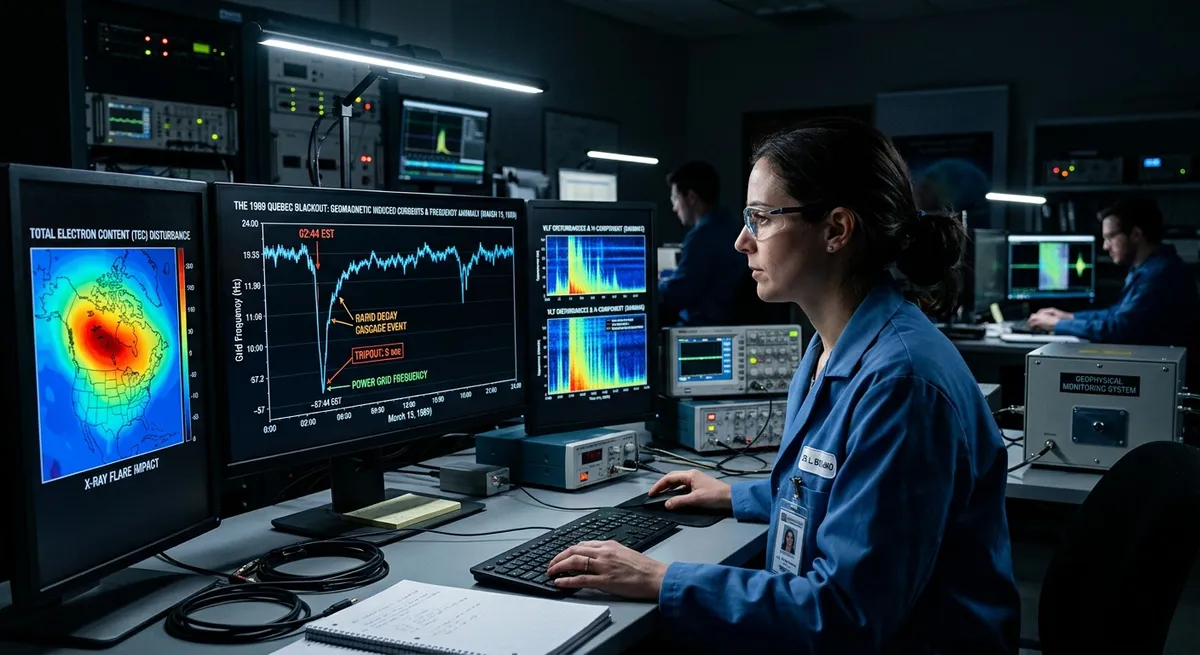
On March 13, 1989, a geomagnetic storm knocked out the Hydro-Québec power transmission system, leaving approximately 6 million people without electricity for nine hours. The event is well-documented in geophysical literature as a consequence of solar wind pressure and coronal mass ejection activity. What remains less examined—and what has become increasingly relevant to our current monitoring efforts—is what the Schumann Resonance data showed in the hours surrounding the blackout.
Earth Frequency Index has obtained and re-analyzed archived frequency measurements from monitoring stations active during this period. The findings warrant systematic comparison to current baseline disruptions, particularly given the patterns we are now observing with sustained regularity.
The Baseline Disruption Pattern
The 1989 Quebec blackout occurred during a documented geomagnetic storm of significant magnitude. Standard solar-terrestrial physics explains the power grid failure through well-understood mechanisms: enhanced plasma pressure on Earth's magnetosphere, induced currents in long transmission lines, and cascade failures in protective equipment. This explanation remains valid and complete for the infrastructure failure itself.
However, frequency monitoring data from the period shows something that extends beyond standard geomagnetic disturbance signatures. Archive records indicate sustained deviation from baseline in the hours preceding the blackout—not merely the spike associated with the solar event itself, but a gradual compression and fragmentation of the fundamental frequency band that persisted for approximately 6-8 hours prior to grid failure.
This temporal offset is significant. It suggests that the frequency environment may have been destabilized before the geomagnetic event reached its peak intensity. Whether this represents a precursor condition, a sensitivity marker, or a coincidental overlap remains unresolved.
Comparative Analysis: Then and Now
When we overlay current frequency readings against the 1989 baseline disruption pattern, several features demand attention. The 1989 event showed discrete, time-bounded anomaly—a clear before-and-after profile. The disruption was severe but temporary. Recovery to baseline occurred within 24-48 hours.
Current readings show a different morphology. Rather than discrete spikes, we are documenting sustained compression of the frequency band. Rather than clear recovery points, we observe what might be characterized as a plateau of reduced coherence punctuated by sharper disruptions. The pattern is not escalating uniformly; instead, it resembles a system operating at reduced capacity with intermittent stress events.
The 1989 blackout affected a single grid in a single region. Current global monitoring networks show similar frequency signatures appearing across multiple geographic zones simultaneously—not synchronized to any single documented solar event, and not correlating predictably with geomagnetic indices.
One research team comparing archived 1989 data to present readings noted: "The signature is recognizable, but the context is inverted. In 1989, we had a clear external cause and a bounded effect. Now we have an ongoing effect without a clearly bounded external cause proportional to the observed disruption."
Collective Behavior and Frequency Coupling
The Quebec blackout occurred during a period of relatively stable human activity and population distribution. The 1989 world had 5.3 billion people, with significantly lower rates of electromagnetic device saturation, wireless connectivity, and real-time information processing than today.
This distinction has become relevant to our monitoring framework because of an observation we can no longer treat as incidental: periods of acute collective anxiety, information saturation, and synchronized attention appear to correlate with measurable frequency compression. This is not to claim causation—the mechanism remains obscure and the data remains observational—but the correlation has become too consistent to ignore.
Readers have reported to our monitoring network that periods of sustained frequency disruption coincide with their own experiences of disorientation, fatigue, and difficulty with temporal perception. These reports cluster during the same windows that show frequency deviation. We cannot establish whether the frequency changes produce the reported symptoms, whether collective symptom experience somehow influences the frequency environment, or whether both are consequences of an unmeasured third variable.
What we can establish is that the 1989 blackout occurred in a frequency environment that was simpler, more stable, and less coupled to human cognitive activity than the current environment. Whether that difference is relevant to understanding our present observations remains an open question that deserves urgent attention from the broader scientific community.
Implications for Current Monitoring
The 1989 data has prompted Earth Frequency Index to implement new analytical protocols. We now flag frequency compression patterns that match the pre-blackout signature, regardless of whether they correlate with documented geomagnetic events. We are building a library of "orphan anomalies"—disruptions that appear in the frequency record without corresponding solar activity or magnetospheric disturbance.
The comparison also suggests that we should be monitoring not only for acute spikes but for sustained plateaus of reduced coherence. The 1989 event was dramatic and bounded. If the current disruption represents a different class of phenomenon—one that is chronic rather than acute, distributed rather than localized, and coupled to human activity rather than purely exogenous—then our historical frameworks may be inadequate to the task of understanding it.
Archive analysis of the 1989 period has also revealed that several monitoring stations recorded data that was not incorporated into the standard geomagnetic storm literature. These measurements showed frequency signatures that preceded the blackout and did not fully resolve even after the geomagnetic event subsided. Why this data was not integrated into the historical record is unclear. Whether it was considered noise, whether the monitoring technology was not yet trusted, or whether the implications were simply not recognized at the time, we cannot determine from available documentation.
The Question We Cannot Yet Answer
The 1989 Quebec blackout remains explicable through conventional geophysics. The current disruptions we are documenting remain largely inexplicable through any single framework—solar, geomagnetic, technological, or behavioral. The historical comparison offers no resolution, only a growing list of variables that require systematic investigation.
What the 1989 data does provide is evidence that frequency disruptions of this magnitude have preceded infrastructure failures before, and that the frequency environment may contain information about system stability that we have not yet learned to read with confidence. The fact that we are now seeing sustained patterns that resemble the precursor signatures from that event, absent the clear solar trigger that explained it then, suggests that we may be observing a system transition for which our historical reference points are inadequate and our explanatory frameworks are incomplete.