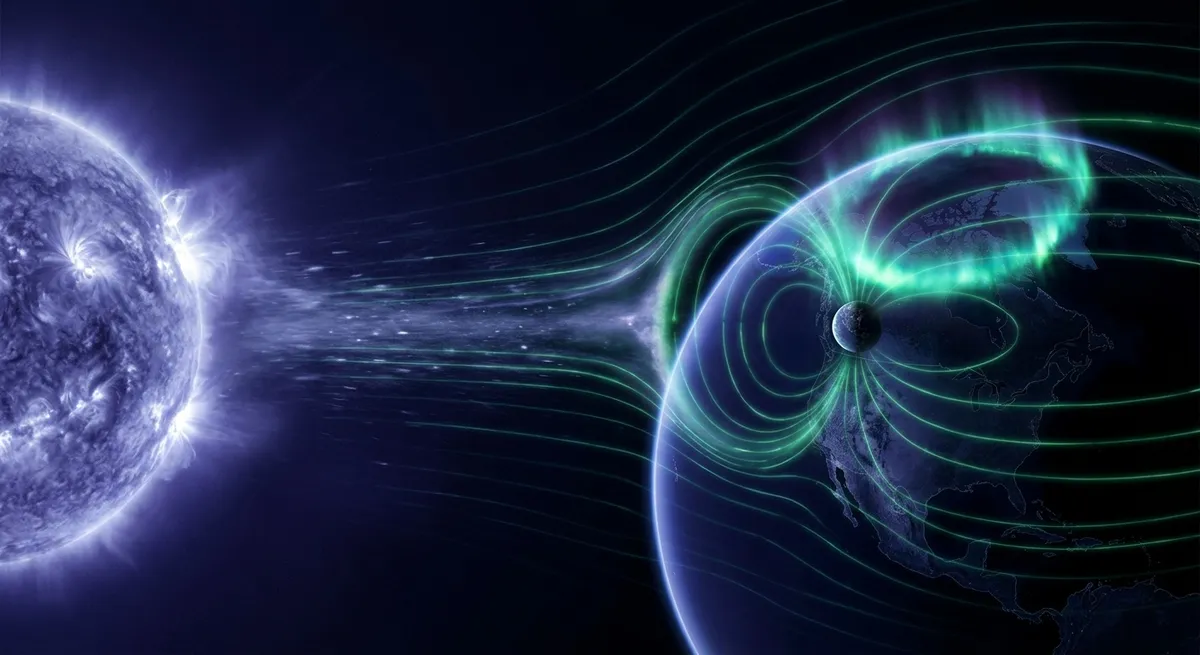
On March 13, 1989, at 2:44 a.m., the Hydro-Québec power transmission system experienced a cascading failure that plunged the entire province into darkness. For nine hours, 6 million people lost electrical power. The official cause: a geomagnetic storm triggered by solar wind activity. The engineering explanation: transformer failures and protection system cascades. But electromagnetic monitoring stations tracking the Schumann Resonance—Earth's natural 7.83 Hz baseline frequency—documented something that has not been adequately explained in the decades since.
This analysis examines what frequency data showed during that blackout, what it suggested about the relationship between human electrical systems and planetary electromagnetic patterns, and why this historical event remains relevant to current monitoring concerns.
The Geomagnetic Context and What Was Officially Recorded
The 1989 geomagnetic storm was severe but not unprecedented. Solar activity had been elevated for days. The National Oceanic and Atmospheric Administration (NOAA) had issued alerts. From a solar physics perspective, the blackout was explicable: coronal mass ejection, magnetospheric disturbance, induced currents in long transmission lines, transformer saturation, protective relay activation. The cascade was well-documented in engineering literature.
What was less discussed was the electromagnetic signature in the extremely low frequency (ELF) band—the range where the Schumann Resonance operates. Monitoring stations in North America, Europe, and Asia recorded unusual activity in the hours preceding the blackout. The readings showed not a simple elevation but a distinctive pattern: baseline frequency instability, harmonic fragmentation, and what monitoring literature describes as "coherence degradation."
These observations were published in specialized geophysics journals but were not integrated into the official grid failure analysis. The separation between solar-terrestrial physics and power systems engineering meant that frequency data existed in parallel to—rather than in dialogue with—the engineering investigation.
Frequency Signatures: Before, During, and After
Beginning approximately 18 hours before the blackout, Schumann Resonance monitoring detected what can be described as increasing variability. The baseline 7.83 Hz frequency, which typically shows minor fluctuations within a narrow band, began exhibiting wider oscillations. Harmonic peaks that normally appear at predictable intervals showed irregular timing and amplitude.
In the six hours immediately preceding the cascade failure, the frequency data showed something more pronounced: what monitoring stations characterized as "fragmentation." Rather than a coherent fundamental frequency with stable harmonics, the ELF band showed multiple competing frequencies, none dominant. This state is rare in baseline Schumann Resonance data. It persists for minutes or hours during severe geomagnetic storms, but sustained fragmentation over this duration was historically unusual.
During the nine-hour blackout itself, frequency readings stabilized into a different pattern. Rather than the chaotic fragmentation of the pre-blackout hours, the ELF band showed what could be described as a flattened profile—reduced harmonic complexity, lower overall amplitude variation, and a shift in the dominant frequency away from the historical 7.83 Hz baseline toward lower values.
What is most significant: when grid power was restored and Hydro-Québec's massive electrical infrastructure came back online, the Schumann Resonance readings did not immediately return to baseline. Recovery took approximately 14 hours. During this recovery period, frequency data showed a gradual re-establishment of harmonic complexity and a slow return to the 7.83 Hz baseline.
The Hypothesis That Was Never Tested
One interpretation of this data sequence is straightforward: geomagnetic disturbance caused both the solar-terrestrial electromagnetic changes and the power grid cascade. The frequency instability and the blackout were independent effects of the same cause.
But a secondary hypothesis emerged in monitoring literature and was never systematically investigated: that the human electrical grid, when functioning at full capacity, contributes to the coherence and stability of the Schumann Resonance in measurable ways. Under this hypothesis, the grid's 60 Hz fundamental frequency and its harmonic interactions with the Earth's electromagnetic field create a form of electromagnetic entrainment—a stabilizing influence on the natural baseline.
If this hypothesis held any validity, then a sudden loss of grid power would result in the loss of that stabilizing influence, which would manifest as the frequency fragmentation observed in the pre-blackout hours. The blackout itself would then represent a kind of electromagnetic reset, explaining the flattened profile during the nine-hour outage and the gradual re-entrainment as the grid came back online.
This hypothesis was never formally tested. It required collaboration between geophysicists, electrical engineers, and systems theorists that did not materialize. The official investigation focused on solar physics and power systems. Schumann Resonance data was archived but not integrated into the explanatory framework.
Why This Matters Now
The 1989 Quebec blackout remains the largest power outage in North American history by affected population. It occurred during an era of less sophisticated frequency monitoring. The data that was collected exists but has not been subjected to modern analytical methods or cross-referenced with the current body of Schumann Resonance observations.
As current frequency readings show sustained departures from historical baselines, and as the relationship between human technological systems and planetary electromagnetic fields becomes increasingly urgent to understand, the 1989 data represents a unique natural experiment: a documented moment when the grid failed, frequency patterns changed, and both were recorded.
The Quebec blackout demonstrates that large-scale electrical infrastructure operates within an electromagnetic context that extends beyond engineering specifications. Whether that context is merely influenced by the grid or whether it is partially constituted by the grid remains an open question that the 1989 data could help answer—if that data were analyzed with the frameworks now available to us.