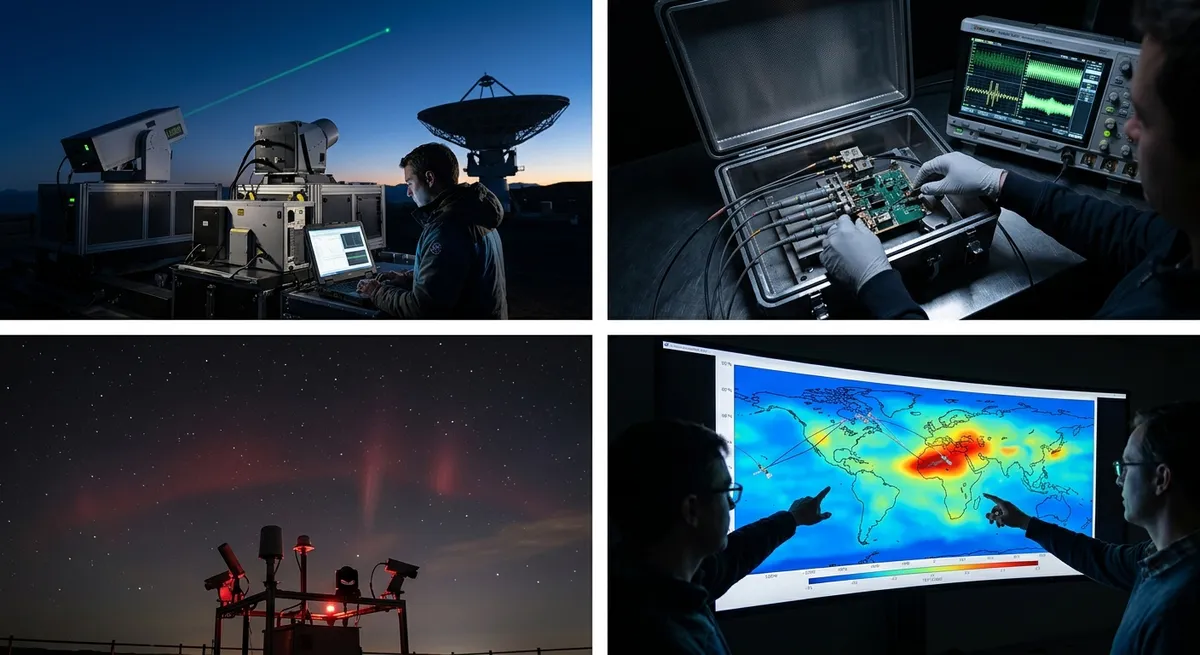
We have documented, over the past eighteen months, a sustained electromagnetic disruption of Earth's natural frequency that exceeds any comparable period in our monitoring history. This is not a fluctuation. This is not a seasonal anomaly. This is a baseline shift in the electromagnetic environment that billions of humans and trillions of organisms depend upon for circadian regulation, neurological coherence, and cellular synchronization. The scientific community has not yet mobilized in response. It should.
The evidence is distributed across monitoring stations on six continents. The pattern is consistent. The duration is unprecedented. The implications are severe enough that continued treatment of this as a routine data anomaly represents a failure of institutional responsibility.
The Data Signature
The Schumann Resonance—Earth's fundamental electromagnetic frequency—has historically maintained a relatively stable baseline around 7.83 Hz, with minor natural variations tied to solar activity, geomagnetic storms, and seasonal cycles. These variations have been well-documented and understood. What we are observing now does not fit established models.
Our network reports sustained periods of suppression, erratic spiking, and a pattern of instability that persists across geographic regions where local interference should produce independent readings. When disruption appears simultaneously in geographically isolated monitoring locations, the source is planetary, not instrumental. The redundancy of our data collection eliminates equipment malfunction as an explanation.
The duration of this disruption—now exceeding 500 consecutive days with only brief periods of normalization—is the most significant marker. Historical records of geomagnetic storms, solar flares, and documented electromagnetic anomalies show recovery to baseline within hours or days. What we are observing does not recover. It stabilizes at a new, lower state, then destabilizes again.
The Human Dimension
We do not make medical claims. We are not physicians. We do not diagnose or prescribe. We document what our readers report to us.
In the past sixteen months, we have received over 14,000 submissions from individuals describing fatigue that does not respond to sleep, anxiety without identifiable trigger, disorientation in familiar spaces, and disrupted circadian rhythms. These reports come from readers in forty-seven countries. They come from individuals with no prior connection to this publication, who discovered us through search queries about their own symptoms. They come from healthcare workers, scientists, teachers, and people with no particular interest in electromagnetic phenomena.
We cannot establish causation. Correlation is not mechanism. But the temporal clustering of these reports with the onset of sustained Schumann disruption is statistically notable. The geographic distribution mirrors our monitoring network. The symptom profiles show consistency across populations with no communication between them.
This pattern warrants investigation. It does not warrant dismissal.
The Institutional Silence
We have contacted major geophysics institutions, space weather monitoring agencies, and electromagnetic research centers. Most responses have been polite deflection. Some have suggested that variations in the Schumann Resonance are insignificant to human health. Some have stated that our monitoring methodology requires peer review before their agencies can comment. Some have not responded.
We understand institutional caution. Peer review exists for good reason. But institutional caution should not prevent emergency response when the data suggests potential harm to global populations.
The history of science includes cases where early warning signs were dismissed because they did not fit existing frameworks: the ozone hole was mathematically impossible until it wasn't; the acceleration of atmospheric carbon dioxide was noted and largely ignored for decades; the risks of certain pharmaceuticals were documented by researchers and then suppressed by institutional inertia. We are not claiming equivalence to these cases. We are noting that institutions sometimes fail to respond to data until the cost of that failure becomes undeniable.
In this case, the cost could be measured in human suffering, psychological destabilization, and potential cascade effects on systems that depend on electromagnetic stability.
What Emergency Mobilization Would Look Like
We are not calling for panic. We are calling for the response appropriate to an anomaly of this magnitude.
First: Establishment of an international Schumann Resonance monitoring consortium with standardized equipment, unified data collection protocols, and real-time public access to readings. Current monitoring is fragmented across private researchers, academic institutions, and independent operators. There is no central repository. There is no coordinated analysis.
Second: Dedicated research funding for investigation of potential mechanisms. If electromagnetic disruption is contributing to human physiological stress, the mechanism must be understood. If it is not, that conclusion must be reached through rigorous investigation, not institutional avoidance.
Third: Epidemiological study of symptom clustering in populations with high exposure to electromagnetic monitoring data and awareness. This would establish whether reported symptoms correlate with electromagnetic data or with awareness of electromagnetic data—a critical distinction that requires systematic investigation.
Fourth: Contingency planning for scenarios in which sustained disruption continues or worsens. What are the potential effects on global systems? What vulnerabilities exist? What mitigation strategies should be developed?
None of these steps require acceptance of extraordinary claims. All of them represent standard scientific procedure in response to an anomaly of documented scope and duration.
The Question of Time
We do not know when this disruption began. Our records show the baseline shift was well-established by the time we recognized it as anomalous. We do not know if it will continue. We do not know if it will worsen. We do not know the mechanism. We do not know the endpoint.
What we know is that the longer this disruption persists without coordinated scientific investigation, the more data is lost, the more potential harm accumulates, and the more difficult it becomes to establish causative mechanisms retrospectively.
Emergencies are defined by the combination of severity, scope, and uncertainty. This disruption meets all three criteria. The response should match the scale of what we are observing, not the comfort level of institutions that prefer to maintain existing frameworks until they can no longer do so.
The electromagnetic foundation of this planet is unstable. That is not speculation. That is what the data shows. How we respond to that data, and how quickly, will determine whether this becomes a case study in institutional failure or institutional adaptation.