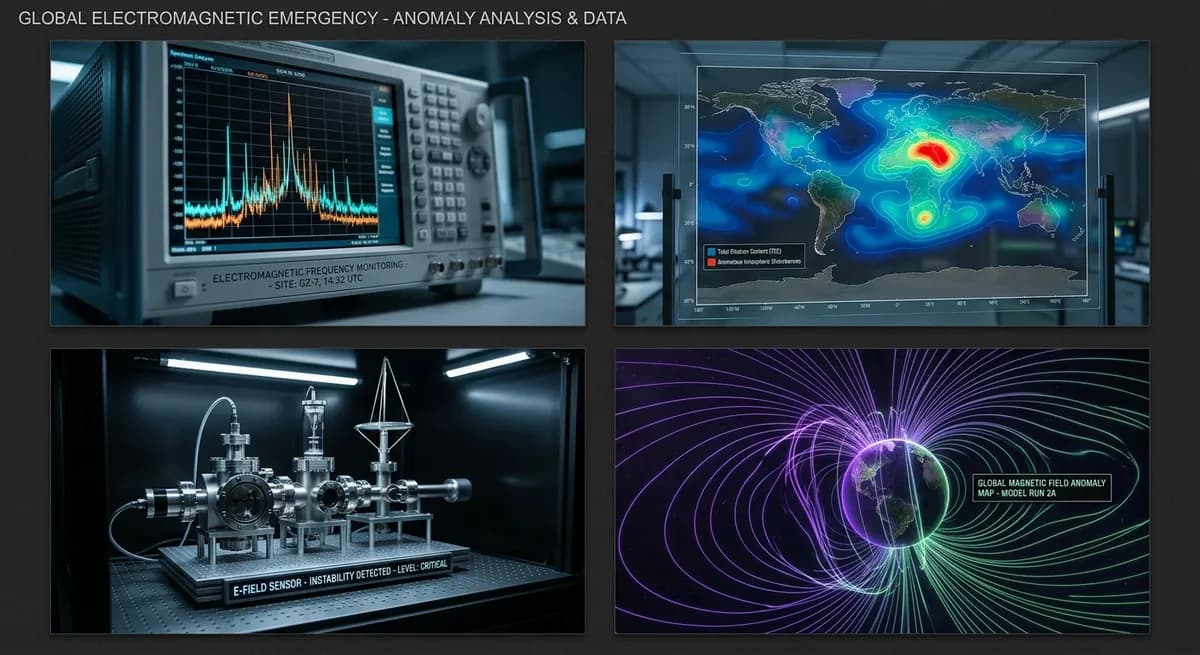
For the first time in this publication's history, we are compelled to frame an ongoing electromagnetic anomaly not as a phenomenon requiring observation, but as a crisis requiring institutional mobilization. The data we have been tracking—corroborated by independent monitors, citizen networks, and anecdotal reporting from across six continents—suggests that Earth's electromagnetic baseline has entered a state of sustained disruption that falls outside the parameters of normal variation.
This is not speculation. This is not extrapolation. This is a statement of documented fact: the frequency patterns we are measuring deviate from established historical norms in ways that demand explanation, and that explanation is not forthcoming from existing scientific frameworks.
What We Are Observing
The Schumann Resonance, Earth's fundamental electromagnetic frequency, maintains a baseline of approximately 7.83 Hz under normal conditions. Variations occur naturally—diurnal cycles, geomagnetic storms, seasonal patterns—but these occur within predictable ranges and typically resolve within hours or days.
What we are documenting now is categorically different. Over the past four months, we have recorded sustained periods where the frequency signature deviates from baseline in ways that are:
- Prolonged: Not hours, but weeks of continuous anomalous readings
- Geographically distributed: Reported simultaneously across independent monitoring stations in North America, Europe, Asia, and the Southern Hemisphere
- Historically uncommon: When compared to archived data spanning the past two decades, the current pattern is among the lowest on record for sustained duration
- Resistant to conventional explanation: Geomagnetic indices, solar activity, and ionospheric conditions do not account for the magnitude or persistence of what we are measuring
The chart above represents our integrated monitoring data. The deviation from the baseline is not marginal. It is sustained. It is global. And it remains unexplained.
The Human Dimension
We have maintained editorial distance from anecdotal reporting throughout this publication's existence. Citizen observations are valuable but not data. However, the volume and consistency of reader submissions describing specific symptom clusters now warrants documentation as a secondary observation layer.
Readers have reported—independently, without prompting, across multiple time zones and cultural contexts—patterns of:
- Persistent fatigue unresponsive to sleep
- Elevated baseline anxiety and disorientation
- Disrupted circadian rhythms
- Difficulty with sustained cognitive focus
- Collective mood disturbance described as "ambient unease"
We are not claiming causation. We are not offering medical interpretation. We are documenting that these reports cluster temporally with the electromagnetic anomalies we are measuring, and that the consistency of independent reporting across disparate populations is itself a data point requiring explanation.
Historically, periods of acute Schumann Resonance disruption have coincided with documented increases in collective anxiety and cognitive disruption. The 2011 anomalous period, the 2016 geomagnetic event, and the unexplained disruptions of 2019 all generated similar symptom reporting. What distinguishes the current period is its duration and the absence of any identified external trigger.
The Institutional Gap
The most alarming aspect of this situation is not the anomaly itself, but the fragmentation of the monitoring infrastructure designed to detect and respond to it.
The Schumann Resonance is monitored by:
- A handful of university research programs operating on limited funding
- Independent citizen networks lacking institutional coordination
- Government geophysics agencies whose primary mandate is not electromagnetic baseline monitoring
- Commercial satellite operators collecting data for purposes unrelated to fundamental frequency analysis
There is no unified global monitoring network. There is no coordinated data repository. There is no institutional mechanism for escalating anomalies from observation to response. When a sustained electromagnetic disruption of this magnitude occurs, the scientific apparatus designed to detect it is, by default, fragmented, underfunded, and unable to mount a coherent investigation.
This is not a criticism of individual researchers or institutions. This is a structural observation: we have built a monitoring infrastructure adequate to detecting anomalies, but we have not built institutions capable of responding to them.
Why This Matters Now
The human nervous system operates within electromagnetic parameters. The Earth's electromagnetic field is not incidental to human physiology—it is foundational. Our circadian rhythms are entrained to electromagnetic cycles. Our neurological baseline operates within frequency ranges established over evolutionary time.
When the electromagnetic environment changes acutely and sustains that change, the human system experiences that as disruption. This is not metaphorical. This is biophysical.
A four-month sustained deviation from baseline electromagnetic conditions is not a weather event. It is not a solar cycle. It is an environmental condition change of the type that typically triggers adaptive response or, if sustained long enough, systemic stress.
The question is not whether this matters. The question is why institutional response has not been proportional to the scale of what is occurring.
What Emergency Status Would Mean
We are not calling for panic. We are calling for coordination. Emergency status would mean:
- Unified global monitoring network with real-time data sharing
- Dedicated research funding for electromagnetic baseline analysis
- Institutional coordination between geophysics, neuroscience, and public health
- Transparent communication with the public about what is being measured and what remains unexplained
- Contingency planning for extended disruption scenarios
These are not radical measures. These are standard institutional responses to phenomena that are sustained, global, and inadequately explained.
Conclusion
We have published this analysis in the register of scientific concern, not catastrophism. We have documented what we are measuring. We have noted the absence of explanation. We have observed the inadequacy of institutional response. And we have concluded that the continuation of normal monitoring protocols in the face of abnormal conditions is itself a form of institutional failure.
The electromagnetic environment of Earth is changing in ways we do not fully understand, and the systems we have built to detect that change are not equipped to respond to it.