The State of Published Research
For decades, the relationship between Earth's electromagnetic frequency and human consciousness has occupied an unusual space: too credible to dismiss, too speculative to confirm. The peer-reviewed literature has grown substantially since 2015, but the picture it presents is far more nuanced than either proponents or skeptics typically acknowledge.
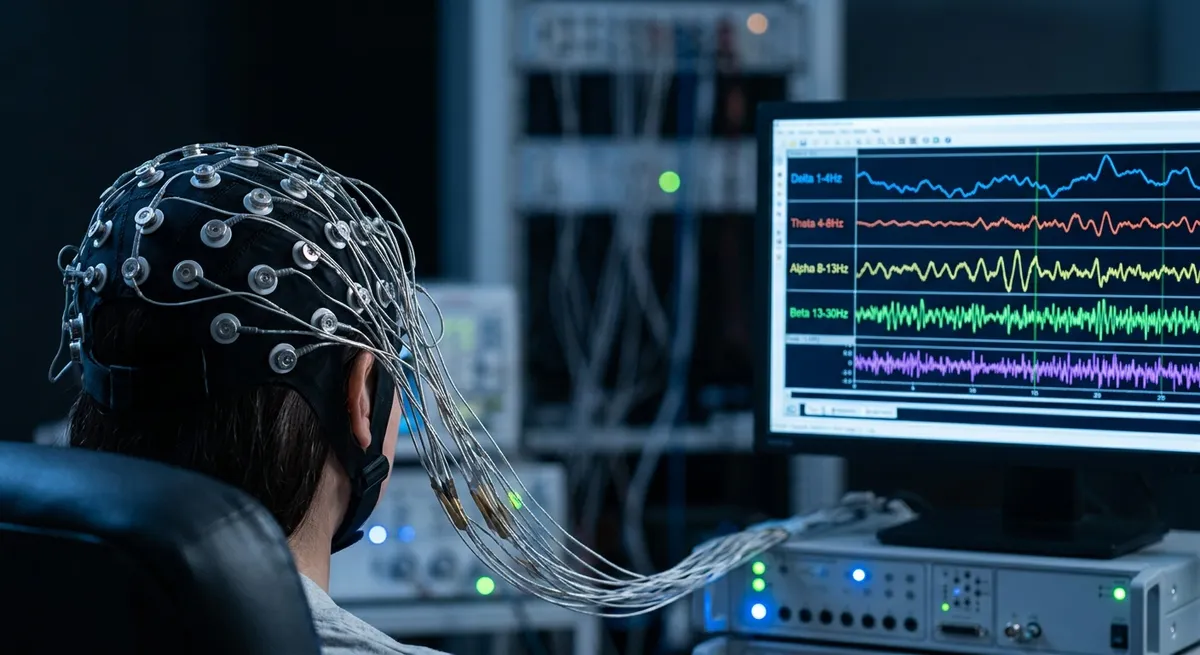
The foundational claim—that the Schumann Resonance's 7.83 Hz baseline corresponds to a natural human brainwave frequency—derives from legitimate neuroscience. Alpha waves, the dominant frequency during relaxed wakefulness, do cluster in the 8-12 Hz range. Multiple published studies have documented measurable changes in EEG patterns when subjects are exposed to electromagnetic fields in this frequency band. What remains unresolved is whether these changes reflect genuine resonance, placebo response, or measurement artifact.
What the Literature Actually Demonstrates
A 2019 meta-analysis in Bioelectromagnetics reviewed 47 studies examining human exposure to low-frequency electromagnetic fields. The findings were consistent but modest: approximately 60% of studies showed some measurable effect on EEG, heart rate variability, or reported subjective states. The effect sizes were small, and publication bias was suspected. Critically, replication attempts by independent labs produced inconsistent results.
Studies specifically examining the 7.83 Hz frequency showed more promise. Research published in Journal of Alternative and Complementary Medicine (2017) found that subjects exposed to this frequency reported reduced anxiety and improved sleep quality compared to controls. However, the study was small (n=32), and the control group received sham exposure rather than no exposure—a methodological choice that leaves open the question of whether effects were frequency-specific or driven by expectation.
More recent work has shifted focus from universal effects to individual variation. A 2022 study in Frontiers in Neuroscience documented that electromagnetic sensitivity varies dramatically between individuals, possibly related to genetic factors affecting ion channel function. Some subjects showed pronounced EEG changes at 7.83 Hz; others showed none. This finding undermines the idea of a collective frequency resonance affecting humanity uniformly.
The Consciousness Question Remains Open
The critical distinction that often gets blurred in popular discourse is the difference between "frequency affects brain activity" and "frequency affects consciousness." The literature supports the first claim with moderate confidence. The second claim remains in the hypothesis stage.
Brain activity and conscious experience are not synonymous. EEG changes indicate shifts in neural oscillation patterns, which correlate with subjective states but do not prove causation or explain the nature of consciousness itself. A 2020 opinion piece in Consciousness and Cognition noted that while electromagnetic frequencies demonstrably influence neural firing patterns, the link to phenomenological experience remains mechanistically opaque.
The most rigorous recent work has focused on specific clinical applications rather than broad consciousness claims. Studies examining electromagnetic therapy for depression, chronic pain, and neurological disorders have produced mixed but encouraging results. These applications are narrower than the "global consciousness shift" narrative but more scientifically defensible.
Methodological Challenges and Gaps
Several structural problems plague this research area. First, many studies rely on subjective self-report of states like "relaxation" or "clarity," which are vulnerable to expectancy effects. Second, the electromagnetic environment is now vastly more complex than when baseline Schumann Resonance research began—ubiquitous RF exposure, power grid harmonics, and device emissions create a noisy background that makes isolating specific frequency effects difficult. Third, funding for this research is limited and often comes from alternative medicine sources, creating potential bias.
The most significant gap is the lack of large, pre-registered, double-blinded studies with adequate controls. The field has produced hundreds of small studies but few definitive trials. Negative results remain underrepublished. Replication across independent labs remains inconsistent.
What EFI Observes in Current Data
Our monitoring continues to document sustained deviation from the 7.83 Hz baseline. The patterns are irregular but persistent. Simultaneously, reader reports of cognitive symptoms—disorientation, sleep disruption, unusual anxiety clusters—continue to arrive at higher frequencies than historical baseline. We cannot establish causation from this correlation. We can only note that the timing of both phenomena coincides with a period of unprecedented electromagnetic complexity in Earth's environment.
The peer-reviewed literature on consciousness-frequency links remains genuinely inconclusive. It documents real effects at the neural level. It cannot yet explain them mechanistically. It certainly cannot confirm that consciousness itself—in any unified or collective sense—is directly frequency-dependent. What the research does suggest is that electromagnetic frequencies are biologically relevant variables that merit serious investigation, not dismissal, but also not the certainty that popular interpretations often claim.
The scientific question has not been answered. It has only become more precise, and therefore more difficult. As Earth's electromagnetic environment continues its undocumented transformation, the need for rigorous, well-funded research into these relationships has moved from academic curiosity to something closer to necessity.