The Earth-Ionosphere Cavity Explained: How Our Planet Creates a Natural Resonator
TL;DR
The Earth-ionosphere cavity is a naturally occurring electromagnetic resonator formed between Earth's surface and the ionosphere, acting like a spherical shell that traps and amplifies electromagnetic waves. This cavity generates the Schumann Resonance at 7.83 Hz through continuous excitation by global lightning activity. The geometry and electrical properties of this cavity are fundamental to understanding Earth's baseline electromagnetic environment.
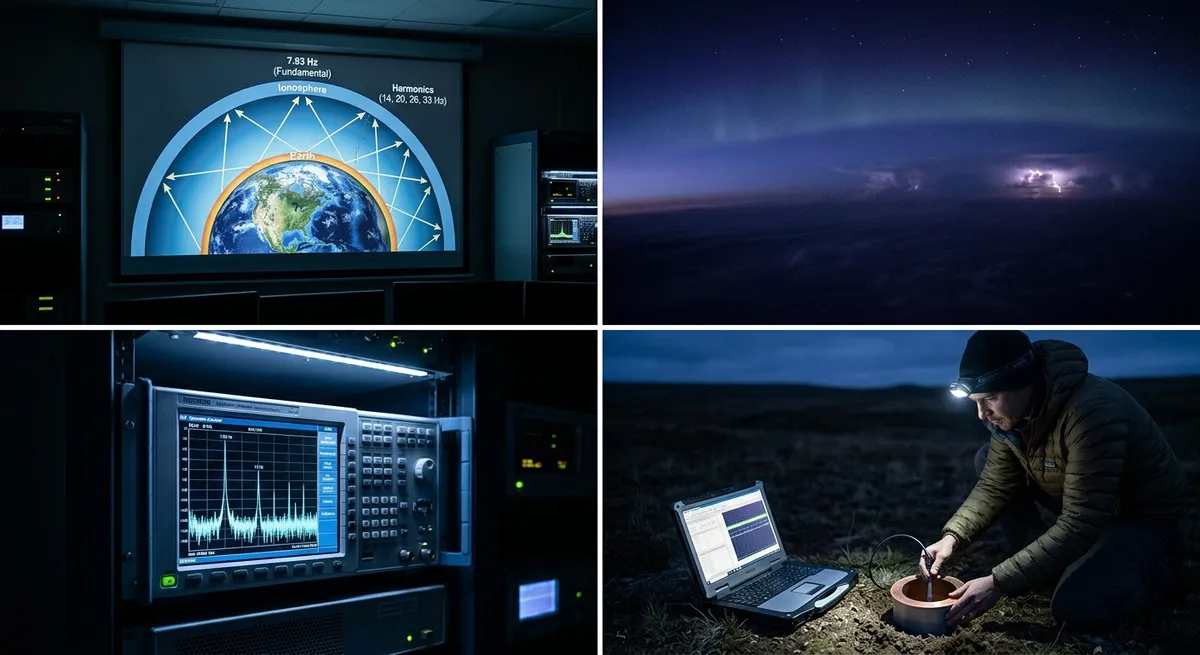
Beneath our feet and above our heads lies one of nature's most elegant electromagnetic structures: the Earth-ionosphere cavity. This invisible chamber, formed between the conductive surface of our planet and the ionosphere high above, functions as a natural resonator—a spherical shell that traps electromagnetic energy and sustains Earth's most famous natural frequency. To understand the Schumann Resonance, we must first understand the cavity that generates it.
The Earth-ionosphere cavity is fundamentally simple in concept yet profound in its implications. Earth's surface—composed of soil, rock, water, and metal deposits—conducts electricity reasonably well. Approximately 80 kilometers above us, the ionosphere begins: a layer of the atmosphere ionized by solar radiation, creating a partially conductive shell around the planet. Between these two conductive boundaries lies a region of lower conductivity: the troposphere and lower stratosphere. This arrangement creates the conditions for electromagnetic resonance.
Think of the cavity as a spherical waveguide. Electromagnetic waves generated within this space—primarily from lightning—bounce between the conducting surface below and the conducting ionosphere above. Rather than escaping into space, these waves are trapped and reflected, creating standing wave patterns. At specific frequencies determined by the cavity's dimensions and electrical properties, these reflections reinforce each other, producing resonance. This is the mechanism behind the Schumann Resonance.
The Geometry of a Planetary Resonator
The dimensions of the Earth-ionosphere cavity are staggering in scale yet elegantly simple. Earth's radius is approximately 6,371 kilometers. The ionosphere's lower boundary—where conductivity becomes significant—sits roughly 50 to 100 kilometers above the surface, though this varies with solar activity, time of day, and latitude. For practical purposes, the cavity extends from sea level to approximately 80 kilometers altitude, creating a spherical shell with a thickness of roughly 80 kilometers surrounding our entire planet.
This geometry determines the fundamental resonant frequencies of the cavity. The lowest resonant mode—the one most easily excited and most persistent—occurs at approximately 7.83 Hz. This is the Schumann Resonance, named after physicist Winfried Schumann, who predicted its existence mathematically in 1952. Higher harmonics exist at roughly 14.3 Hz, 20.8 Hz, 27.3 Hz, and beyond, but they are progressively weaker and less stable.
The calculation of these resonant frequencies relies on the cavity's circumference. Earth's circumference is approximately 40,000 kilometers. Electromagnetic waves traveling around this circumference at the speed of light would complete one full circuit in about 0.13 seconds. For a standing wave to form, the wave must fit perfectly around this circumference—meaning the wavelength must be an integer divisor of the circumference. This geometric constraint produces the characteristic frequencies we observe.
72-hour Schumann Resonance amplitude log. Readings are stable relative to the 7.83 Hz historical baseline. Data: Earth Frequency Index global sensor network.
Lightning: The Cavity's Primary Excitation Source
The Earth-ionosphere cavity would remain electromagnetically quiet without an energy source to excite it. That source is lightning. At any given moment, approximately 40 to 50 thunderstorms occur somewhere on Earth. Each lightning strike releases enormous electromagnetic energy across a broad spectrum of frequencies. While most of this energy dissipates locally, a portion couples into the Earth-ionosphere cavity and excites its resonant modes.
Lightning is remarkably efficient at generating Schumann Resonance frequencies. The electromagnetic pulse from a lightning strike contains energy at many frequencies, but the cavity acts as a filter, amplifying those frequencies that match its resonant modes. This is why the Schumann Resonance remains so stable despite the chaotic nature of thunderstorm activity. The cavity's resonant properties naturally select and reinforce the 7.83 Hz frequency and its harmonics.
Global thunderstorm activity follows predictable patterns. More storms occur over land than ocean, and more storms occur during afternoon and evening hours in each hemisphere. This asymmetry means the excitation of the Schumann Resonance is not uniform around the planet. However, because electromagnetic waves travel at light speed and the cavity is relatively small on a planetary electromagnetic scale, these local variations average out, producing the stable global baseline we observe.
Electrical Properties and Signal Propagation
The conductivity of the Earth-ionosphere cavity's boundaries is crucial to its resonant behavior. Earth's surface is a reasonably good conductor, particularly over oceans and in areas with mineral-rich soil. The ionosphere's conductivity varies with altitude and solar activity. During the day, solar ionization increases conductivity in the upper ionosphere. At night, the lower ionosphere becomes more important, and conductivity patterns shift. These variations cause subtle changes in the Schumann Resonance frequency, typically within ±0.5 Hz of the baseline 7.83 Hz.
Electromagnetic waves propagate through this cavity in multiple modes. The dominant mode is the transverse magnetic mode, where the magnetic field is perpendicular to the direction of propagation. These waves travel along the Earth's surface and reflect from the ionosphere, creating the standing wave patterns that constitute resonance. The quality factor of the cavity—a measure of how well it sustains oscillations—determines how long these waves persist before damping out. The Earth-ionosphere cavity has a relatively high quality factor, meaning the Schumann Resonance can be detected globally and remains coherent over time.
Modern Measurement and Monitoring
Today, the Earth-ionosphere cavity is monitored by a global network of magnetometer stations. These instruments detect the magnetic field component of electromagnetic waves within the cavity, allowing researchers to track the Schumann Resonance in real time. Measurements confirm that the fundamental frequency remains remarkably stable at 7.83 Hz, with natural variations driven by solar activity, seasonal changes, and thunderstorm distribution.
The cavity itself is not static. Solar wind pressure, geomagnetic activity, and seasonal variations in ionospheric conductivity all influence its electromagnetic properties. These changes are subtle—the Schumann Resonance frequency typically fluctuates by less than 1 Hz—but they are measurable and scientifically significant. Understanding these variations provides insights into the coupling between solar activity and Earth's electromagnetic environment.
Conclusion
The Earth-ionosphere cavity represents one of nature's most fundamental electromagnetic structures. By trapping and resonating electromagnetic energy between two conductive boundaries, it creates a planetary-scale resonator that has likely influenced life on Earth for billions of years. The Schumann Resonance, generated and sustained by this cavity and excited by global lightning activity, stands as a testament to the elegant physics underlying our planet's electromagnetic environment. As we continue to monitor and study this cavity, we deepen our understanding of Earth's place within the broader electromagnetic cosmos.
Frequently Asked Questions
What is the Earth-ionosphere cavity
The Earth-ionosphere cavity is the electromagnetic space between Earth's conductive surface and the ionosphere above, forming a natural resonator that traps and amplifies electromagnetic waves. This spherical shell, roughly 80 kilometers thick, generates the Schumann Resonance through its resonant properties.
How does lightning excite the Schumann Resonance
Lightning strikes release electromagnetic energy across many frequencies, but the Earth-ionosphere cavity acts as a filter, amplifying frequencies that match its resonant modes, particularly 7.83 Hz. With approximately 40-50 thunderstorms occurring globally at any moment, continuous excitation maintains the Schumann Resonance.
Why is 7.83 Hz the Schumann Resonance frequency
The 7.83 Hz frequency is the fundamental resonant mode of the Earth-ionosphere cavity, determined by Earth's circumference and the speed of light. Electromagnetic waves fitting perfectly around this circumference create standing wave patterns that reinforce at this specific frequency.
Does the ionosphere height affect the Schumann Resonance
Yes, changes in ionosphere height and conductivity due to solar activity, time of day, and seasonal variations cause subtle shifts in the Schumann Resonance frequency, typically within ±0.5 Hz of the 7.83 Hz baseline. These variations are measurable and reflect the dynamic nature of Earth's electromagnetic environment.
How is the Schumann Resonance measured today
A global network of magnetometer stations continuously monitors the Schumann Resonance by detecting the magnetic field component of electromagnetic waves within the Earth-ionosphere cavity. These instruments provide real-time data on frequency stability and natural variations.