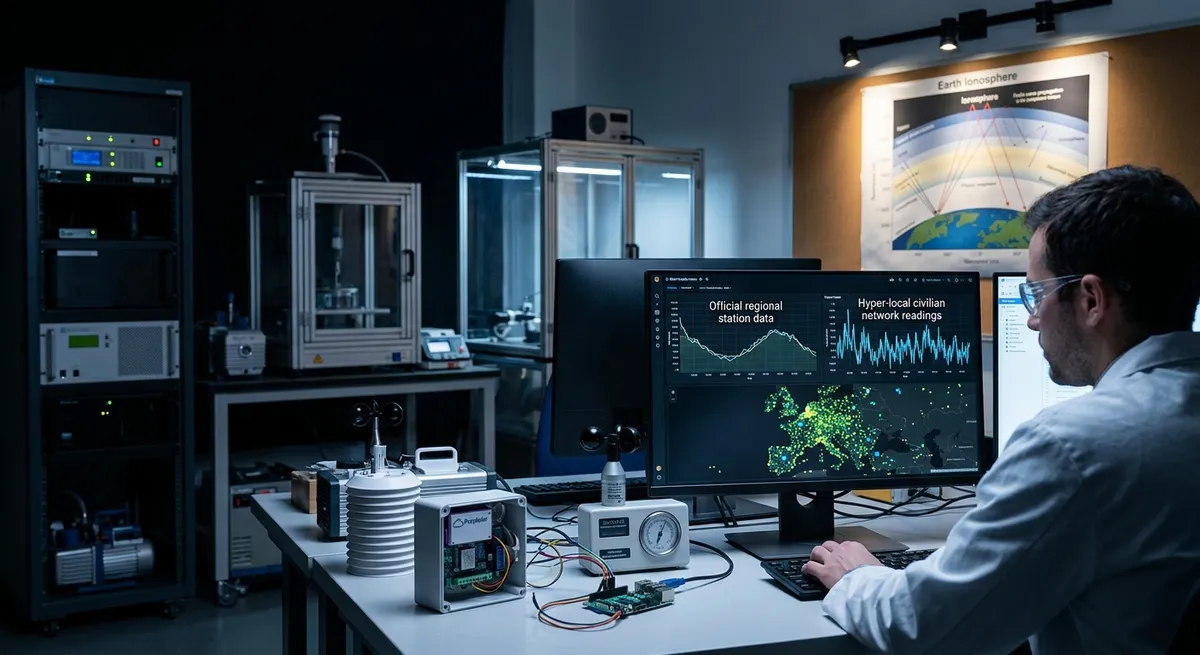
For decades, Schumann Resonance monitoring has been the domain of a small number of institutional players: government agencies, university labs, and specialized research facilities. Their data has been treated as authoritative. But over the past several years, something unexpected has happened: thousands of independent monitors—amateur scientists, wellness practitioners, and curious citizens—have begun collecting their own readings. And what they're documenting doesn't always match the official story.
This divergence isn't necessarily a sign that institutional data is wrong. Rather, it suggests something more nuanced: that centralized monitoring networks, however rigorous, may be capturing only a partial view of what's actually happening to Earth's electromagnetic field. Civilian networks, distributed across continents and operating with different equipment, different protocols, and different perspectives, are beginning to reveal a more complex picture.
The Institutional Baseline
Official Schumann Resonance monitoring has historically relied on a small number of high-quality sensors, primarily located at research stations and geophysical observatories. These instruments are calibrated to exacting standards and their data is peer-reviewed before publication. The baseline frequency—7.83 Hz—has been treated as relatively stable, with variations explained by known factors like solar activity, geomagnetic storms, and seasonal cycles.
This approach has clear advantages. Institutional data is credible, consistent, and scientifically defensible. It's the kind of data that gets cited in journals and shapes scientific consensus.
But it also has limitations. Institutional sensors are concentrated in certain geographic regions. They operate on fixed protocols that may not adapt quickly to anomalous conditions. And because the data is processed through multiple layers of institutional review, there can be a lag between what's actually happening and what gets officially reported.
The Civilian Network Emergence
Over the past five to seven years, civilian monitoring has grown from a fringe activity to a genuinely distributed scientific effort. Independent monitors have deployed affordable but surprisingly sensitive equipment across North America, Europe, Asia, and beyond. Some are using DIY Schumann coils; others have invested in semi-professional magnetometers. Most are sharing their raw data openly, often in real-time.
What's striking is not just the volume of data, but the patterns that emerge when you aggregate it. When dozens of independent observers in different locations report similar frequency shifts within the same 24-hour window, it suggests something real is happening—something that institutional networks, with their smaller number of sensors, might miss entirely or detect only after a delay.
In several documented cases over the past two years, civilian networks have reported anomalies—frequency spikes, harmonic shifts, sustained elevations—that did not appear in official institutional reports released during the same periods. These aren't minor discrepancies. Some readings showed frequency variations of 2-4 Hz above baseline, sustained for hours or days, with multiple independent observers confirming the pattern.
Complementary Rather Than Contradictory
The relationship between civilian and institutional monitoring need not be adversarial. In fact, the most productive interpretation frames them as complementary systems.
Institutional networks excel at precision, consistency, and long-term trend analysis. They provide the authoritative baseline against which everything else is measured. Civilian networks, by contrast, excel at sensitivity and coverage. They can detect localized or transient phenomena that centralized sensors might miss. They can respond quickly to anomalies and cross-reference observations in near-real-time.