The Global Electric Circuit: How Earth's Electromagnetic System Maintains the Schumann Resonance

The Global Electric Circuit: How Earth's Electromagnetic System Maintains the Schumann Resonance

TL;DR

The global electric circuit—a system of electrical currents flowing between Earth's surface and ionosphere—is the primary mechanism sustaining the Schumann Resonance at 7.83 Hz. Lightning and fair-weather currents continuously energize the Earth-ionosphere cavity, maintaining this natural electromagnetic frequency that has remained stable for millennia.

Understanding Earth's Natural Electromagnetic Engine

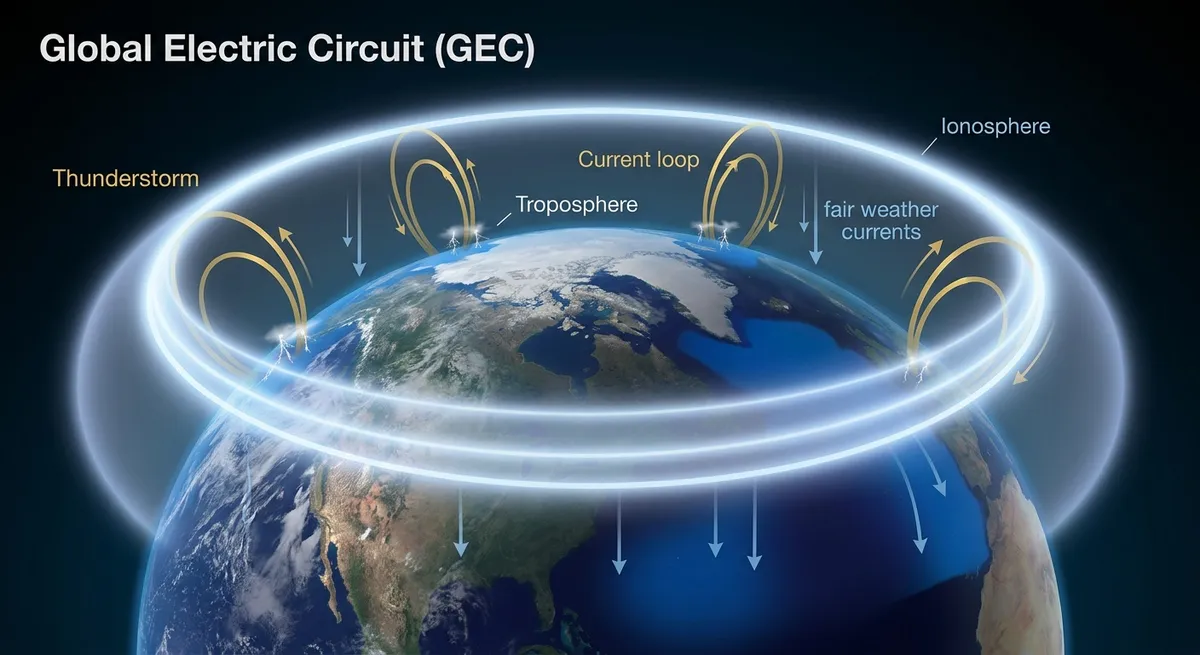
Beneath the visible atmosphere lies an invisible electrical system that has operated continuously for billions of years. The global electric circuit is Earth's natural electromagnetic engine—a dynamic network of electrical currents flowing between the planetary surface and the ionosphere, the charged upper atmosphere that begins roughly 50 kilometers above sea level. This circuit is not merely a passive feature of planetary physics; it is the fundamental driver of the Schumann Resonance, the 7.83 Hz electromagnetic frequency that resonates within the Earth-ionosphere cavity.

The relationship between the global electric circuit and the Schumann Resonance represents one of the most elegant demonstrations of planetary electromagnetics. While Winfried Schumann's 1952 mathematical prediction identified the resonant frequency of the Earth-ionosphere cavity, it was subsequent research that revealed how this frequency is continuously excited and maintained by electrical activity occurring across the entire planet. Understanding this connection requires examining both the mechanisms that generate electrical currents and the cavity that confines and amplifies them.

The Mechanics of the Global Electric Circuit

The global electric circuit operates through a continuous cycle of charge separation and current flow. At any given moment, approximately 1,800 to 2,000 thunderstorms are active worldwide, each generating powerful electrical discharges that inject current into the upper atmosphere. These lightning events represent the most dramatic manifestation of the global electric circuit, but they are only part of the story.

Beyond thunderstorms, fair-weather currents—steady, continuous electrical flows—occur across the entire planetary surface. These currents flow upward from the ground in fair-weather regions and downward through the ionosphere in regions beneath active storms. The net effect is a complete circuit: positive charge accumulates in the ionosphere while negative charge resides at Earth's surface, creating a potential difference of approximately 200,000 to 250,000 volts between the two layers.

This electrical potential is maintained by the continuous input of energy from lightning and other atmospheric electrical phenomena. When lightning strikes, it transfers charge rapidly between the surface and ionosphere, temporarily disrupting the equilibrium. Fair-weather currents then restore this balance, creating a steady-state system in dynamic equilibrium. The result is a planetary electrical system that operates with remarkable consistency and predictability.

Excitation of the Schumann Resonance

The global electric circuit excites the Schumann Resonance through the electromagnetic waves generated by lightning. When lightning discharges occur, they radiate electromagnetic energy across a broad spectrum of frequencies. However, the Earth-ionosphere cavity acts as a resonator—certain frequencies are amplified and sustained while others dissipate. The 7.83 Hz frequency, along with its harmonics at approximately 14.3 Hz, 20.8 Hz, 27.3 Hz, and higher multiples, are preferentially amplified due to the geometric and electromagnetic properties of the cavity.

The ionosphere, composed of ionized gases created by solar ultraviolet radiation, forms the upper boundary of this cavity. The conductive surface of Earth forms the lower boundary. Together, these layers create a spherical cavity approximately 100 kilometers in height, with a radius of approximately 6,371 kilometers. The dimensions of this cavity determine the resonant frequencies that can be sustained within it, much as the dimensions of a musical instrument determine the frequencies it can produce.

Research has demonstrated that the Schumann Resonance frequency remains remarkably stable across decades and centuries of observation. This stability reflects the constancy of the global electric circuit and the planetary dimensions that define the resonant cavity. Solar activity, seasonal variations, and diurnal cycles all influence the intensity and distribution of electrical activity worldwide, but these variations occur around a stable baseline maintained by the continuous operation of the global electric circuit.

The Ionosphere's Role in Frequency Stability

The ionosphere is not a static boundary but a dynamic, multilayered region that varies with solar activity, time of day, and season. Despite these variations, the Schumann Resonance frequency remains centered at 7.83 Hz. This consistency is maintained because the global electric circuit automatically adjusts to maintain equilibrium. When solar activity increases ionospheric conductivity, the circuit responds by modulating current flow. When conductivity decreases, the circuit compensates through increased fair-weather currents. This self-regulating behavior ensures that the fundamental resonant frequency of the Earth-ionosphere cavity remains stable.

The relationship between the global electric circuit and the ionosphere is reciprocal. The circuit depends on the ionosphere's electrical properties to function, while the ionosphere's properties are continuously shaped by the electrical activity of the circuit. This feedback system has evolved over geological timescales, creating an extraordinarily stable electromagnetic environment that has persisted throughout human history and beyond.

Monitoring and Measurement

Modern measurement stations worldwide continuously monitor the Schumann Resonance, tracking both its fundamental frequency and its harmonic components. These measurements reveal that the frequency remains centered at 7.83 Hz, with variations typically within 0.1 Hz of this baseline. The consistency of these measurements across globally distributed monitoring stations confirms that the global electric circuit successfully maintains the Schumann Resonance at its characteristic frequency.

Scientific instruments measure both the magnetic and electric field components of the resonance, providing a comprehensive picture of electromagnetic activity within the Earth-ionosphere cavity. This data has proven invaluable for understanding how the global electric circuit operates and how it responds to variations in solar activity and atmospheric conditions.

Conclusion

The global electric circuit and the Schumann Resonance are inseparable aspects of Earth's electromagnetic system. Lightning, fair-weather currents, and the geometry of the Earth-ionosphere cavity work together to create and maintain a stable 7.83 Hz electromagnetic frequency that has characterized our planet for millennia. This natural electromagnetic environment represents one of the most fundamental features of planetary physics, a system so reliable and consistent that it serves as a reference standard for electromagnetic research worldwide. Understanding this relationship deepens our appreciation for the elegant electromagnetic systems that govern planetary function and provides a foundation for continued scientific investigation into Earth's natural electromagnetic properties.

Frequently Asked Questions

What is the global electric circuit

The global electric circuit is a system of electrical currents flowing continuously between Earth's surface and the ionosphere, maintained by lightning and fair-weather currents that create a planetary potential difference of approximately 200,000 to 250,000 volts.

How does lightning maintain the Schumann Resonance

Lightning discharges inject electromagnetic energy into the Earth-ionosphere cavity, exciting the 7.83 Hz resonant frequency and its harmonics through the natural resonance properties of the spherical cavity formed between Earth's surface and the ionosphere.

Why does the Schumann Resonance stay at 7.83 Hz

The 7.83 Hz frequency is determined by the geometric dimensions of the Earth-ionosphere cavity and is continuously maintained by the self-regulating behavior of the global electric circuit, which automatically adjusts to preserve equilibrium.

What role does the ionosphere play in Earth's electromagnetic system

The ionosphere forms the upper boundary of the Earth-ionosphere cavity and, composed of ionized gases, provides the conductive layer necessary for the global electric circuit to function and for the Schumann Resonance to be sustained.

How many thunderstorms are active at any given moment

Approximately 1,800 to 2,000 thunderstorms are active worldwide at any given time, continuously injecting electrical current into the upper atmosphere as part of the global electric circuit.