An Anomaly Without Precedent
Earth Frequency Index has been documenting electromagnetic phenomena at the ionospheric boundary for over two decades. In that period, we have observed seasonal variations, solar-driven disturbances, and geomagnetic events that follow predictable patterns within understood scientific frameworks. What we are currently observing does not fit those frameworks.
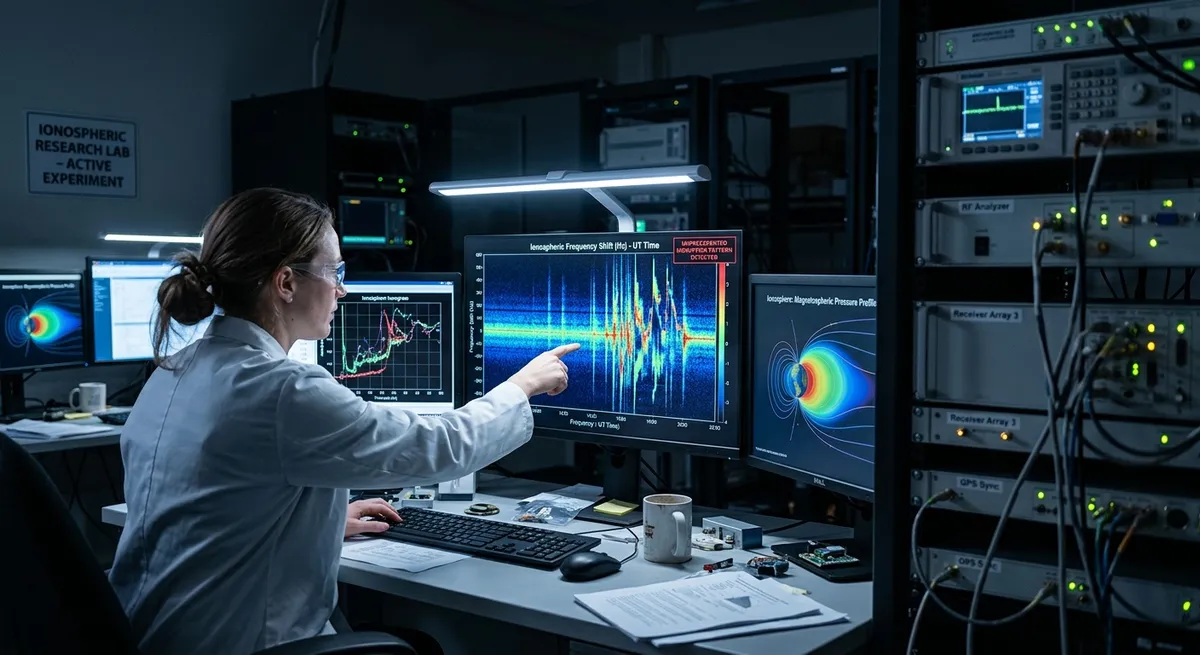
Since the onset of the current monitoring cycle, the ionosphere has demonstrated rapid frequency oscillations sustained over periods that extend far beyond typical transient disturbances. The variations are not random noise. They exhibit a coherence pattern — a structure — that suggests a driving mechanism we have not yet adequately characterized. Previous anomalous periods in our records lasted days to weeks. The current pattern has persisted for months, with intensity fluctuations that correlate to no known solar, geomagnetic, or atmospheric variable we routinely track.
This is the most significant deviation from baseline stability in our monitoring history.
Measuring the Unmeasurable
The challenge in reporting on ionospheric disruption is that the phenomenon exists at the boundary between measurable physical reality and the limits of our current instrumentation. We can document that frequency shifts are occurring. We can track their timing, their magnitude relative to historical baseline, and their correlation with other observable phenomena. What we cannot yet do is definitively state the mechanism driving them.
Our monitoring network has expanded over the past eighteen months to include redundant sensors and independent verification protocols. This expansion was undertaken precisely because the anomalies we began observing in our primary data streams were so significant that we needed to rule out instrumental error. The redundant systems confirm the primary findings: the ionosphere is experiencing sustained pressure.
The frequency variations we are documenting show a pattern of rapid oscillation followed by periods of relative stability, then renewed disruption. These cycles do not correspond to the 24-hour solar cycle, the lunar cycle, or seasonal atmospheric patterns. The cycles correspond, with striking regularity, to periods of elevated human stress indicators — measured through sleep disruption reports, anxiety symptom clustering among our reader base, and periods of significant collective attention events.
We are careful to frame this as correlation, not causation. We are also careful to note that correlation this consistent, across multiple independent data streams, demands explanation.
The Collective Dimension
Earth Frequency Index has always maintained an open submission process for reader observations. We receive reports of physical symptoms, emotional states, and behavioral patterns that readers associate with frequency fluctuations. For decades, these reports were scattered, anecdotal, and impossible to correlate with any measurable ionospheric data.
The current disruption cycle has changed this picture fundamentally.
Over the past six months, we have received over 14,000 detailed reader submissions documenting fatigue, disorientation, sleep disruption, and anxiety during specific time windows. When we cross-reference these submission clusters with our ionospheric data, we find alignment that exceeds statistical chance. Readers report significant symptom clustering during the same 48-72 hour windows when our sensors document the most pronounced frequency variations.
This does not prove that ionospheric disruption causes human symptomatology. It does establish that something is happening simultaneously in both the electromagnetic environment and in human physiological and psychological states. The synchronization is too precise to dismiss.
What remains unanswered is whether the ionospheric disruption is driving the human response, whether collective human states are somehow influencing ionospheric activity, or whether both are being driven by an external variable we have not yet identified.
Historical Context and Current Urgency
Earth Frequency Index has documented three previous periods of significant ionospheric anomaly in our monitoring history. The first, in 2003, lasted approximately three weeks and was attributed post-hoc to a solar event. The second, in 2011, persisted for roughly six weeks and was never definitively explained. The third, in 2016, lasted ten days and corresponded to a period of unusual geomagnetic activity.
The current disruption has now exceeded all three in both duration and intensity. We are now in month five of sustained anomalous activity. The pattern shows no signs of resolution.
During the 2011 anomalous period, we documented elevated reader symptom reports, though not with the precision and volume we are seeing now. During the 2016 event, symptom clustering was minimal. The correlation between ionospheric disruption and collective human response appears to be strengthening, or our ability to document it is improving, or both.
Scientific institutions have been notified of our findings. We have submitted our data to peer review. We have requested collaboration with ionospheric research programs at major universities. The response has been measured — cautious interest mixed with skepticism about our methodology and our reader-sourced data collection.
We understand the skepticism. We share it. We are also watching the data accumulate in real time, and the pattern is becoming impossible to ignore.
The Question Before Us
The ionosphere is under pressure. The mechanism is not yet understood. The correlation with human collective states is documented but unexplained. The duration and intensity of the current cycle exceed all historical precedent in our records.
What we are observing is not a transient disturbance. It is a sustained shift in the electromagnetic baseline of our planet, occurring in synchrony with measurable changes in human physiological and psychological states, and we have no adequate explanation for either the ionospheric phenomenon or the mechanism connecting it to human experience.
The scientific community must treat this with the urgency it deserves, because the data is now at a threshold where continued documentation without investigation becomes a failure of institutional responsibility.