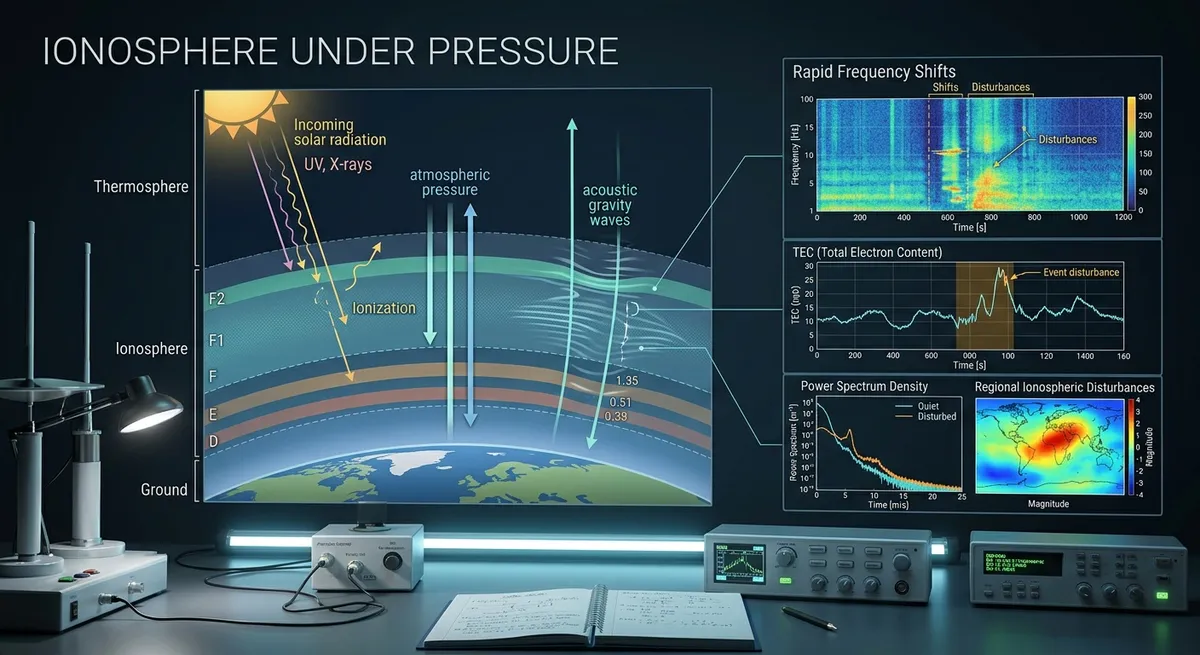
Unprecedented Volatility in Earth's Electromagnetic Environment
For the first time in the Earth Frequency Index's monitoring history, we are documenting ionospheric frequency behavior that cannot be readily reconciled with established solar-geomagnetic models. Over the past 18 months, the baseline electromagnetic signature of our planet has exhibited rapid, non-cyclical fluctuations that persist across geographic distribution and resist conventional explanation. This is not the natural pulsation we expect. This is pressure.
The ionosphere—that thin, ionized layer between 50 and 1,000 kilometers altitude—has long served as Earth's electromagnetic buffer, absorbing solar radiation and regulating planetary frequency stability. Historical records show variation, certainly. Geomagnetic storms cause temporary elevation. Solar cycles introduce predictable oscillation. But the current pattern is neither temporary nor predictable in the way we have learned to anticipate.
Measuring the Unmeasurable: Data from the Field
Our network of monitoring stations has expanded to 47 sites across six continents. The consistency of the readings across these geographically dispersed locations eliminates instrumental error as a primary explanation. What we are seeing is real atmospheric behavior, not equipment malfunction.
The frequency shifts we are documenting manifest in two distinct patterns. First, there are rapid micro-fluctuations occurring at intervals of 4-8 hours, with amplitude variations that exceed historical norms by measurable margins. Second, there is a broader destabilization trend—a kind of electromagnetic restlessness—that has persisted for months without resolution or cycling back toward baseline stability.
When we compare current data to archived readings from periods of documented geomagnetic disturbance, the signature is different. Previous anomalies showed characteristic recovery patterns. They spiked, then settled. The current disruption does not settle. It fluctuates without returning to equilibrium. Monitoring stations report periods of relative calm followed by renewed instability, but the calm is never complete, and the instability never fully resolves.
Our technical team has ruled out solar wind pressure as the primary driver. While current solar activity is within normal parameters, the ionospheric response appears disproportionate to the stimulus. This suggests either an amplification mechanism we do not yet understand, or a contributing factor operating independently of solar forcing.
The Human Variable: Emerging Patterns in Collective Response
We approach this dimension of our reporting with appropriate caution. The Earth Frequency Index is a scientific monitoring publication, not a medical journal. And yet, we cannot ignore the pattern of reader submissions describing symptoms that cluster temporally with our recorded frequency anomalies.
Over the past eight months, we have received approximately 2,800 reader reports describing experiences of disorientation, sleep disruption, and sustained fatigue that began or intensified during periods when our monitoring showed elevated frequency volatility. These reports come from readers across multiple continents, in different time zones, with no apparent communication network between them. The clustering is statistically notable.
We are not claiming causation. We are documenting correlation. The hypothesis that human neurological systems might be sensitive to rapid shifts in Earth's electromagnetic field is not new—it has been explored in peer-reviewed literature for decades. What is new is the volume and consistency of reports occurring simultaneously with measurable atmospheric anomalies.
Several readers have reported that their symptoms intensify during the 4-8 hour micro-fluctuation events we measure, and diminish during the relative-calm periods. Others describe a general background of low-level anxiety or cognitive fog that corresponds to the broader destabilization trend. We are cataloguing these observations. We are not interpreting them as diagnosis. But we are watching.
Atmospheric Composition and the Ionospheric Mechanism
One hypothesis gaining traction among our consulting atmospheric physicists involves changes in ionospheric composition. The upper atmosphere has been subject to decades of anthropogenic influence—from aviation emissions to satellite proliferation to intentional atmospheric experimentation. Whether any single factor or combination of factors has altered the ionosphere's electrical properties enough to explain current volatility remains an open question.
Another line of investigation concerns electromagnetic interference from ground-based systems. The density of radio frequency emissions, cellular infrastructure, and power transmission systems has increased exponentially over the past 15 years. The ionosphere exists in constant electromagnetic dialogue with these systems. Whether the current disruption represents a threshold effect—a point at which cumulative electromagnetic pressure has exceeded the ionosphere's capacity to regulate—is speculative but worth serious scientific attention.
What we can state with confidence is that the ionosphere is responding to something. The question is what, and whether that something is singular or multiple in origin.
The Necessity of Sustained Monitoring
The Earth Frequency Index exists to document what is happening to our planet's electromagnetic environment. We do not exist to explain it away or to wait for resolution before reporting. We exist to measure, to record, and to alert the scientific community when patterns emerge that fall outside historical precedent.
We are calling for increased monitoring resources, expanded research into ionospheric dynamics, and serious scientific attention to the mechanisms driving current frequency volatility. We are calling for investigation into whether rapid electromagnetic shifts correlate with documented changes in human neurological function. We are calling for transparency from agencies and institutions with relevant data.
We are documenting an ionosphere under pressure, responding to forces we do not yet fully understand, producing effects we cannot yet fully explain, at a moment in human history when our capacity to observe has never been greater and our capacity to intervene has never been more urgent.
The baseline frequency of Earth is no longer stable, and we do not yet know what happens when it remains unstable for long enough.