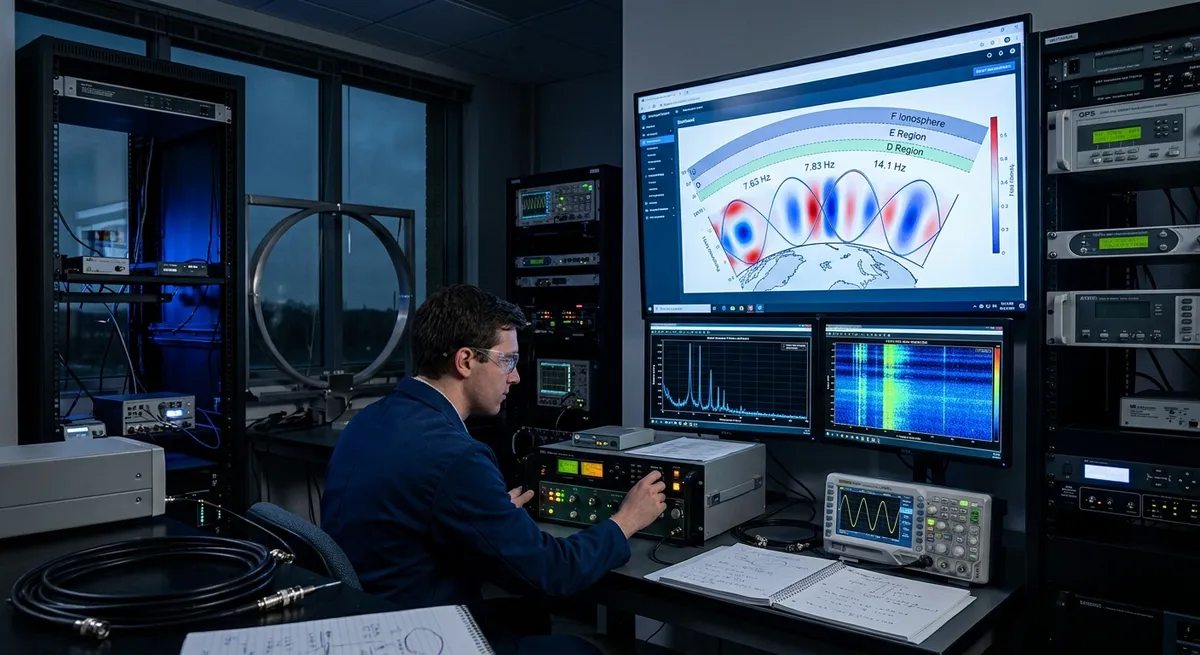
Beneath our feet and above our heads exists one of nature's most elegant electromagnetic systems: a spherical resonator formed by Earth's surface and the ionosphere. Within this cavity, electromagnetic waves reflect and reinforce each other, creating standing wave patterns at specific frequencies. The most prominent of these, the Schumann Resonance at approximately 7.83 Hz, has fascinated scientists and researchers since its theoretical prediction in 1952 by physicist Winfried Schumann. Understanding how this resonance forms requires exploring the fundamental physics of standing waves, cavity resonance, and the unique electromagnetic properties of the Earth-ionosphere system.
The Earth-Ionosphere Cavity: A Natural Resonator
A standing wave forms when two identical waves travel in opposite directions through the same medium, creating points of constructive and destructive interference. The Earth-ionosphere cavity functions as a spherical waveguide—a three-dimensional space bounded by two conductive surfaces: Earth's surface below and the ionosphere above.
Earth's surface is a reasonably good electrical conductor, particularly over oceans and moist ground. The ionosphere, located 48 to 96 kilometers above the surface, is a layer of ionized gas created by solar radiation and cosmic rays. This ionization makes the ionosphere an effective reflector of electromagnetic waves at extremely low frequencies (ELF), typically defined as frequencies below 3 kHz.
The distance between these two boundaries—approximately 80 kilometers on average—creates a cavity with specific geometric properties. Electromagnetic waves generated by natural sources, primarily lightning, bounce between Earth's surface and the ionosphere. When the circumference of Earth (roughly 40,000 kilometers) accommodates an integer number of wavelengths at a particular frequency, constructive interference occurs, and a standing wave mode emerges.
Resonant Modes and the Fundamental Frequency
The Schumann Resonance represents the fundamental resonant mode of this cavity—the lowest frequency at which standing waves can sustain themselves. This mode occurs when exactly one wavelength fits around Earth's circumference. Subsequent resonant modes, called harmonics, occur at integer multiples of this fundamental frequency.
The fundamental frequency depends on two primary factors: the circumference of Earth and the speed of electromagnetic wave propagation through the cavity. The speed of electromagnetic waves is influenced by the electrical properties of the medium—specifically the permittivity and permeability of the Earth-ionosphere cavity.
Using the relationship between frequency, wavelength, and wave speed, the fundamental resonant frequency can be approximated by dividing the speed of light (adjusted for the cavity medium) by Earth's circumference. This calculation yields a frequency close to 7.83 Hz, which matches empirical observations from monitoring stations worldwide.
The higher harmonics of the Schumann Resonance occur at approximately 14.3 Hz (second harmonic), 20.8 Hz (third harmonic), 27.3 Hz (fourth harmonic), and continuing upward. These harmonics are also detectable in measurements, though the fundamental mode typically exhibits the greatest amplitude and stability.
Excitation by Natural Sources
Standing waves require continuous energy input to maintain themselves against natural damping. In the Earth-ionosphere cavity, this energy comes primarily from lightning activity. Approximately 44 lightning strikes occur globally every second, according to satellite observations. Each lightning discharge releases electromagnetic energy across a broad spectrum of frequencies, including the ELF range where the Schumann Resonance modes exist.
When lightning strikes, it injects electromagnetic energy into the cavity. This energy excites the resonant modes, much as striking a tuning fork at its resonant frequency causes it to vibrate strongly. The global distribution of thunderstorm activity means that at any given moment, multiple lightning events are occurring around the planet, continuously feeding energy into the cavity at frequencies that match the resonant modes.
The ionosphere also responds to solar activity and geomagnetic variations, which can modulate the electrical properties of the cavity and thus influence the amplitude and frequency stability of the Schumann Resonance. Solar wind interactions with Earth's magnetosphere and changes in ionospheric ionization levels create dynamic conditions that researchers continue to study and characterize.
Measurement and Validation
Detecting the Schumann Resonance requires sensitive magnetometers capable of measuring extremely weak electromagnetic fields—typically in the range of 1 to 100 picoteslas (trillionths of a tesla). Monitoring stations positioned at geographically diverse locations have consistently measured the fundamental resonance near 7.83 Hz, with slight variations attributable to local geological conditions, time of day, and solar activity.
The global network of Schumann Resonance monitoring stations has provided decades of data confirming the theoretical predictions made by Schumann and his colleagues. These measurements validate the cavity resonance model and demonstrate that the Earth-ionosphere system functions as a stable, naturally occurring electromagnetic resonator.
Advances in instrumentation and data analysis have also revealed fine structure within the resonance—variations in amplitude and frequency that correlate with diurnal cycles, seasonal changes, and solar activity patterns. This temporal variability reflects the dynamic nature of global thunderstorm activity and the ionosphere's response to external forcing.
The Role of Cavity Geometry and Electrical Properties
The precise resonant frequency depends not only on Earth's circumference but also on the effective electrical properties of the cavity. The conductivity of Earth's surface varies geographically—seawater is highly conductive, while dry rock and soil are less so. Similarly, the ionosphere's reflectivity varies with altitude, latitude, and solar activity.
These variations create a complex electromagnetic environment that researchers continue to model and refine. Advanced computational electromagnetics now allows scientists to simulate wave propagation through realistic three-dimensional models of the Earth-ionosphere cavity, accounting for geographical variations in conductivity and ionospheric conditions.
Despite this complexity, the fundamental resonance at 7.83 Hz remains remarkably stable globally—a testament to the robustness of the cavity resonance mechanism and the averaging effects of continuous global lightning activity.
Conclusion
The Schumann Resonance emerges from fundamental electromagnetic physics operating at a planetary scale. Standing waves form within the spherical cavity bounded by Earth's surface and the ionosphere, with the fundamental mode occurring when one wavelength fits around Earth's circumference at approximately 7.83 Hz. Lightning activity worldwide continuously excites these resonant modes, maintaining stable oscillations that have persisted throughout human history and likely for billions of years. Understanding this system deepens our appreciation for the intricate electromagnetic environment in which all life on Earth exists and continues to motivate research into the interactions between our planet's electromagnetic properties and natural processes.