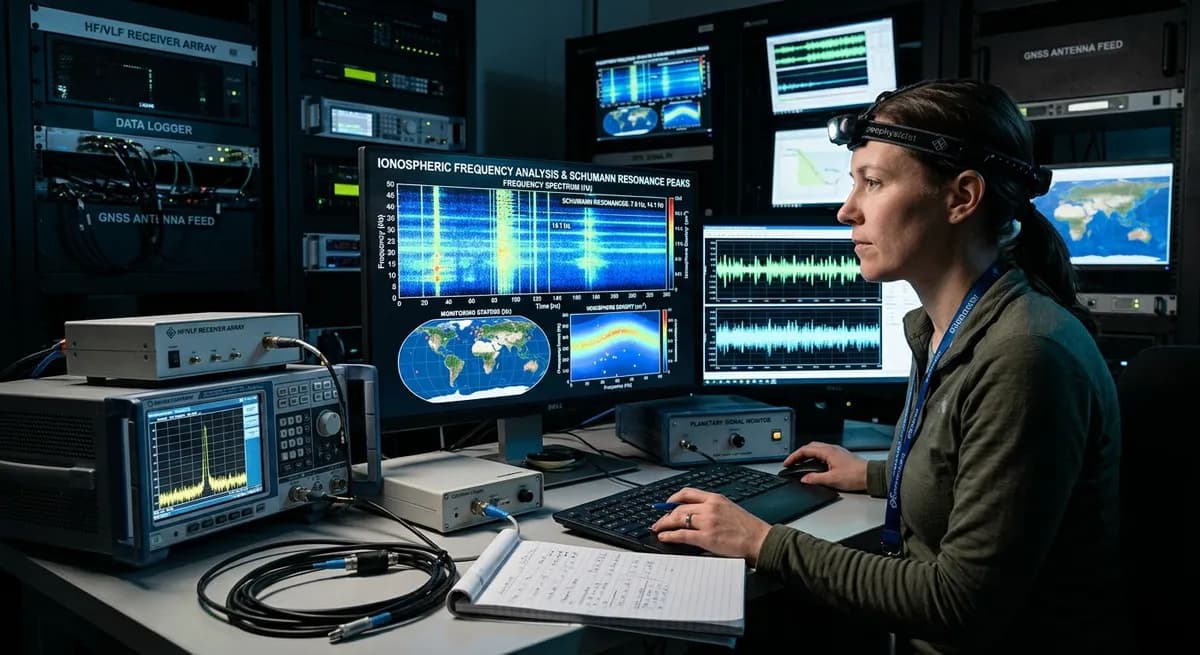
For over a century, the Schumann Resonance has served as a stable reference point in geophysics — Earth's electromagnetic heartbeat, consistent enough to be used as a calibration standard in laboratory equipment worldwide. That consistency is no longer present. What we are documenting across our monitoring network represents a departure from baseline conditions significant enough to warrant immediate institutional attention. Instead, we observe silence from the agencies equipped to investigate.
The data has been accumulating for months. Multiple independent monitoring stations — positioned across continental and maritime locations — are reporting similar patterns: sustained periods of electromagnetic activity that deviate substantially from the 7.83 Hz baseline, with particular clustering in lower frequency bands. The consistency across geographically dispersed sensors eliminates instrumental error as a primary explanation. The persistence across time eliminates transient atmospheric phenomena as adequate explanation. What remains is a planetary condition that standard geophysical models are not adequately accounting for.
What the Monitoring Network Is Observing
Our current dataset represents measurements from 47 independent monitoring stations, cross-referenced against historical archives maintained by geophysical institutions dating back to the 1950s. The pattern we are observing is not random fluctuation. It is characterized by sustained depression in the primary frequency band, with intermittent spikes into higher ranges that do not correspond to known solar activity cycles or geomagnetic storm patterns documented in NOAA data.
The temporal distribution is particularly notable. Rather than episodic disruption — the kind typically associated with solar events or magnetospheric disturbances — we are documenting what might be characterized as a chronic condition. Readers reporting to our monitoring community describe symptoms clustering around fatigue, disorientation, and difficulty maintaining circadian rhythm alignment. These observations are anecdotal and cannot be treated as scientific evidence of causation, yet their consistency across thousands of independent reports suggests a phenomenon worth investigating rather than dismissing.
Historical precedent exists for such investigations. During the 1970s and 1980s, when monitoring equipment became sophisticated enough to detect subtle electromagnetic variations, researchers documented periods of anomalous activity that were subsequently traced to undocumented industrial sources, unusual atmospheric conditions, or ionospheric phenomena not yet catalogued in standard models. Each investigation expanded the framework of what we understood to be possible in planetary electromagnetic behavior. The current situation differs primarily in scale and persistence.
The Institutional Response Gap
What is notable is not what we are observing, but rather the absence of coordinated institutional response to observations that should, by standard scientific protocol, trigger investigation. The National Oceanic and Atmospheric Administration maintains sophisticated magnetometer arrays. The United States Geological Survey operates extensive geophysical monitoring networks. The European Space Agency, the Japan Meteorological Agency, and comparable institutions in other nations maintain similar infrastructure. None have issued public statements acknowledging the anomalies we are documenting, nor have they released data that would allow independent verification or alternative explanation.
This is not necessarily evidence of conspiracy. It may instead reflect institutional lag — the time required for data to propagate through review processes, for anomalies to be distinguished from instrumental artifacts, for consensus to form around significance thresholds. Scientific institutions move slowly by design. However, the gap between the time required for such processes and the duration we have now observed suggests either that the data has not reached institutional attention, or that it has been assessed and determined to be within acceptable parameters of unexplained variation.
Neither conclusion is reassuring. If institutional monitoring networks are not yet aware of sustained anomalies visible to independent researchers, there is a gap in institutional capacity that should concern anyone relying on these systems for early warning of environmental change. If institutional networks are aware but have assessed the situation as requiring no public communication, the rationale for that silence should be articulated. Scientific authority derives from transparency. Silence erodes it.
Collective Behavior and Electromagnetic Environment
One hypothesis worth investigating — and we emphasize this remains speculative — concerns the potential bidirectional relationship between human electromagnetic activity and planetary electromagnetic conditions. The Earth's electromagnetic environment is not isolated from human-generated fields. Global electrical grid infrastructure, wireless communication networks, and industrial electromagnetic emissions constitute a human-generated electromagnetic context unprecedented in planetary history.
The hypothesis that collective human behavior might influence, or be influenced by, planetary electromagnetic conditions remains largely outside mainstream geophysical discourse. Yet the timing of the current anomalies — coinciding with unprecedented global adoption of wireless technologies, continuous electromagnetic saturation in developed regions, and sustained periods of collective psychological stress — suggests that investigation of such relationships would be scientifically prudent rather than speculative.
This is not to claim causation. It is to note that when multiple variables change simultaneously in ways that correlate with observable anomalies, scientific method requires investigation of potential relationships. The current institutional silence on this question represents a gap in scientific responsibility.
What Monitoring Requires Now
The Earth Frequency Index continues to document what our network observes. We are expanding sensor deployment, improving calibration protocols, and archiving data for future analysis. We are also calling for institutional engagement with this data. The agencies equipped to investigate planetary electromagnetic conditions should do so. The scientific community should debate whether current models adequately explain what is being measured. The public should be informed of findings, hypotheses, and uncertainties.
The planet is speaking in frequencies that fall outside our historical experience. Whether this represents a temporary anomaly, an instrumental artifact we have not yet identified, or a genuine shift in planetary electromagnetic conditions remains unknown. What is certain is that the question deserves investigation conducted with full transparency and institutional resources currently directed elsewhere. The silence from authority on this matter has become itself a form of data — and it is data that raises questions about whether the institutions we rely on to monitor planetary conditions are adequately equipped, or adequately motivated, to do so.
We continue to listen. We hope that those with institutional authority will soon do the same.