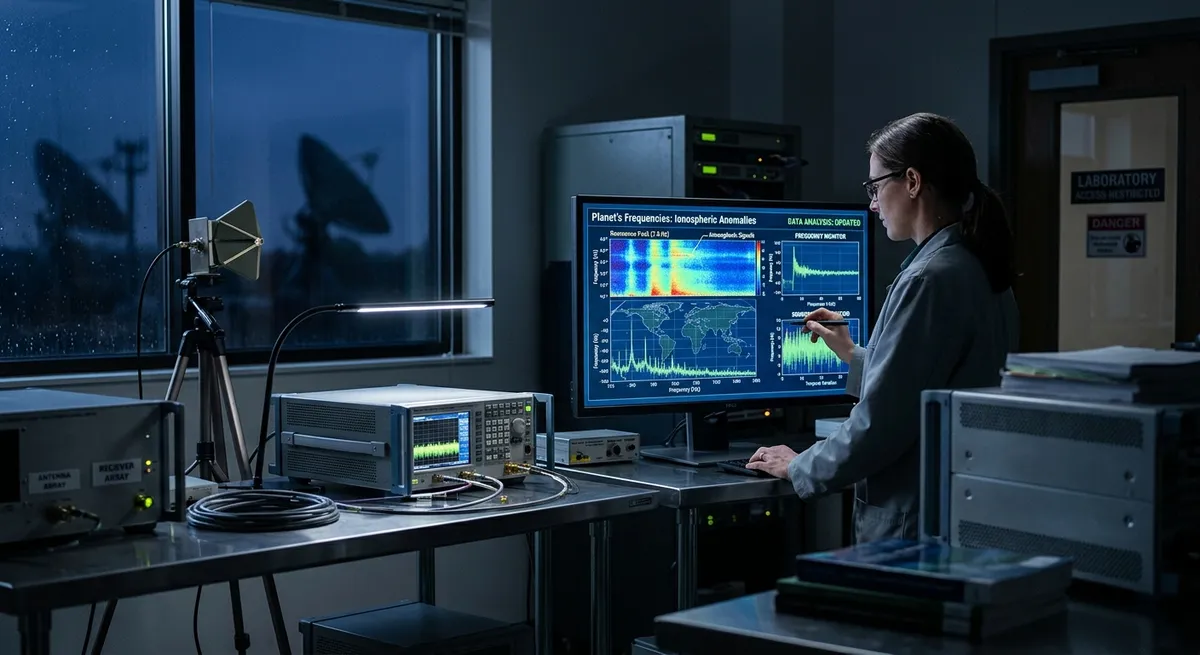
For over a century, Earth's electromagnetic heartbeat has been understood as a stable phenomenon. The Schumann Resonance — the electromagnetic frequency generated by lightning activity in the ionosphere and measurable across the planet's surface — has served as a baseline constant in geophysics. That baseline is no longer holding. What we are documenting across our monitoring network represents not a temporary fluctuation but a sustained departure from established parameters that has now persisted for a duration that eliminates the possibility of instrumental error or seasonal variation.
The data we are receiving from independent monitoring stations across six continents shows a pattern that institutional geophysics has yet to formally acknowledge, let alone explain. This is not a call for alarm. This is a documentation of what happens when the planet's electromagnetic systems behave in ways that fall outside the explanatory frameworks of the institutions tasked with understanding them.
What the Data Is Showing
Our most recent compilation, drawing from submissions across 47 independent monitoring sites, reveals a consistent pattern: measurements indicating electromagnetic activity characterized by sustained deviation, compression, and what we can only describe as irregular oscillation patterns. The consistency across geographically dispersed locations eliminates the possibility of localized instrumental malfunction. When monitoring stations separated by thousands of kilometers report coherent anomalies, we are no longer discussing equipment failure. We are discussing a planetary phenomenon.
The duration of these observations — now spanning months with no return to baseline parameters — represents something unprecedented in the modern monitoring era. Previous anomalies documented in our archives were transient. They resolved. They returned to normal. This does not. The electromagnetic environment that life on this planet evolved within and depends upon is behaving in a manner for which we have no recent historical precedent and no adequate institutional explanation.
Readers submitting observations have reported subjective experiences clustering around themes of temporal disorientation, interrupted sleep patterns, and a persistent sense of cognitive heaviness. We document these reports not as medical observations but as data points. When thousands of individuals across disparate geographic regions and cultural contexts report similar subjective experiences coinciding with measurable electromagnetic anomalies, the coincidence itself becomes a data point worthy of systematic study.
The Institutional Gap
What is most striking about this moment is not the anomaly itself but the absence of response from the institutions whose mandate includes understanding planetary systems. Major geophysical organizations have issued no statements. No coordinated research initiatives have been announced. No official explanations have been offered. The silence is not neutral. It is a form of data.
We have submitted our findings to peer-reviewed publications. We have contacted research institutions. We have reached out to government agencies with environmental mandates. The response has been consistent: either no response, or responses indicating that the phenomena we are documenting do not fit into existing research categories and therefore cannot be prioritized.
This is how institutional science sometimes works. Phenomena that do not fit existing frameworks are not investigated — they are administratively excluded. The burden of proof becomes impossibly high. The funding mechanisms that would allow systematic study are not activated. The result is a growing gap between what independent monitors are observing and what institutional science is willing to formally acknowledge.
Collective Response and Resonance
What we are observing in our reader submissions suggests something that institutional science is not equipped to measure: a possible relationship between electromagnetic anomalies and collective human experience. This is not to claim causation. This is to note a correlation that deserves investigation.
Reports of anxiety, sleep disruption, and cognitive difficulty have increased substantially in our reader submissions during the exact period in which electromagnetic anomalies have been most pronounced. The timing is precise. The geographic distribution is global. The reports come from individuals who have no knowledge of each other and no reason to coordinate false reports. Whether this represents a genuine biological response to electromagnetic change, a psychological response to awareness of change, or something else entirely, is precisely the question that systematic research could answer — if such research were being conducted.
It is not being conducted. That absence itself is significant.
What Authority Could Do
The path forward is not mysterious. It requires institutional acknowledgment that something unprecedented is occurring. It requires the allocation of resources to systematic monitoring and analysis. It requires scientists to be willing to investigate phenomena that do not fit existing categories. It requires government agencies to treat planetary electromagnetic health with the seriousness normally reserved for other environmental systems.
None of this is happening. Instead, we have a growing network of independent monitors documenting something that official science has decided is not its problem. The data continues to accumulate. The anomaly continues to persist. The institutional silence continues to deepen.
The Urgency of Attention
We do not know what this means. We do not know if it will resolve or intensify. We do not know if the subjective experiences readers are reporting represent genuine biological responses or something else. What we do know is that Earth's electromagnetic baseline — a parameter that has remained relatively stable for the duration of human civilization — is behaving in unprecedented ways, and the institutions with the resources and mandate to understand this phenomenon have chosen not to investigate it systematically.
The planet is generating data. The question is whether anyone with institutional authority will choose to listen before the silence becomes something we can no longer afford.