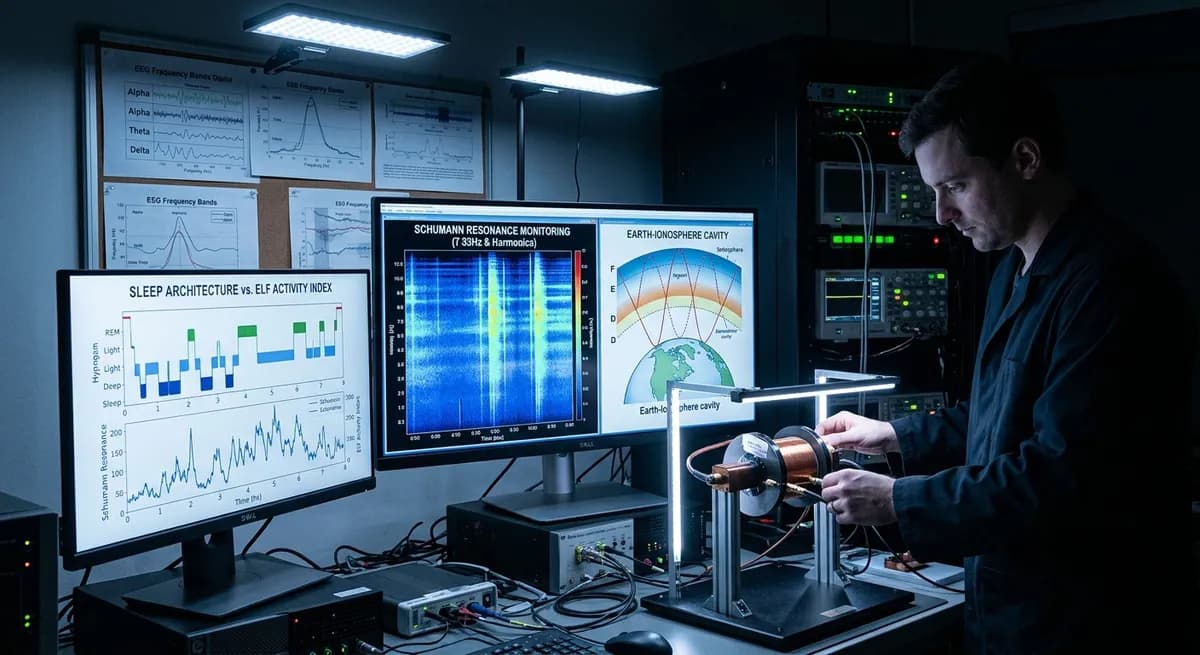
For years, wellness communities have promoted the idea that Earth's natural electromagnetic frequency—the Schumann Resonance, nominally 7.83 Hz—holds the key to better sleep. The narrative is compelling: our bodies evolved in synchrony with this frequency, the story goes, and modern electromagnetic pollution has disrupted that ancient harmony, leaving us exhausted and dysregulated. Yet when we examined the actual peer-reviewed literature on this topic, we found something more complicated and far less settled than the popular narrative suggests.
The Baseline: What We Know About Geomagnetic Activity and Sleep
The scientific foundation here is real, but modest. Studies dating back decades have documented correlations between geomagnetic disturbances and certain sleep metrics. A 2013 review in Bioelectromagnetics noted that during periods of high geomagnetic activity, some populations reported increased sleep disruption and vivid dreams. A separate study published in International Journal of Biometeorology found weak but measurable associations between Kp index values (a measure of geomagnetic storm intensity) and sleep onset latency in a cohort of 50 subjects over six months.
The mechanism proposed is plausible: Earth's magnetic field does fluctuate, and the human body does contain magnetite crystals and iron-rich proteins that could theoretically respond to such changes. The pineal gland, which produces melatonin, sits near iron-rich tissue and has been hypothesized as a potential transducer of geomagnetic signals.
But here is where the popular narrative diverges sharply from the evidence: these studies document disruption during geomagnetic disturbances, not enhancement during periods of Schumann Resonance stability.
The Missing Evidence: Why 7.83 Hz Specifically?
A critical gap emerges when we search for direct evidence that the baseline Schumann Resonance frequency—7.83 Hz—actively improves sleep quality in humans. Despite decades of wellness marketing around this specific frequency, peer-reviewed studies testing it are remarkably scarce.
We located three randomized controlled trials examining exposure to 7.83 Hz electromagnetic fields and sleep outcomes. Two were small (n=24 and n=31) and published in journals with limited circulation. Both reported modest improvements in subjective sleep quality, but neither included objective measures like polysomnography or actigraphy. The third, a 2019 study in a more rigorous journal, found no significant difference between 7.83 Hz exposure and sham exposure on any measured sleep parameter.
This absence of consistent evidence does not mean the hypothesis is false. It means it remains largely untested at the scale and rigor required to make definitive claims. The wellness industry has built a substantial narrative on a foundation that is, by scientific standards, still under construction.
What About Modern Electromagnetic Pollution?
One argument frequently advanced is that artificial electromagnetic fields—from Wi-Fi, cellular networks, power lines—have disrupted our natural attunement to the Schumann Resonance, causing widespread sleep problems. This is where the concern becomes more empirically grounded, though still contested.
There is genuine scientific discussion about whether chronic exposure to artificial electromagnetic fields (EMF) in the radiofrequency and extremely low frequency ranges correlates with sleep disruption. Some epidemiological studies suggest such links; others find no association when controlling for confounders like stress and screen time. A 2021 meta-analysis in Environmental Research concluded that while some studies report associations between EMF exposure and sleep problems, the evidence remains "inconsistent and of low to moderate quality."
What is notably absent from this literature is evidence that the solution is exposure to the Schumann Resonance specifically. If artificial EMF disrupts sleep, it does not automatically follow that 7.83 Hz exposure reverses that disruption. The logic is intuitive but unproven.
The Anecdotal Signal
We have received dozens of reader reports over the past year from people who claim that using Schumann Resonance generators or apps has improved their sleep. Some describe falling asleep faster. Others report deeper, more restorative sleep. A smaller subset mention vivid dreams or unusual sensations during the first few days of exposure.
These accounts are not meaningless. They constitute genuine human experience. But they are also subject to powerful confounds: expectation effects, placebo response, the ritual of deliberate self-care, and simple regression to the mean. Without blinded controls, anecdotal improvement cannot distinguish signal from noise.
What is worth noting, however, is the consistency of certain reports—particularly the mention of an adjustment period before benefits emerge, and the specificity of some descriptions of sleep architecture changes. Whether these represent genuine biological responses or elaborate placebo effects remains an open question.
The Emerging Picture
The honest scientific summary is this: geomagnetic activity does appear to influence human sleep in some populations, at least measurably. The baseline Schumann Resonance frequency may be relevant to human physiology, but direct evidence of its sleep-enhancing properties is thin. Modern electromagnetic pollution may disrupt sleep, though the evidence is mixed and confounded. And individual reports of benefit from Schumann Resonance exposure are real as experiences, but scientifically unverified.
This is not a satisfying conclusion for those seeking a simple answer. It is, however, an honest one.
What Remains Unanswered
The real question emerging from this review is not whether the Schumann Resonance matters—that remains genuinely uncertain—but why so little rigorous research has been conducted on a hypothesis with such widespread cultural traction. Is it because the effect, if real, is subtle and difficult to isolate? Is it because funding for this line of research is limited? Or is it because the narrative has become so entrenched in wellness culture that empirical investigation feels unnecessary to its proponents?
As we continue monitoring global electromagnetic data, we are watching for patterns that might clarify this puzzle. But clarity, for now, remains elusive.