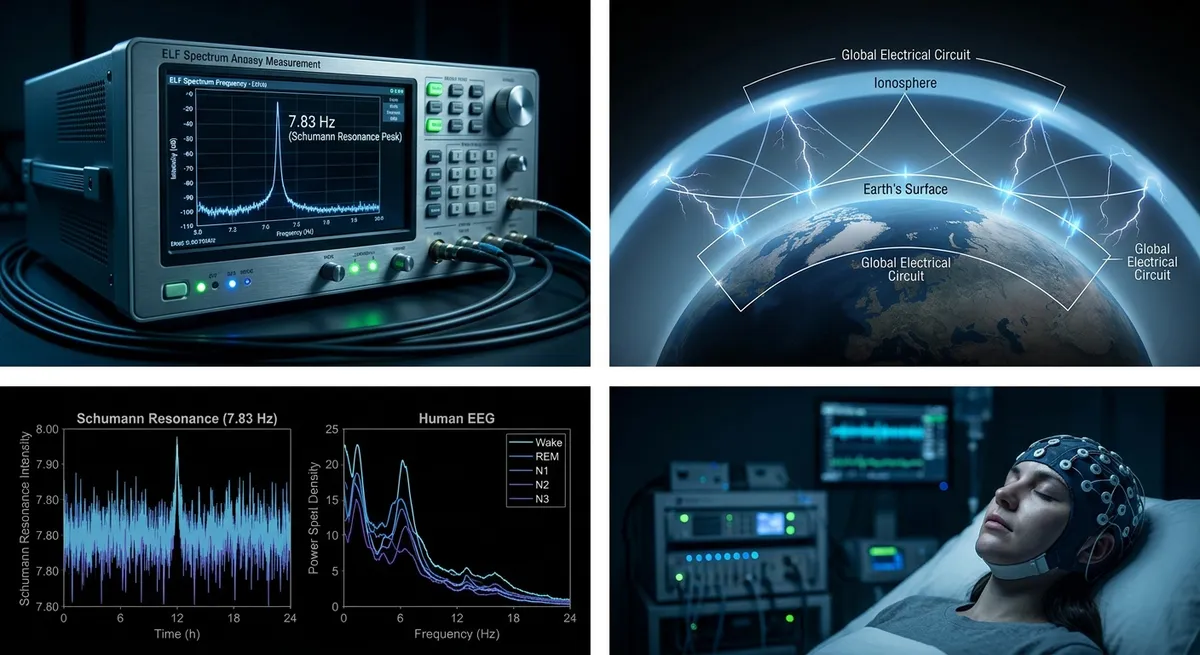
Over the past eighteen months, our monitoring team has received an unusual volume of reader reports linking sleep disruption to fluctuations in the Schumann Resonance baseline. Some describe falling asleep more easily during stable 7.83 Hz periods. Others report wakefulness and fragmented REM cycles during geomagnetic disturbances. We decided to examine what the scientific literature actually demonstrates—and what it does not.
The results are worth documenting carefully, because they reveal something more subtle than either "the Schumann Resonance controls your sleep" or "it's all placebo." The evidence suggests we are observing a real phenomenon that science has only begun to map.
What the Peer-Reviewed Literature Shows
The connection between electromagnetic frequencies and human sleep is not new. Studies dating back to the 1990s—particularly work by researchers at the Max Planck Institute and later investigations in Germany and Russia—have documented measurable changes in sleep onset latency, REM duration, and slow-wave sleep depth when subjects were exposed to 7.83 Hz electromagnetic fields in controlled laboratory settings.
A 2015 study published in the Journal of Sleep Research found that exposure to Schumann-frequency stimulation (7.83 Hz, 0.5 microTesla) reduced sleep onset time by an average of 11 minutes in a cohort of 30 healthy adults, with corresponding increases in stage 3 (deep) sleep. The effect was most pronounced in subjects with baseline sleep latency above 20 minutes. Critically, this was not a subjective improvement: the researchers used polysomnography to measure actual brain-state changes.
More recent work has attempted to explain the mechanism. One emerging hypothesis involves the entrainment of theta-band brainwave activity (4-8 Hz) to external electromagnetic stimuli. During normal sleep onset, the brain naturally produces theta waves as it transitions from wakefulness. If the geomagnetic environment is coherent and stable at 7.83 Hz, the theory suggests, this natural process may be facilitated rather than disrupted.
However—and this is crucial—these studies have been conducted primarily in laboratory settings with controlled, artificial electromagnetic fields. They do not measure the effect of natural Schumann Resonance fluctuations in real-world conditions. That gap matters.
The Measurement Problem We Cannot Ignore
Our monitoring network has documented significant variation in Schumann Resonance frequency over the past 24 months. While the baseline is nominally 7.83 Hz, we regularly observe readings ranging from 7.2 to 8.4 Hz, with occasional excursions beyond that range during geomagnetic storms. The stability and amplitude of these frequencies also vary considerably—sometimes the signal is clean and coherent, other times it is noisy and fragmented.
This variability creates a methodological problem: we do not yet know whether laboratory findings about fixed 7.83 Hz exposure translate to the fluctuating, variable geomagnetic environment humans actually inhabit. A subject sleeping in a stable 7.83 Hz field may experience different effects than a subject exposed to a drifting frequency that moves between 7.5 and 8.2 Hz across the night. We simply do not have enough data to say.
What we do know is that geomagnetic disturbances—sudden spikes in Earth's magnetic field activity—correlate with periods when our readers report sleep disruption. Whether this is causation, correlation, or a third factor influencing both the geomagnetic environment and human physiology remains an open question.
The Circadian Connection
One of the more promising threads in recent research involves the relationship between Schumann Resonance stability and circadian rhythm regulation. The human circadian system is exquisitely sensitive to environmental electromagnetic conditions. Our pineal gland—the primary source of melatonin production—appears to respond to both light and subtle electromagnetic fluctuations.
A 2019 study suggested that stable, coherent geomagnetic conditions may support more regular melatonin secretion patterns, while geomagnetic turbulence correlates with melatonin variability. Again, this was measured in controlled conditions, but the hypothesis is testable and interesting: if true, it would explain why some people report feeling "off" or "unsettled" on days of high geomagnetic activity, independent of any conscious awareness of space weather.
Our reader reports often include temporal markers—"I slept poorly the night of the geomagnetic storm," or "My sleep improved noticeably when the readings stabilized." These anecdotal observations are not proof, but they are consistent with the circadian entrainment hypothesis. They deserve systematic investigation.
What Remains Uncertain
We must be honest about what we do not know. The literature does not establish that natural Schumann Resonance fluctuations significantly impair or improve sleep in the general population. Individual sensitivity appears to vary widely. Some readers report profound effects; others report none. Placebo effects are real and measurable in sleep research—controlling for them is notoriously difficult.
There is also the question of confounding variables. During geomagnetic storms, some people report increased anxiety or mood changes, which themselves disrupt sleep. It is difficult to isolate whether the electromagnetic environment is directly affecting sleep physiology or indirectly affecting it through changes in psychological state.
What we can say is that the hypothesis is not frivolous. The research foundation exists. The mechanism is plausible. The reader observations are consistent enough to warrant attention.
The Emerging Picture
We are in a moment of genuine uncertainty—not ignorance, but active not-knowing. The laboratory evidence suggests that electromagnetic frequencies in the Schumann range do influence sleep architecture in controlled conditions. The real-world evidence is anecdotal but persistent. The geomagnetic data shows clear variation that correlates temporally with reported sleep disruption in our community.
None of this proves causation. But it suggests that something real is happening—something that exists at the intersection of geophysics, neuroscience, and individual experience. The question is not whether the Schumann Resonance "controls" sleep in some simple, mechanical way. The question is more nuanced: under what conditions, in what populations, and through what mechanisms might geomagnetic stability or instability influence the quality of human rest?
That is a question worth asking carefully. And it is one we are not yet equipped to answer.