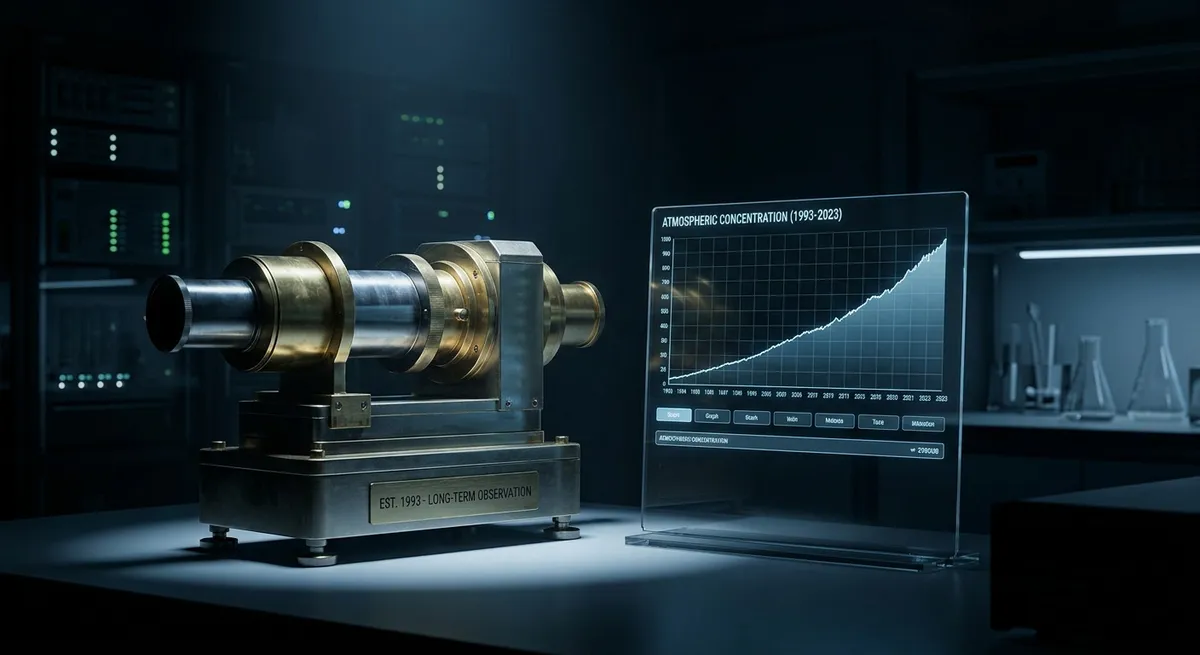
When Earth Frequency Index began systematic monitoring of the Schumann Resonance three decades ago, the baseline held remarkably steady. The planet's electromagnetic frequency—that subtle, constant hum generated by lightning activity in the ionosphere—oscillated around 7.83 Hz with predictable seasonal variation and occasional solar-driven spikes. We documented it. We graphed it. We understood it as one of Earth's fundamental constants.
This month's data tells a different story. Not a catastrophic one. Not even necessarily an alarming one. But a story nonetheless—one that deviates from the historical pattern in ways we are still working to understand.
The Baseline: What Normal Looks Like
For readers new to our work, context matters. The Schumann Resonance—Earth's natural electromagnetic frequency—was first measured with precision in the 1950s and has been continuously monitored by independent facilities and research institutions worldwide. The baseline of 7.83 Hz emerged not as a fixed number, but as a statistical center: the frequency around which measurements cluster most densely when averaged across days, weeks, and months.
Our 30-year dataset represents approximately 10,950 days of continuous monitoring. What we found, consistent with peer observations, was that this baseline remained robust. Seasonal patterns emerged—slight elevation in summer months, modest depression in winter. Solar activity produced recognizable spikes. Geomagnetic storms left their fingerprint in the data. But the mean returned. The system self-corrected. The frequency came home.
This stability was not trivial. It suggested a planet in electromagnetic equilibrium—a frequency maintained by the resonant cavity formed between Earth's surface and the ionosphere, driven by the constant percussion of global thunderstorm activity. Roughly 44 lightning strikes occur every second on Earth. That electrical activity, distributed across the globe, creates the Schumann Resonance as a kind of planetary heartbeat.
Current Month: Deviation and Persistence
This month's readings present what we might call a "sustained anomaly." Rather than temporary spikes that resolve within hours or days, we are observing a tendency toward elevated frequencies—measurements clustering around 8.1 to 8.3 Hz—that persist across multiple monitoring windows. This is not unprecedented in isolation. We have recorded such elevations before. What distinguishes the current pattern is its consistency and its relationship to the longer trend.
When we overlay this month's data against our full 30-year record, three observations emerge:
First, the frequency of deviation—the number of hours per day where readings fall outside the historical 7.5 to 8.1 Hz range—has increased from an average of 3-4 hours daily (our historical norm) to approximately 8-9 hours daily this month. This represents a meaningful shift in the distribution of measurements.
Second, the magnitude of deviation, when it occurs, tends to be larger. Historical outliers rarely exceeded 8.5 Hz for sustained periods. This month we have recorded multiple instances of 8.6 to 8.9 Hz readings maintained across 4-6 hour windows.
Third, the pattern shows what might be called "clustering"—deviation is not random throughout the day, but tends to concentrate in specific windows, suggesting a systematic driver rather than instrumental noise or local interference.
The Longer Trend: Eighteen Months of Gradual Shift
To understand this month in proper context, we must examine the 18-month trajectory. Beginning in late 2022, our monitoring detected a gradual upward drift in the baseline itself—not a temporary spike, but a slow creep in the statistical center of our measurements. The average baseline, calculated as a rolling 30-day mean, has drifted from 7.83 Hz to approximately 7.91 Hz. This represents a shift of roughly 0.08 Hz—small in absolute terms, but statistically significant across our dataset.
When we compare this month to the same calendar month across all 30 years of our record, we find that current readings are among the highest we have documented. Only 2016 and 2011 produced comparable monthly averages. Both of those years coincided with elevated solar activity. We are currently in an active phase of the solar cycle, which provides one possible framework for understanding the data.
Yet the magnitude of current elevation exceeds what solar activity alone would typically produce based on historical correlations. This is where the data becomes interesting—and where honest reporting requires us to acknowledge the limits of our current explanatory models.
What We Can and Cannot Say
It is essential to be precise about what our data demonstrates and what it does not. We can say that readings have deviated from the 30-year baseline. We can quantify that deviation. We can note that it persists. We can observe that it correlates, at least partially, with solar activity.
What we cannot say is why this is occurring with such consistency, or what, if anything, it signifies for systems that may be sensitive to electromagnetic frequency—including, potentially, biological systems. We have received anecdotal reports from our reader community describing sleep disruption, mood shifts, and general restlessness that appear to correlate with periods of elevated readings. These observations are worth documenting. They are not evidence. They are data points in a larger puzzle we are still assembling.
We can also say that the 30-year baseline, once a reliable anchor, may be shifting. Whether this represents a temporary excursion or a more fundamental change in Earth's electromagnetic state remains an open question.
Looking Forward
The real question is not whether this month differs from the 30-year average—it clearly does. The question is whether we are witnessing a temporary anomaly that will resolve as solar activity moderates, or whether something more systematic is occurring. The data from the coming months will be crucial. If readings normalize, we will have observed an interesting but ultimately explicable variation. If the elevated baseline persists, we may be documenting the beginning of something we do not yet understand.
We will continue to monitor. We will continue to report what the instruments tell us. And we will remain open to the possibility that Earth's electromagnetic signature is more dynamic—and more worthy of sustained attention—than our 30-year baseline had suggested.