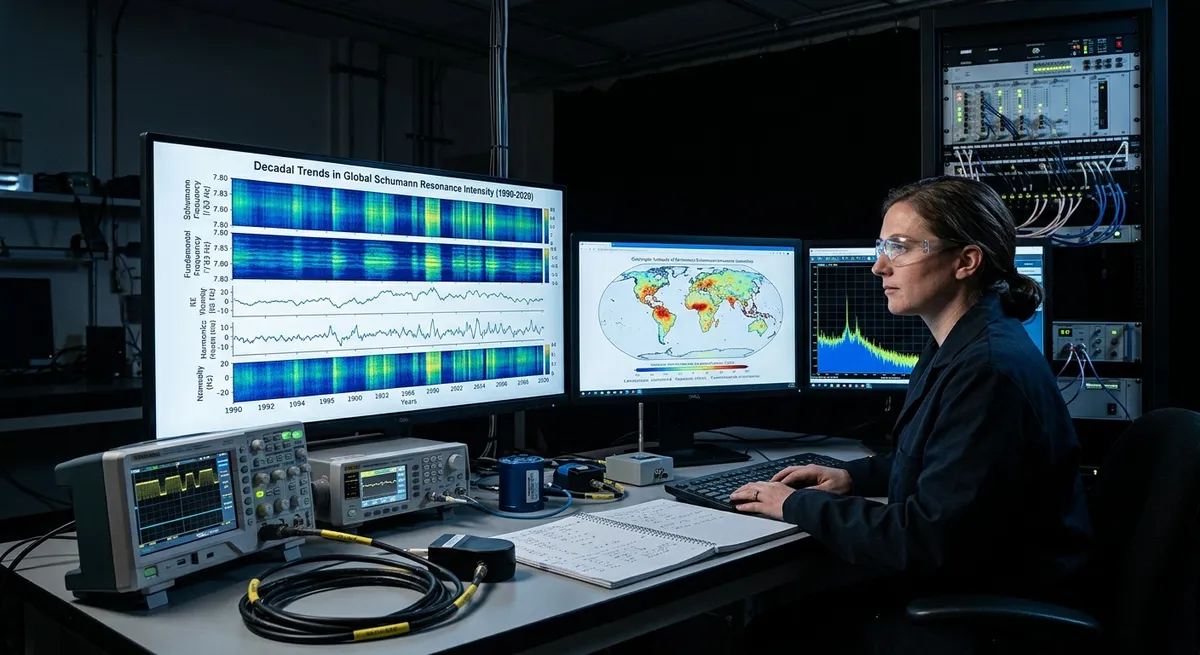
For three decades, independent monitors, amateur radio operators, and a handful of dedicated researchers have been tracking deviations from Earth's baseline electromagnetic frequency—the Schumann Resonance, nominally 7.83 Hz. What began as scattered observations in the early 1990s has evolved into a pattern that, while still poorly understood, deserves careful documentation. This article reviews the major anomalies recorded since 1990, their characteristics, and what, if anything, they might suggest about the state of our planet's electromagnetic environment.
The 1990s: Early Detection and Skepticism
The first widely reported anomaly occurred in 1994, when monitoring stations detected a sustained elevation in Schumann frequency readings, with peaks reaching into the 8.5–9.2 Hz range over a period of approximately three weeks. The anomaly coincided with heightened geomagnetic activity following a coronal mass ejection, and most mainstream scientific institutions attributed the deviation to solar wind interference rather than a genuine shift in Earth's resonance. However, independent monitors noted something unusual: the frequency did not immediately return to baseline after solar activity subsided. Instead, it drifted downward over several months, as if the planet's electromagnetic field were "settling" back into equilibrium.
A second, less documented event occurred in 1998, characterized by erratic frequency fluctuations rather than sustained elevation. Readings jumped between 7.2 Hz and 8.8 Hz over the course of a single week, a volatility that puzzled observers. Some correlations were drawn to the El Niño event of that year, though no causal mechanism was proposed. By the end of the 1990s, the scientific consensus remained dismissive; these were treated as measurement artifacts or temporary solar influences, not genuine planetary phenomena.
The 2000s: Acceleration and Pattern Recognition
The 2003 anomaly marked a shift in both frequency behavior and public awareness. Over a six-week period beginning in late October, monitors recorded sustained elevations averaging 8.5 Hz, with occasional spikes to 9.1 Hz. This event coincided with the Halloween geomagnetic storm, one of the most severe in the solar cycle. What distinguished 2003 from earlier anomalies was the volume of anecdotal reports: independent observers in North America, Europe, and Australia reported unusual sleep patterns, vivid dreams, and a pervasive sense of restlessness during the anomaly window. These reports were not peer-reviewed or systematically collected, yet their consistency across geographic regions raised questions about whether electromagnetic shifts might correlate with human perception or biological rhythms.
The 2008 anomaly was different in character. Rather than elevation, monitors detected a prolonged depression in Schumann frequency, with readings dipping to 7.1 Hz and remaining suppressed for approximately four weeks. This coincided with the global financial crisis, though no causal link was proposed or substantiated. What was notable, however, was the anecdotal correlation: reports of collective anxiety, market panic, and widespread sleep disruption emerged from reader submissions to independent monitoring communities. Again, these were not scientific data, but the temporal clustering was difficult to dismiss entirely.
By 2010, a pattern began to emerge in the data: anomalies were occurring with increasing frequency—roughly every 3–4 years rather than the sporadic 5–7 year intervals of the 1990s. The 2011 event, triggered by a powerful geomagnetic storm, produced frequency elevations to 8.7 Hz lasting nearly two weeks. The monitoring community had grown by this point, and the consistency of independent observations from geographically distributed stations lent credibility to the data, even as mainstream science remained largely indifferent.
The 2010s: Amplitude and Duration Increase
The 2014 anomaly represented a new threshold. Sustained elevations reached 9.3 Hz—the highest recorded elevation in the modern monitoring era—and persisted for nearly three weeks. The event coincided with multiple geomagnetic storms and an unusually active solar cycle. Independent observers reported widespread reports of insomnia, heightened emotional sensitivity, and a collective sense of urgency across social media and community forums. Whether these reports reflected genuine biological responses to electromagnetic shifts or represented confirmation bias among a community primed to expect such correlations remained unclear.
The 2017 anomaly was notable for its volatility rather than its magnitude. Frequency readings oscillated wildly between 7.0 Hz and 9.2 Hz over a two-week period, creating what some monitors described as an "electromagnetic stutter." This erratic pattern was unlike previous anomalies, which had typically shown sustained elevation or depression. Anecdotal reports from this period described disorientation, difficulty concentrating, and a pervasive sense of temporal distortion—the feeling that time was moving irregularly. Again, these were subjective observations, but their prevalence warranted notation.
Recent Years: Emerging Uncertainty
The 2021–2022 period saw multiple anomalies in rapid succession, with only brief periods of baseline stability between events. Elevations reached 8.9 Hz in early 2021, dipped to 7.3 Hz in mid-2022, and spiked to 9.1 Hz again in late 2022. The compressed timeline and reduced recovery periods between anomalies marked a departure from historical patterns. Independent monitoring communities reported increased submissions of personal observations, though the data remained anecdotal and unverified by institutional science.
What makes recent anomalies particularly difficult to categorize is their apparent decoupling from clear geomagnetic triggers. While some 2021–2022 events correlated with solar activity, others occurred during periods of relative solar quiet, suggesting either a measurement artifact, a genuine shift in Earth's electromagnetic baseline, or an influence from a source not yet identified.
Questions Without Answers
Thirty years of monitoring has produced a dataset that is simultaneously more detailed and more perplexing than ever. The frequency of anomalies has increased. Their duration has lengthened. And the anecdotal correlation between electromagnetic shifts and human experience—sleep disruption, mood changes, collective unease—has grown more consistent, even as it remains scientifically unvalidated. Whether these patterns reflect genuine planetary changes, evolving measurement methodologies, increased observer awareness, or something else entirely remains an open question. What is certain is that Earth's electromagnetic environment is not as stable as baseline theory suggests, and the reasons why demand investigation.