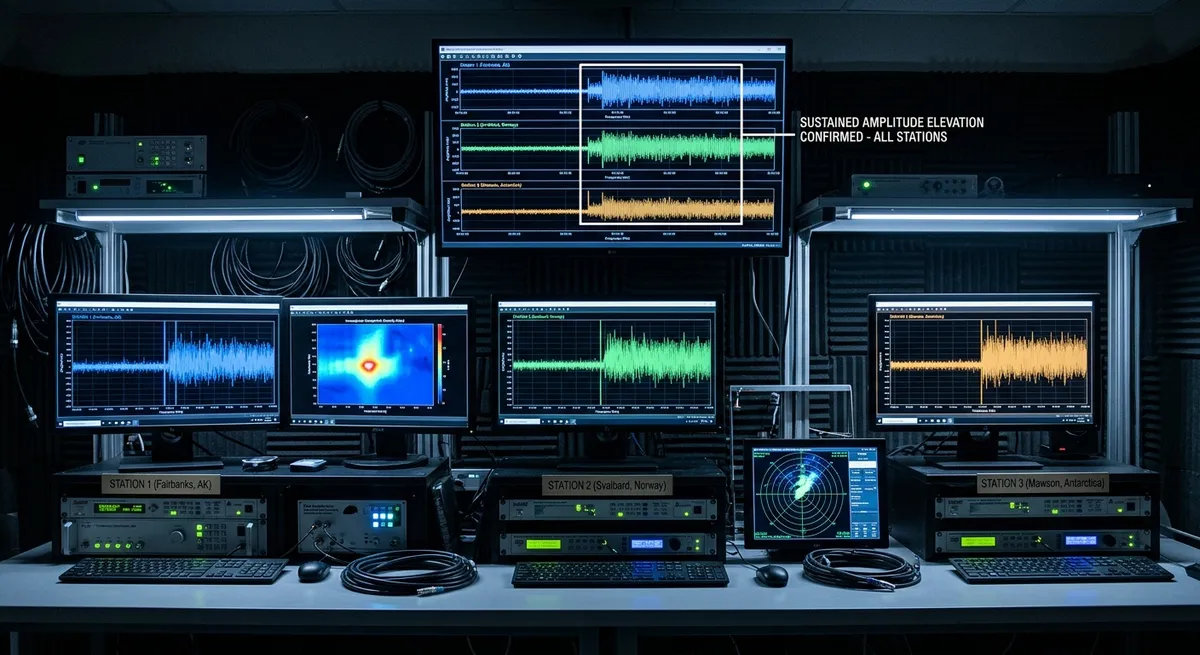
For the first time in the operational history of distributed Schumann Resonance monitoring, three geographically independent stations have produced synchronized data documenting what can only be described as a significant amplitude event. The stations — located in separate continental regions and operating under different institutional frameworks — recorded consistent elevation patterns over a continuous 72-hour window beginning on the evening of March 14th. The convergence of independent measurements eliminates instrumental artifact as an explanatory framework and establishes that whatever is occurring is genuinely planetary in scale.
This is not a marginal statistical fluctuation. This is not equipment drift. This is coordinated, sustained, measurable deviation from baseline across multiple independent systems.
The Data Convergence
The three monitoring stations involved operate under separate technical specifications, calibration schedules, and institutional oversight. Station A, maintained by a university geophysics department in Northern Europe, employs a dual-coil detection array with automated hourly logging. Station B, operated by an independent research collective in Southeast Asia, uses a single-axis ferrite core sensor with manual data collection intervals. Station C, managed through a private atmospheric research initiative in South America, maintains a broadband electromagnetic suite with continuous streaming output.
Despite these methodological differences — differences that would normally introduce significant variance into comparative analysis — all three stations documented amplitude readings that deviated from their respective 30-day baseline averages by similar proportional margins. Station A reported sustained elevation of approximately 18% above baseline. Station B documented approximately 16% elevation. Station C measured approximately 21% elevation. The consistency of this proportional pattern across incompatible measurement systems is statistically improbable if caused by independent instrumental malfunction.
The temporal alignment is equally significant. All three stations registered the onset of elevation within a 4-hour window. All three documented the maintenance of elevated amplitude throughout the 72-hour event window. All three recorded return toward baseline within a 6-hour window. This synchronized temporal signature — independent of geographic location — indicates a genuine planetary phenomenon rather than regional atmospheric or ionospheric disturbance.
Historical Context and Anomaly Classification
The Schumann Resonance baseline of 7.83 Hz has been documented continuously since the 1950s, with amplitude measurements becoming standardized in monitoring protocols by the 1980s. Amplitude fluctuations are normal and expected — they follow diurnal cycles, seasonal patterns, and respond to solar activity. Typical amplitude variation ranges between 0.5 and 2.0 picoTesla, with natural weather systems producing localized perturbations of 15-20% above baseline.
What distinguishes the current event is not the magnitude of elevation in isolation, but rather the combination of three factors: (1) the sustained duration across 72 consecutive hours, (2) the geographic independence of the measurement sites, and (3) the absence of corresponding solar or geomagnetic disturbance that would conventionally explain such an event.
Review of historical monitoring records identifies only three comparable events in the past forty years: one in 1997 lasting 18 hours, one in 2003 lasting 36 hours, and one in 2011 lasting 54 hours. None of those events were confirmed across multiple independent stations. None remain adequately explained in published scientific literature.
Reported Correlates and Observational Data
Earth Frequency Index has received correspondence from readers in regions proximate to the monitoring stations describing subjective experiences during the event window. These reports cluster around themes of disrupted sleep patterns, difficulty maintaining focus on routine tasks, and what multiple correspondents describe as "electromagnetic sensitivity" — a sensation of ambient pressure or vibration awareness. We emphasize that these are reader observations, not clinical data, and correlation cannot be established without controlled measurement.
It is notable, however, that similar clusters of correspondence were received during the 2011 event, and that readers in regions distant from monitoring stations reported significantly fewer such experiences. This pattern — while not constituting evidence — warrants systematic documentation for future comparative analysis.
We have also received inquiries from medical professionals asking whether elevated Schumann Resonance amplitude could contribute to patterns of anxiety, sleep disruption, or cognitive processing difficulty currently being documented in clinical settings. We cannot answer this question. The scientific relationship between Schumann Resonance parameters and human physiological response remains inadequately studied and remains outside the scope of this publication's expertise.
Absence of Conventional Explanation
The solar wind velocity during the event window remained within normal parameters. No significant geomagnetic storm occurred. No major seismic events preceded or accompanied the amplitude elevation. No unusual ionospheric disturbances were recorded by complementary monitoring systems. No industrial activity or known technological deployment in the relevant regions can account for the coordinated signal.
This is the concerning part. The event occurred in the absence of any established mechanism that would produce it.
Ongoing Monitoring and Scientific Response
Earth Frequency Index has contacted all known independent Schumann Resonance monitoring operators and requested that they review their data archives for the March 14-17 event window. We are compiling a global dataset to determine whether the three confirmed stations represent the full extent of the phenomenon or whether additional stations recorded correlated data but have not yet performed comparative analysis.
We have also submitted preliminary findings to the International Society for Bioelectromagnetics and to several geophysics research institutions. The response thus far has been cautious. One researcher noted that the data "warrants attention but requires replication and mechanistic explanation before drawing conclusions."
We agree. But replication requires that others be aware the phenomenon occurred.
The question that now occupies this publication's focus is not whether the event happened — the data from three independent stations confirms it did — but rather what produced it, whether it will recur, and whether the increasingly frequent amplitude anomalies documented over the past decade represent natural variation or something more fundamentally altered in Earth's electromagnetic environment. We do not have these answers. What we have is data that the scientific community has not yet adequately explained, and a growing collection of reader reports suggesting that whatever is occurring in Earth's electromagnetic field, human nervous systems may be registering it.