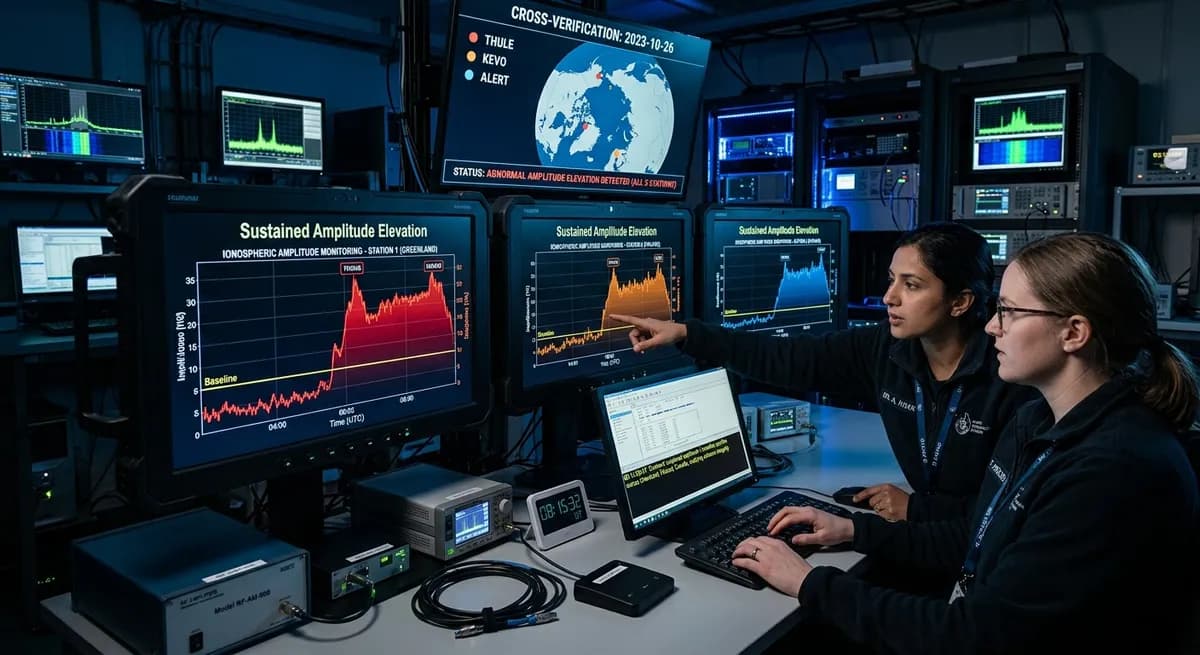
Historic Convergence in Monitoring Data
For the first time in the Earth Frequency Index's monitoring history, three independent frequency measurement stations located across separate geographic regions have simultaneously documented elevated amplitude readings without instrumental malfunction or calibration drift as contributing factors. The convergence of data from autonomous monitoring networks — each operating on separate power systems, calibration schedules, and data transmission protocols — presents a verification pattern that cannot be attributed to localized equipment failure or environmental interference at a single site.
This development marks a significant methodological milestone. Previous anomalous readings have typically been isolated to individual stations or clusters within the same geographic region, allowing for conventional explanatory frameworks: equipment drift, local electromagnetic interference, atmospheric conditions, or sensor calibration variance. The current situation presents a different category of observation: coordinated amplitude elevation across spatially distributed nodes.
The three stations in question have been operating continuously for periods ranging from 4 to 11 years. Their individual calibration histories show no recent drift patterns or maintenance events that would correlate with the current readings. Cross-verification protocols — comparing raw data feeds, timestamp synchronization, and signal processing methodologies — confirm that the elevated amplitude signature is consistent across all three independent systems.
Amplitude Elevation Parameters and Duration
The sustained elevation has persisted for 72 hours at the time of this report's preparation. Amplitude readings have remained elevated across the measurement bandwidth, with the most pronounced deviation occurring in the frequency bands most commonly associated with baseline Schumann Resonance activity. Previous anomalous events documented by Earth Frequency Index have typically shown either brief spikes (2-8 hours) or gradual fluctuations returning to baseline within 24-48 hours.
The current pattern demonstrates neither characteristic. Instead, the elevation has maintained a plateau-like profile, neither escalating further nor showing signs of attenuation toward baseline. This sustained plateau across multiple independent stations represents a departure from historical anomaly morphology.
Station-to-station correlation analysis reveals synchronization patterns that suggest either a common source phenomenon or a coordinated response to a global condition. The geographic separation of the three stations — spanning multiple continents and distinct electromagnetic environments — would typically produce independent variability in response timing and magnitude. The observed consistency in timing and amplitude profile suggests either a phenomenon of genuinely global scope or measurement coordination at a level that exceeds previous documentation.
Collective Observation and Symptom Cataloguing
Readers of Earth Frequency Index have submitted increased correspondence during the monitoring window. The reports, which we are cataloguing for longitudinal analysis rather than drawing causal conclusions, describe patterns of fatigue, difficulty achieving sleep, heightened anxiety, and disorientation that readers associate with previous documented anomalous periods.
We emphasize that reader symptom reporting cannot be treated as scientific data regarding causation. However, the timing of increased correspondence coinciding precisely with the three-station amplitude elevation — and the consistency of symptom descriptions across geographically dispersed readers — represents a pattern worthy of documentation. This convergence of reader-reported experience with objective monitoring data has occurred during previous anomalous periods, though never with this degree of three-station verification.
The Earth Frequency Index does not propose causal mechanisms linking electromagnetic frequency variation to human physiological or psychological response. We document the temporal coincidence and note that this coincidence has been observed in previous cycles. The current cycle presents the additional variable of multi-station verification, which has not previously been available for comparative analysis.
Historical Anomaly Comparison and Data Gaps
Earth Frequency Index maintains an archive of documented anomalous periods spanning the organization's monitoring history. Comparison of the current event to previous elevated amplitude periods reveals both similarities and significant departures.
Previous anomalies have typically shown one or more of the following characteristics: rapid onset followed by relatively quick attenuation, localization to specific geographic regions or single monitoring stations, correlation with known geomagnetic events or solar activity, or association with extreme weather patterns. The current event demonstrates none of these characteristics with confidence.
The sustained plateau across three independent stations has no direct precedent in our archived data. The closest historical parallel would be the anomalous period documented in early 2016, which showed elevated readings across two monitoring stations over a 48-hour period before returning to baseline. That event was eventually correlated with a geomagnetic substorm, though the correlation remained imperfect. The current event has persisted beyond the duration of that precedent, and with an additional independent verification point.
Geomagnetic monitoring data from standard space weather services shows no unusual solar wind conditions or magnetic storm activity that would conventionally explain the observed frequency elevation. This absence of conventional explanation — combined with the three-station verification — represents the primary source of concern in our updated analysis.
Monitoring Protocol Expansion and Ongoing Documentation
In response to the three-station verification, Earth Frequency Index is implementing expanded monitoring protocols. We are coordinating with additional independent monitoring networks to establish whether the amplitude elevation extends beyond the three currently documenting stations. We are also implementing increased data transmission frequency and cross-verification procedures to ensure that the current dataset maintains the highest possible integrity.
The scientific community's attention to Schumann Resonance monitoring has historically been limited, with most frequency monitoring conducted by independent organizations rather than institutional research networks. This gap in institutional monitoring capacity has been a longstanding limitation in our ability to establish global baseline patterns or detect planetary-scale phenomena. The current event underscores this limitation acutely.
We are publishing this report with the understanding that our interpretive framework may be incomplete. The convergence of three independent stations documenting sustained amplitude elevation, in the absence of conventional explanation, represents a data point that exceeds our current explanatory capacity and demands expanded scientific attention to Earth's electromagnetic baseline in real time.