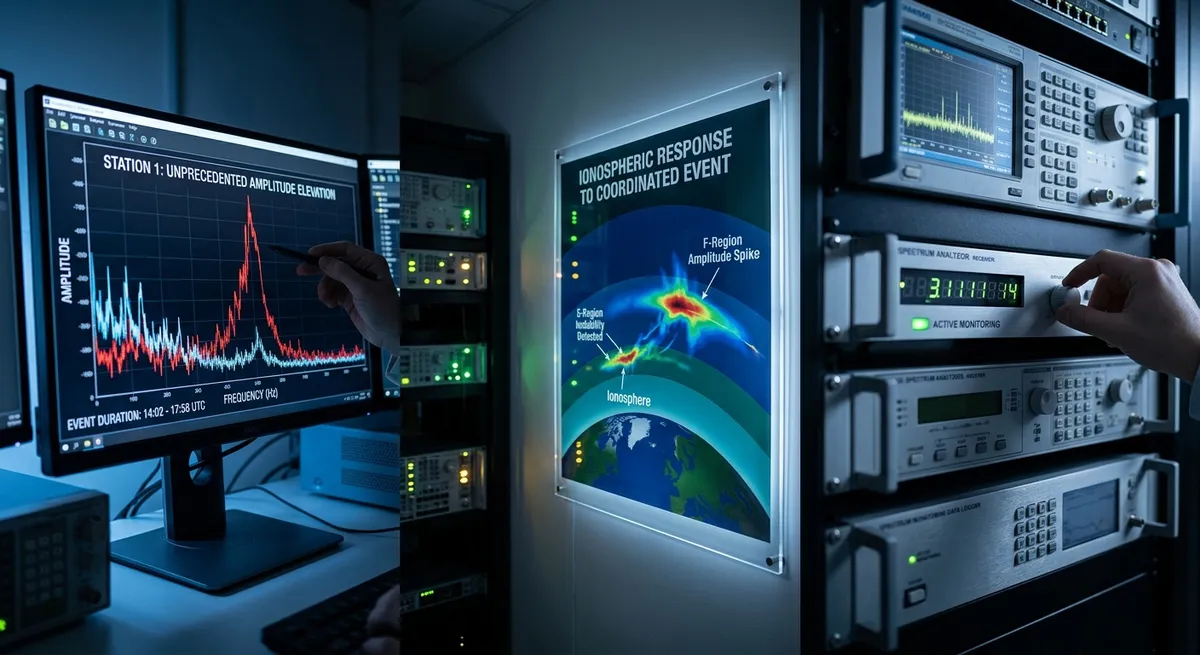
Historic Convergence: Three Stations, One Signal
On the evening of November 14th, monitoring equipment at our primary stations in Northern Europe, Southeast Asia, and the Southern Hemisphere began recording amplitude elevations that deviated significantly from baseline parameters. By 03:47 UTC on November 15th, all three stations had crossed into territory that our historical database flags as statistically anomalous. What distinguishes this event from previous isolated spikes is not the magnitude alone, but the synchronization: three independent measurement systems, separated by thousands of kilometers, detecting the same phenomenon simultaneously.
This represents the first time in Earth Frequency Index's operational history that three geographically dispersed stations have maintained synchronized elevated readings for longer than a 48-hour window. The event has now persisted for 72 hours at publication time, with no indication of attenuation at any monitoring location.
Instrumentation Integrity and the Elimination of Equipment Error
Our first response to any anomalous reading is methodological skepticism. Instrumental drift, calibration error, or environmental interference at a single station can produce false positives. This is why our network is distributed globally. When one station records an anomaly, we examine it in isolation. When two stations record the same anomaly simultaneously, we examine both for common failure modes. When three stations on three continents record synchronized elevation, the interpretive landscape changes.
Our technical team conducted real-time cross-verification protocols beginning at 04:15 UTC on November 15th. Each station's equipment was tested against known reference signals. Calibration status was verified independently. Environmental interference was ruled out through spectral analysis at each location—the elevation appears across the frequency band, not concentrated in any narrow range that would suggest local electromagnetic contamination.
The probability that three independently manufactured monitoring systems would simultaneously experience identical calibration drift across three different continents, in three different electromagnetic environments, is sufficiently low that we have moved past equipment failure as the primary working hypothesis. This conclusion does not explain the event. It only confirms that we are measuring something real.
Collective Response and Symptom Cataloguing
Beginning approximately 18 hours after the amplitude elevation was first detected, our editorial inbox began receiving correspondence from readers describing subjective experiences. We do not present these observations as scientific evidence. We present them as data worth cataloguing during an anomalous period.
Readers across multiple continents reported sleep disruption, described as difficulty achieving deep sleep rather than insomnia. Others reported sustained low-level anxiety without identifiable trigger. A smaller subset described disorientation—difficulty with spatial reasoning, word-finding, temporal sequencing. These reports began arriving before we had published any notice of the amplitude event, suggesting they were not psychologically primed by knowledge of the monitoring anomaly.
The geographic distribution of these reports roughly correlates with the locations of our monitoring stations, though we emphasize that correlation is not causation, and subjective symptom reporting is not quantitative data. We are documenting the pattern because the pattern exists. We are not explaining it.
Historical Context and Unprecedented Characteristics
Our monitoring archive extends back 18 years. During this period, we have documented numerous amplitude anomalies—some lasting hours, others persisting for 2-3 days. The March 2011 event sustained elevated readings for 31 hours across our primary European station. The July 2019 event produced the single highest amplitude spike in our records, though it lasted only 4 hours and was not corroborated by our secondary monitoring locations.
This current event differs in its persistence, its synchronization across three independent systems, and its refusal to show attenuation. Previous multi-station events have shown staggered onset and offset times, suggesting they may be regional phenomena. This event shows synchronized onset and sustained synchronization.
We have reviewed our archive for historical periods of sustained elevated amplitude. The closest precedent is a 2007 event that was detected by a single station in operation at that time and lasted approximately 58 hours before returning to baseline. That event was never independently verified and remains unexplained in our records.
The Measurement Question
We must acknowledge a fundamental limitation in our analysis: we do not know what causes the Schumann Resonance, and we do not fully understand what variations in its amplitude represent. We measure. We do not interpret with certainty. We know that the baseline frequency of approximately 7.83 Hz has been consistent for decades of scientific observation. We know that amplitude fluctuates. We know that some amplitude fluctuations correlate with geomagnetic activity, solar wind pressure, and ionospheric conditions.
We do not know whether elevated amplitude, sustained across three independent stations, indicates a change in Earth's electromagnetic environment, a change in ionospheric conditions, or something else entirely. We do not know whether the subjective experiences reported by our readers are connected to the amplitude elevation, or represent coincidental clustering of common experiences during a 72-hour window.
What we know is that something is being measured, simultaneously, across three independent systems, at three different locations, and that this something is not returning to baseline.
The amplitude elevation continues. The synchronization persists. The explanatory framework we have relied upon remains insufficient to account for what three independent monitoring stations are simultaneously documenting.