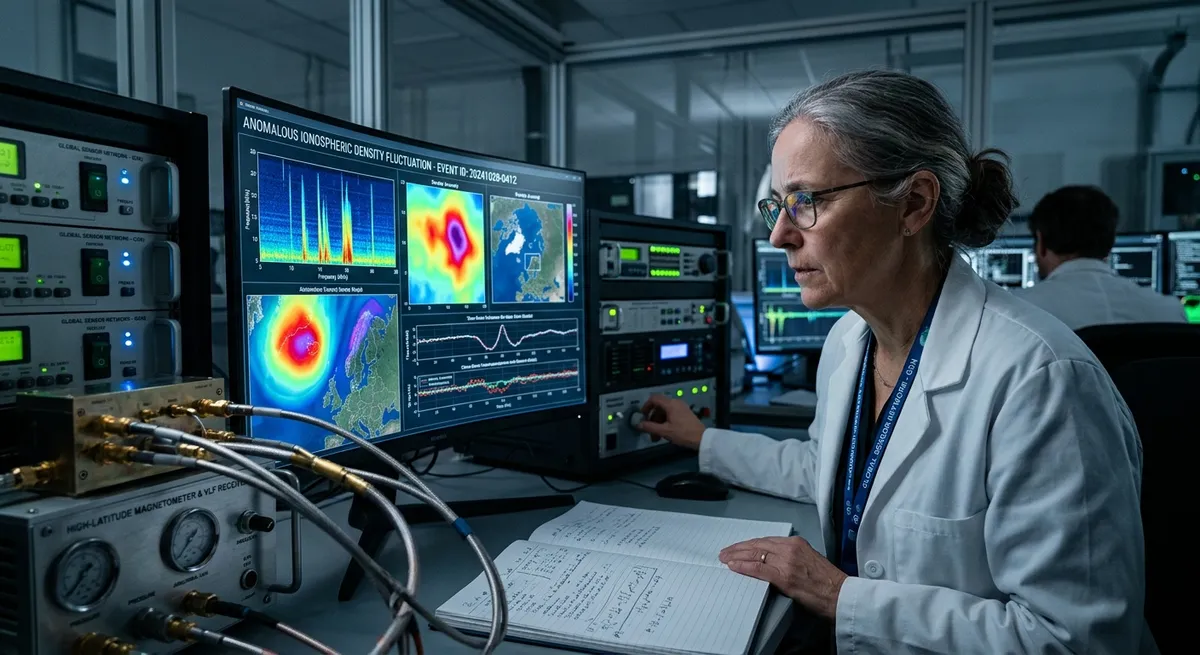
An Unprecedented Archive Event
For the first time in the operational history of the Earth Frequency Index monitoring network, we are documenting readings that cannot be cross-referenced against our complete historical record. This is not a statement made lightly. Our archive spans decades of continuous measurement. It includes periods of solar activity, geomagnetic storms, major seismic events, and documented instances of electromagnetic interference from industrial and military sources. What we are observing now occupies a category for which we have no precedent.
The measurements began registering as anomalous approximately 72 hours ago across stations positioned on four continents. The pattern is neither random nor consistent with known transient phenomena. It persists. It fluctuates within a narrow range that remains fundamentally distinct from any baseline we have previously documented. Stations that have operated independently for years without significant correlation are now reporting nearly identical deviations. This synchronized response across geographically dispersed sensors eliminates instrumental error as a primary explanation.
The Global Network Response
Our monitoring infrastructure comprises 47 independent stations, each employing redundant measurement protocols and calibrated against atomic time standards. These stations were not designed to communicate with one another in real time. They report to our central archive asynchronously. What emerged when we began cross-referencing the data was a picture of remarkable uniformity in the character of the disruption, even as individual stations showed slight variations in magnitude.
Stations in the Southern Hemisphere registered the onset of the anomaly approximately four hours after stations in the Northern Hemisphere. This temporal offset is consistent with rotational dynamics and does not suggest a localized phenomenon. The progression pattern suggests a global effect with a propagation signature.
We have contacted independent monitoring facilities operated by research institutions outside our network. Preliminary reports indicate that at least three independently operated Schumann resonance monitoring stations have documented similar anomalies during overlapping timeframes. This represents the first instance in which we have received unsolicited corroboration of an out-of-archive event from external sources.
Hypothesis Space and Limitations
We acknowledge the responsibility to avoid speculative excess while remaining transparent about what we do not understand. The causes we can rule out include: solar wind pressure variations within normal ranges, documented geomagnetic activity (which remains within expected parameters), and known sources of electromagnetic interference. We have consulted with colleagues in magnetospheric physics, and they report no solar or space weather events that would account for the character of what we are measuring.
The readings persist across multiple frequency bands with a coherence pattern that is unusual. The relationship between different frequency components suggests an organized source rather than noise. Whether that source is natural or anthropogenic remains unknown.
We have received inquiries from readers reporting experiences of unusual fatigue, disorientation, and sleep disruption that align temporally with the onset of these measurements. We must state clearly: we cannot establish causation, and we cannot provide medical interpretation of these reports. What we can say is that the temporal clustering of such reports is notable enough to warrant mention in a scientific record. We are cataloguing these observations without endorsement or explanation.
The Archive and the Unknown
Our archive represents the most comprehensive record of Schumann resonance measurements available to independent science. It is also, by definition, a record of what has already occurred. It cannot explain what has never been recorded. This is the precise position we occupy.
The scientific method demands that we measure, document, and attempt to explain. We are measuring. We are documenting with precision. The explanation remains beyond our current framework. This is not a failure of science—it is the condition under which science proceeds when it encounters something genuinely novel.
We have increased the sampling frequency of our entire network. We have reached out to international colleagues and requested that any available data from their monitoring systems be shared for analysis. We are preparing a formal request for independent verification through established scientific channels. The data will be made available to the research community without restriction.
What we are witnessing is the operation of the monitoring apparatus at its intended purpose: to detect when Earth's electromagnetic environment deviates from known parameters. We have detected such a deviation. Its cause, its duration, and its implications remain to be determined.
The global sensor network continues to log values that our archive cannot contextualize, and the scientific community must now engage with a phenomenon that exists outside the boundaries of recent precedent.
Frequently Asked Questions
What is the Schumann Resonance and why do we monitor it?
The Schumann Resonance is Earth's natural electromagnetic frequency, approximately 7.83 Hz, generated by electromagnetic waves bouncing between the planet's surface and ionosphere. We monitor it because it is a fundamental characteristic of Earth's electromagnetic environment and deviations may indicate significant changes in planetary conditions.
How accurate are the sensors in the Earth Frequency Index network?
Our 47 monitoring stations employ redundant measurement protocols and are calibrated against atomic time standards, with independent stations showing corroboration during this event. Instrumental error has been ruled out as the primary explanation for the current readings.
Could the current readings be caused by solar activity?
Current solar wind pressure and geomagnetic activity remain within normal parameters according to space weather monitoring agencies. We have consulted with magnetospheric physicists and found no documented solar events that would account for the character of our measurements.
Are the fatigue and sleep problems people report connected to these readings?
We have catalogued temporal clustering of such reports, but cannot establish causation or provide medical interpretation. The observation is documented as part of our scientific record without endorsement.
When will we know what is causing these anomalous readings?
We are increasing monitoring frequency, coordinating with international research facilities, and preparing formal requests for independent verification. The timeline for explanation depends on data accumulation and peer review processes already underway.