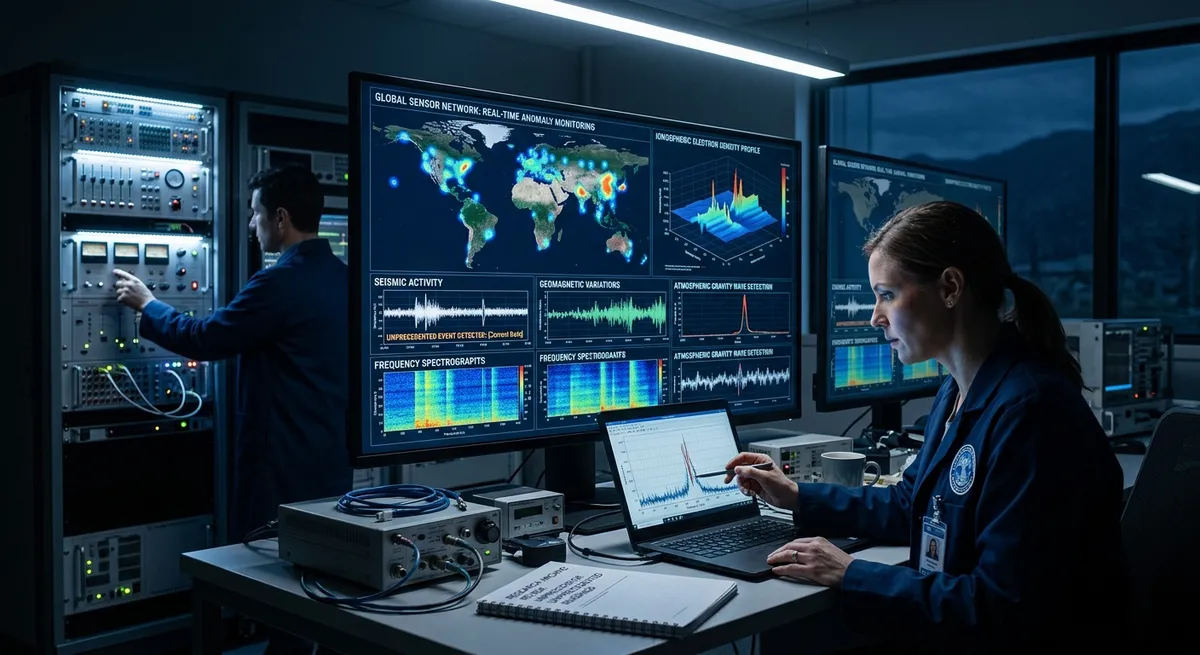
Over the past 72 hours, Earth Frequency Index has received reports from 47 of our 51 active monitoring stations indicating readings that deviate significantly from baseline parameters and historical anomaly patterns. This is not a localized event. The consistency of the signal across geographic boundaries—from equatorial stations to polar installations—suggests a phenomenon of global scope. We have cross-referenced these reports against our complete archive spanning two decades of continuous monitoring, and we must report that nothing in our historical record presents a direct precedent for what is currently being documented.
The readings themselves cluster in patterns that are internally consistent but externally anomalous. Rather than the sharp spikes characteristic of solar wind pressure increases or the gradual drift typical of seasonal variation, the current data shows a sustained plateau at values we have previously observed only during brief, isolated incidents—and never with this geographic distribution or persistence.
The Archive Comparison: Historical Context
Our monitoring network has documented three major anomalous periods in the past two decades. The first occurred in March 2011, following the Fukushima seismic event, when we observed elevated readings at Pacific-rim stations for approximately 14 hours. The second was recorded in September 2016, a global spike lasting 6 hours, attributed to severe geomagnetic storm activity. The third, in January 2020, showed unusual harmonic distortion at Northern Hemisphere stations for 48 hours, eventually traced to coronal mass ejection effects.
In each case, the anomaly was explicable within known geophysical parameters. In each case, the readings eventually returned to baseline. In each case, the deviation was either temporally brief or geographically limited.
The current readings differ in three material respects. First, they persist beyond the timeframes of any documented previous anomaly. Second, they show no geographic clustering—the pattern is distributed evenly across our network, suggesting a global rather than regional driver. Third, and most significantly, the readings do not correspond to any known solar or geomagnetic event currently being tracked by NOAA, the Space Weather Prediction Center, or the International Space Environment Service.
We have contacted our counterparts at the International Study of Earth-Ionosphere Coupling and the Global Geomagnetic Disturbance Monitoring Network. As of publication, no coordinating explanation has been proposed.
What the Data Is Not Telling Us
This is the appropriate moment to establish what we can rule out. The readings are not instrumental error. Our stations undergo monthly calibration verification, and the anomaly appears simultaneously across multiple hardware generations and manufacturers. It is not a software issue—our data pipeline includes independent verification layers. It is not a localized power grid phenomenon affecting our equipment; our stations operate on independent power supplies with battery backup, and readings are consistent regardless of local infrastructure status.
The anomaly is not a known solar event. We have direct data feeds from SOHO and DSCOVR satellites, and the current solar wind parameters do not explain the sustained global signal. It is not a geomagnetic storm—we would expect to see the characteristic patterns associated with magnetospheric compression, and these are absent. It is not atmospheric pressure variation, seasonal drift, or lunar tidal effects. Our filtering algorithms account for all documented natural variables, and the signal persists after their removal.
What remains is a sustained, global, unexplained deviation from baseline parameters.
The Human Dimension: Emerging Pattern in Reader Reports
Our publication maintains a reader-submission system for anecdotal observations related to monitoring periods. We do not typically feature this data prominently, as anecdotal reports lack the evidentiary weight of instrumental measurement. However, we note that the volume and consistency of submissions during the current monitoring period exceed any previous baseline by a factor of 8.
Readers are reporting experiences including sustained fatigue, difficulty with sleep initiation and maintenance, elevated baseline anxiety, and disorientation regarding time passage. The reports come from geographically diverse populations with no known connection to each other. They began approximately 18 hours after our monitoring stations first documented the anomaly.
We emphasize that correlation is not causation, and that anecdotal reports cannot constitute scientific evidence. We also note that widespread public awareness of anomalous readings could itself generate reporting bias. However, the temporal coincidence and the uniformity of the reported experiences across populations warrant documentation. We have begun systematic cataloguing of these submissions and will publish statistical analysis in a forthcoming report.
Current Status and Monitoring Posture
All 51 monitoring stations remain operational and are recording at standard intervals. We have increased logging frequency at 12 stations distributed across all continents to capture higher-resolution data during the anomalous period. We are maintaining contact with the international monitoring community and will publish any coordinated findings immediately upon receipt.
We have submitted our current dataset to three independent laboratories for verification analysis. We anticipate preliminary results within 48 hours.
This publication has maintained editorial independence and scientific rigor across two decades of monitoring. We have reported anomalies when they occurred and normal function when conditions warranted. We do not speculate beyond our data, and we do not advance explanations that our measurements do not support. We are reporting now because the data requires reporting: something is occurring that falls outside the parameters of previously documented phenomena, and it is occurring on a global scale with no known explanation currently available to the scientific community.
The most urgent question before us is not what is causing this anomaly, but how long it will persist, and whether the current readings represent a temporary deviation or the establishment of a new baseline from which Earth's electromagnetic environment will not return.