What the Schumann Resonance Tells Us About Ionospheric Health
TL;DR
The Schumann Resonance, Earth's natural electromagnetic frequency at 7.83 Hz, acts as a barometer for ionospheric health by reflecting the activity and stability of the Earth-ionosphere cavity. Continuous monitoring of this frequency provides scientists with insights into atmospheric conditions, solar influences, and the overall electromagnetic environment surrounding our planet.
The Schumann Resonance has fascinated scientists and researchers for over seven decades, yet its most practical application remains rooted in fundamental atmospheric physics: it serves as a window into the health and dynamics of Earth's ionosphere. Unlike speculative interpretations, the resonance frequency itself—measured consistently at approximately 7.83 Hz—provides measurable, objective data about the electromagnetic conditions in the cavity formed between Earth's surface and the ionosphere. Understanding what this frequency reveals about ionospheric health requires examining the physics of the system, the role of monitoring infrastructure, and what variations in the resonance can actually tell us about our planet's electromagnetic environment.
The Earth-Ionosphere Cavity as a Natural Detector
The Schumann Resonance exists because Earth and its ionosphere form a resonant cavity—a natural electromagnetic chamber. Lightning strikes excite this cavity at specific frequencies, with 7.83 Hz being the fundamental mode. This cavity is not static; it responds to changes in ionospheric conditions, solar activity, and atmospheric composition. When scientists measure the Schumann Resonance, they are essentially taking the pulse of this electromagnetic system.
The ionosphere itself is a dynamic layer of ionized gases extending from roughly 60 to 1,000 kilometers above Earth's surface. It is shaped by solar radiation, geomagnetic activity, and seasonal variations. Because the Schumann Resonance frequency depends on the electromagnetic properties of this cavity, changes in ionospheric density, temperature, and ion composition can theoretically influence the resonance characteristics. This relationship makes continuous monitoring of the resonance a potentially valuable tool for understanding ionospheric behavior.
Scientists have established that the resonance frequency remains stable under normal conditions, but the amplitude and harmonic structure of the signal can vary. These variations correlate with known ionospheric phenomena, including diurnal cycles (day-night variations), seasonal changes, and solar activity patterns. By analyzing these patterns, researchers can infer information about ionospheric health without requiring direct measurements at high altitudes.
Solar Activity and Ionospheric Coupling
One of the most significant relationships between the Schumann Resonance and ionospheric health involves solar activity. The sun's energy drives the ionosphere through ultraviolet radiation and particle emissions. During periods of intense solar activity—such as solar flares or coronal mass ejections—the ionosphere becomes more energized and its properties shift. These changes can be reflected in Schumann Resonance measurements.
Researchers have documented correlations between solar activity indices and Schumann Resonance parameters. For instance, during geomagnetic storms, when solar wind interacts with Earth's magnetosphere, ionospheric conditions become disturbed. Monitoring stations have recorded corresponding variations in resonance amplitude and frequency distribution during these events. This relationship provides a complementary data source to traditional space weather monitoring, offering ground-based confirmation of ionospheric disturbances.
The coupling between solar cycles and the Schumann Resonance also reflects longer-term ionospheric trends. The 11-year solar cycle influences average ionospheric density and structure. By maintaining continuous records of the Schumann Resonance over decades, scientists can track how the ionosphere responds to these extended solar patterns. This historical data becomes increasingly valuable for establishing baseline conditions and detecting anomalies.
Monitoring Infrastructure and Data Reliability
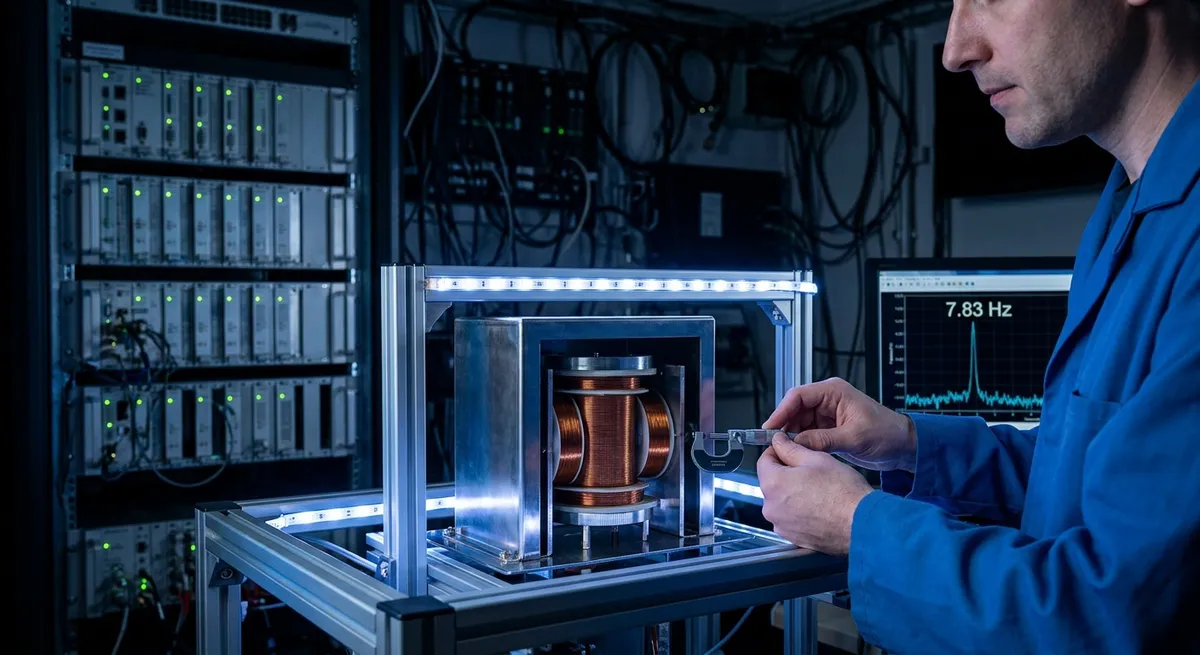
Accurate assessment of ionospheric health through the Schumann Resonance depends on robust, globally distributed monitoring networks. Multiple stations operating simultaneously provide redundancy and geographical coverage. Stations measure the electromagnetic field in the extremely low frequency (ELF) band, with specialized equipment designed to filter out noise and isolate the fundamental 7.83 Hz resonance and its harmonics.
72-hour Schumann Resonance amplitude log. Readings are stable relative to the 7.83 Hz historical baseline. Data: Earth Frequency Index global sensor network.
Modern monitoring stations employ sophisticated signal processing to distinguish the Schumann Resonance from background electromagnetic noise generated by human technology, power grids, and industrial equipment. This distinction is critical; without proper filtering, measurements become unreliable. Established monitoring networks, such as those operated by research institutions and universities, have developed standardized protocols to ensure data quality and comparability across locations.
The reliability of Schumann Resonance data as an ionospheric health indicator depends on consistent, long-term measurement. Individual readings have limited interpretive value; trends and patterns over weeks, months, and years provide meaningful insights. This is why institutions maintaining multi-decade records of the resonance have become invaluable resources for atmospheric and space physics research.
What Variations Reveal About Ionospheric Conditions
The Schumann Resonance does not provide direct measurements of ionospheric temperature, density, or chemical composition—specialized instruments at high altitudes do that. Rather, it provides an integrated, continuous signal reflecting the overall electromagnetic state of the Earth-ionosphere cavity. Variations in this signal correspond to changes in ionospheric conditions.
Diurnal variations in the Schumann Resonance are well-documented and expected. As the terminator line (the boundary between day and night) moves around Earth, it changes the ionospheric properties globally, and the resonance amplitude typically increases during daylight hours in the region above the terminator. Seasonal variations also appear, correlating with changes in solar elevation angle and atmospheric heating patterns.
More significantly, the Schumann Resonance can serve as an early indicator of unusual ionospheric behavior. Unexpected shifts in frequency distribution or amplitude may suggest disturbances not yet captured by other monitoring systems. For researchers tracking ionospheric health over extended periods, the resonance provides a continuous, cost-effective metric that complements satellite data and ground-based radar measurements.
Establishing Baseline Conditions
Understanding what the Schumann Resonance tells us about ionospheric health requires knowing what "normal" looks like. Decades of monitoring have established baseline frequency values, expected amplitude ranges, and typical harmonic structures. These baselines account for diurnal and seasonal variations, solar cycle influences, and geographic differences.
With well-established baselines, deviations become meaningful. A sustained shift in resonance characteristics might indicate a change in ionospheric structure or composition. By comparing current measurements against historical data, scientists can assess whether the ionosphere is behaving within expected parameters or exhibiting unusual patterns. This comparative approach transforms raw frequency data into actionable information about atmospheric health.
Conclusion
The Schumann Resonance serves as a natural diagnostic tool for ionospheric health, reflecting the electromagnetic state of the Earth-ionosphere cavity through a continuous, measurable signal. While it does not replace specialized instruments or satellite measurements, it provides valuable complementary data grounded in established physics. Continued monitoring of this 7.83 Hz frequency, supported by reliable infrastructure and rigorous data analysis, contributes to our understanding of how solar activity, seasonal changes, and atmospheric dynamics influence the electromagnetic environment surrounding our planet. For researchers committed to tracking ionospheric conditions over decades, the Schumann Resonance remains an essential component of comprehensive atmospheric monitoring.
Frequently Asked Questions
How does the Schumann Resonance reflect ionospheric health?
The Schumann Resonance frequency depends on the electromagnetic properties of the Earth-ionosphere cavity, so variations in ionospheric density, temperature, and composition can influence the resonance signal. By monitoring this frequency continuously, scientists can infer changes in ionospheric conditions without requiring direct high-altitude measurements.
What is the normal Schumann Resonance frequency?
The fundamental Schumann Resonance frequency is approximately 7.83 Hz, which remains stable under normal conditions. This frequency is generated by lightning strikes exciting the Earth-ionosphere cavity and represents the primary electromagnetic resonance mode of the system.
Does solar activity affect the Schumann Resonance?
Yes, solar activity influences the ionosphere, and researchers have documented correlations between solar events and Schumann Resonance measurements. During geomagnetic storms and periods of intense solar activity, ionospheric properties shift, and corresponding variations in resonance amplitude and frequency distribution have been recorded.
Can the Schumann Resonance predict ionospheric disturbances?
The Schumann Resonance can serve as an indicator of ionospheric changes and unusual behavior, but it provides integrated data rather than direct predictions. Unexpected shifts in resonance characteristics may suggest disturbances worth investigating with other monitoring systems.
Why do Schumann Resonance readings vary throughout the day?
Diurnal variations occur because the terminator line (the boundary between day and night) continuously changes ionospheric properties as it moves around Earth. Resonance amplitude typically increases during daylight hours in regions above the terminator due to increased solar ionization.