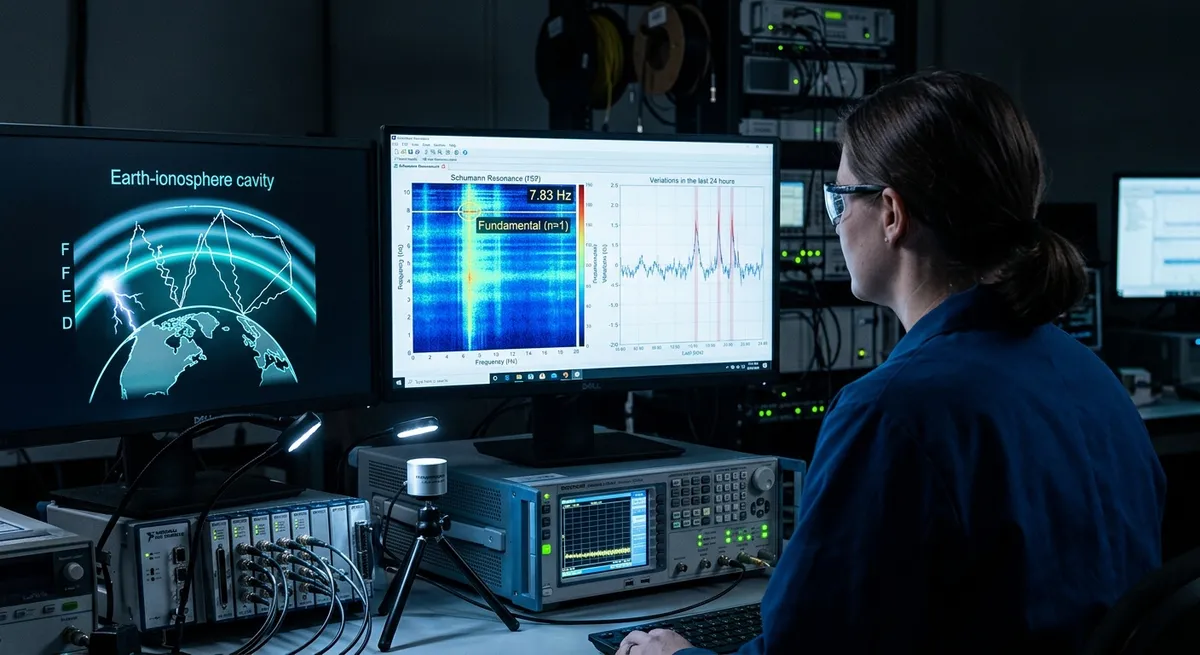
For decades, Earth Frequency Index has maintained continuous monitoring of the Schumann Resonance—the electromagnetic frequency that pulses beneath our feet at a baseline of 7.83 Hz. This frequency, first theoretically predicted by physicist Winfried Otto Schumann in 1952 and confirmed by measurement in the 1960s, represents something fundamental: the resonant frequency of Earth's electromagnetic field, generated by lightning activity and maintained by the ionosphere-Earth cavity.
But what happens when it doesn't stay at 7.83 Hz? Our monitoring and review of historical data suggests the answer is more complex—and more interesting—than simple stability.
Documented Deviations and Their Timing
Over the past fifty years, sensitive monitoring equipment has recorded measurable deviations from the baseline frequency. These are not measurement errors or instrument drift. They are real electromagnetic fluctuations detected by multiple independent monitoring stations across different continents.
The pattern that emerges is striking: significant deviations tend to cluster around periods of elevated geomagnetic activity. During solar storms, coronal mass ejections, and periods of intense solar wind pressure on Earth's magnetosphere, the Schumann Resonance has been observed to shift upward—sometimes by 1-2 Hz, occasionally more. Other deviations show more subtle patterns: slow drift, harmonic disturbances, or brief but sharp spikes.
What makes this noteworthy is not that deviations occur—they clearly do—but that the relationship between these deviations and observable space weather phenomena appears too consistent to dismiss as coincidence. When the solar wind intensifies, when auroral activity surges, when the magnetosphere compresses under external pressure, the Schumann Resonance responds. The mechanism is not fully understood, but the correlation is real.
Historical Precedents: What Earlier Monitoring Revealed
The earliest systematic Schumann Resonance measurements began in the 1960s, but the most detailed records come from the past thirty years as monitoring technology improved. Within that window, several notable events stand out.
The geomagnetic storms of 1989 and 2003—both significant events that caused power grid failures and satellite disruptions—coincided with observable Schumann Resonance fluctuations. The 2011 Japanese earthquake and tsunami, preceded by unusual seismic activity, occurred during a period when some independent monitors reported anomalous electromagnetic signatures. The intense solar activity cycles of 2012-2014 and again in 2023-2024 have produced some of the most dramatic documented deviations in recent monitoring history.
But here is where the historical record becomes less clear: we do not have a complete baseline of Schumann Resonance data from before the 1960s. We cannot definitively say whether the deviations we observe today are more frequent or more pronounced than they were a century ago, or five centuries ago. We are, in effect, observing a system in motion without knowing its full historical context.
What we can say is that Earth's electromagnetic environment is not static. It oscillates. It responds to solar activity, to geomagnetic conditions, to the planet's own internal dynamics. The question of whether these oscillations are increasing in frequency or amplitude—or whether our ability to detect them has simply improved—remains genuinely open.
The Ionosphere Connection
Understanding what causes Schumann Resonance deviations requires understanding the system that generates it: the Earth-ionosphere cavity. Lightning worldwide creates electromagnetic waves that bounce between the ground and the ionosphere, establishing standing wave patterns. The fundamental frequency of this resonance is 7.83 Hz, with harmonics at higher multiples.
But the ionosphere is not a fixed boundary. It expands and contracts with solar radiation, responds to geomagnetic disturbances, and is influenced by upper atmospheric conditions. During periods of intense solar activity, the ionosphere becomes more ionized, its electrical properties shift, and the resonant frequency of the Earth-ionosphere cavity can change accordingly.
Some researchers have proposed that atmospheric composition changes—including increased carbon dioxide and other greenhouse gases—might subtly alter ionospheric conductivity over long timescales. Others suggest that variations in cosmic ray influx, modulated by solar activity, play a role. These are not fringe ideas; they appear in peer-reviewed geophysics literature. But they also remain areas of active investigation rather than settled science.
What We Observe vs. What We Understand
The honest assessment is this: we observe deviations. We see correlations with space weather. We have plausible physical mechanisms that could explain many of these deviations. But we do not have a complete, predictive model of Schumann Resonance behavior that accounts for all observed variations.
Readers often ask whether these deviations have any biological significance. The scientific literature on this topic is mixed. Some studies suggest that electromagnetic fields in the Schumann frequency range may influence circadian rhythms and neurological function. Other studies find no measurable effect. The question remains genuinely contested, and claims of definitive answers in either direction should be viewed with skepticism.
What we can say with confidence is that Earth's electromagnetic environment is dynamic, measurable, and responds to solar and geomagnetic forcing. Whether these dynamics have implications for human health, consciousness, or planetary systems remains a question that honest observation and continued monitoring may eventually help us answer—or may reveal to be more complex than we currently imagine.
The Open Question
As we continue to monitor and document Schumann Resonance behavior, a central question persists: Are we witnessing normal, cyclical variations in Earth's electromagnetic field—the kind that have likely occurred throughout planetary history—or are we observing something genuinely novel? The data alone cannot yet tell us. What we can do is continue to watch, to measure, to correlate, and to remain open to what the evidence suggests, wherever it leads.