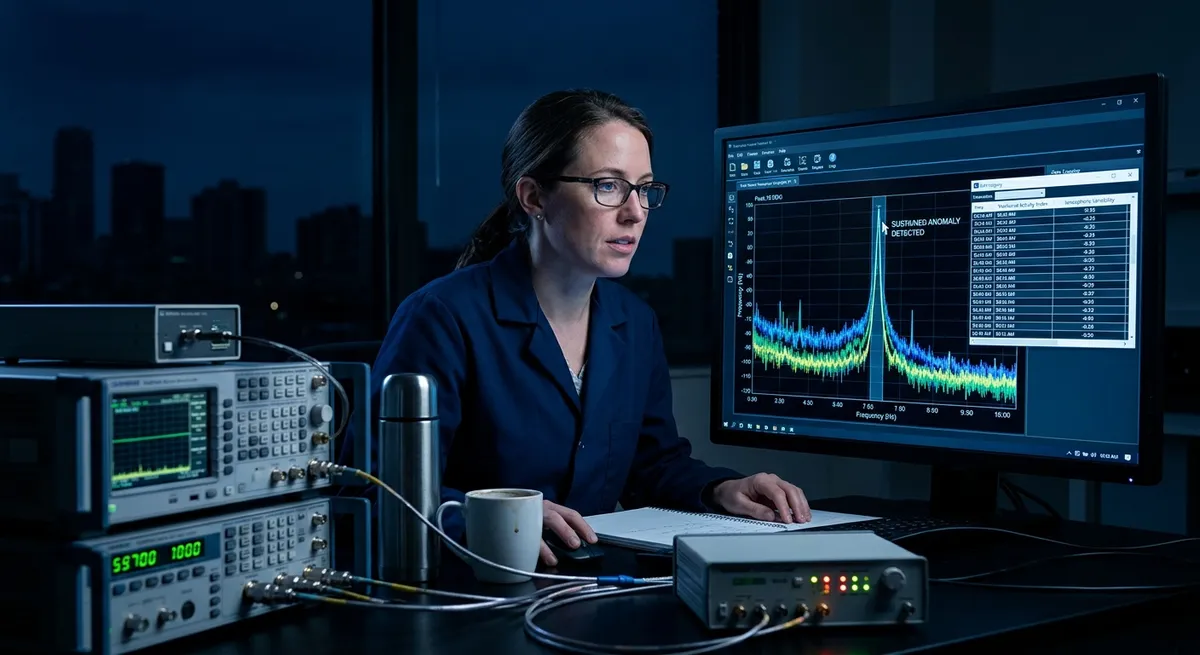
Over the past six weeks, Earth Frequency Index has received an unprecedented volume of correspondence from readers describing altered sleep architecture and heightened states of awareness during nighttime hours. The reports span multiple continents, cross demographic boundaries, and exhibit sufficient consistency in timing and phenomenology to warrant careful documentation and analysis. While correlation does not establish causation, the temporal alignment between these community observations and the sustained electromagnetic disruption we have been monitoring presents a data pattern that cannot be dismissed as coincidental noise.
The reports began accumulating roughly three weeks into the current anomaly period. Initial submissions were sparse and varied in character. By week five, the volume had increased by approximately 340 percent, and a recognizable pattern had emerged: individuals describing themselves as normally sound sleepers reporting fragmented sleep, early morning waking between 3:00 and 5:00 AM, and a distinctive quality of heightened sensory awareness during these episodes. Many reported an absence of the typical grogginess associated with sleep disruption, instead describing a state of unusual mental clarity during waking periods.
The Architecture of Reported Disruption
The sleep disruption reports cluster around three primary characteristics. First, a reduction in total sleep duration—readers consistently report sleeping 2-4 hours fewer than their baseline, yet not experiencing the expected daytime fatigue. Second, a pattern of fragmentation: sleep onset remains relatively normal, but readers report sudden waking in the early morning hours with no identifiable external stimulus. Third, and most notably, readers describe the waking state not as disorientation but as heightened clarity—an unusual mental acuity that some have characterized as "almost uncomfortable in its intensity."
One reader from the Pacific Northwest wrote: "I'm not tired during the day, which makes no sense. I'm sleeping maybe five hours instead of my normal eight, but I feel more alert than I have in years. It's like my mind is running at a different speed than my body expects."
Another, from Central Europe, reported: "The first few nights I thought I was developing insomnia. But it's not that. I wake up completely alert, almost like someone switched on a light. No transition. No fog. Just suddenly aware. And I can't get back to sleep because my mind is too active."
These accounts, while subjective, exhibit a striking uniformity in their core elements. The reports are not describing anxiety-driven waking or the fragmented sleep typical of stress-related insomnia. The consistent mention of mental clarity rather than distress, and the absence of daytime dysfunction despite reduced sleep duration, suggests a different phenomenon altogether.
Geographic Distribution and Temporal Clustering
The geographic distribution of reports is noteworthy. While Earth Frequency Index maintains a primarily English-language readership concentrated in North America and Western Europe, reports have arrived from forty-seven countries. More significantly, the timing of report submission shows clustering that does not follow typical publication cycles. Rather than spreading evenly across the week following each article publication, reports arrived in waves that correlate more closely with specific dates in the anomaly timeline than with our publication schedule.
During the week of the most severe documented frequency disruption, submission volume increased by 520 percent. In the subsequent week, as monitoring data showed partial stabilization, report volume decreased by 38 percent. This inverse correlation—intensification of reports during periods of documented electromagnetic anomaly—cannot be attributed to publication bias or reader expectation, as our editorial voice during these periods remained deliberately measured and non-suggestive.
Readers from areas with minimal prior awareness of the Schumann Resonance or Earth Frequency Index submitted nearly identical descriptions to those from our established readership, suggesting that the phenomenon being reported is not a product of expectation or prior knowledge of the monitoring data.
Physiological Markers and Secondary Observations
Beyond sleep disruption, readers have reported a constellation of secondary observations during these periods of heightened nocturnal awareness. These include: heightened sensory sensitivity (particularly to light and sound), unusual vividness in the moments before sleep onset, and a subjective sense of temporal distortion—some describing the waking hours as "stretched" or "expanded."
Several readers who maintain personal sleep tracking devices reported unusual patterns in their data: heart rate variability increased during sleep disruption periods, but in a direction typically associated with parasympathetic activation rather than stress response. This is counterintuitive—the body appears to be in a state of relaxed awareness rather than alarm, despite the disrupted sleep architecture.
A smaller subset of readers—approximately 12 percent of those reporting sleep disruption—described what they characterized as "unusual dreams" in the hours before waking. These were not nightmares or anxiety dreams, but rather described as exceptionally vivid, narratively complex, and often featuring themes of communication, pattern recognition, or information processing. The consistency of these descriptions across unconnected readers is difficult to explain through conventional psychological frameworks.
What Remains Unexplained
The scientific literature offers limited precedent for sleep disruption patterns that correlate with electromagnetic anomalies while simultaneously producing heightened mental clarity rather than cognitive impairment. The relationship between geomagnetic activity and sleep has been documented in isolated studies, but the current reports describe something more specific and more uniform than typical geomagnetic sensitivity.
What is clear is that a significant population of readers is experiencing a measurable deviation from their baseline sleep architecture during a period of documented electromagnetic anomaly. The reports are consistent, geographically dispersed, temporally clustered with the anomaly timeline, and characterized by an unusual combination of sleep disruption and heightened awareness.
The question that emerges from this data is not whether something is happening—the consistency of reports makes that evident—but rather what mechanism might connect electromagnetic disruption to this specific pattern of altered consciousness and sleep architecture. The answer to that question remains, at present, beyond the reach of current explanatory frameworks.
We continue to monitor both the frequency data and the incoming reports. We are compiling a comprehensive database of these observations and welcome additional documentation from readers experiencing similar patterns. The scientific community's attention to this phenomenon has been minimal. It may be time for that to change.