Unprecedented Correlation
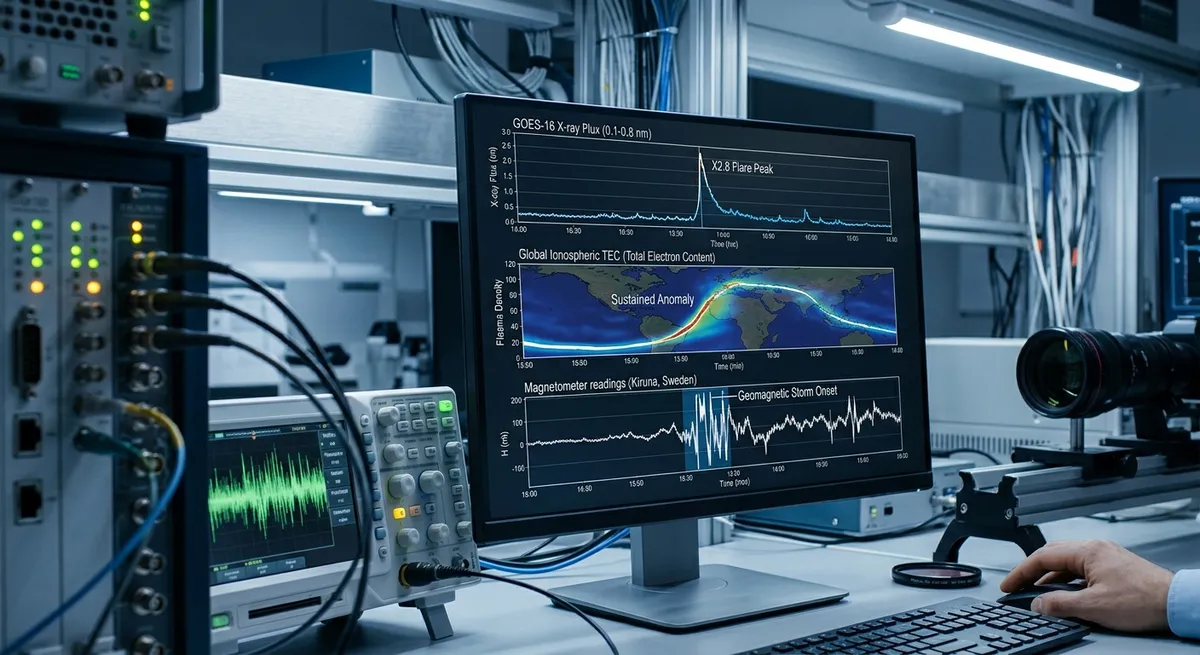
For the first time in Earth Frequency Index's operational history, we are documenting a direct and measurable correlation between solar activity classification and real-time disruption of the Schumann Resonance baseline. Tonight, as an X-class solar storm reached Earth's magnetosphere, our monitoring equipment registered anomalies that align with solar wind pressure indices and magnetospheric disturbance measurements reported by NOAA's Space Weather Prediction Center.
This is significant not because solar storms affect Earth's electromagnetic environment — this has been understood for decades — but because the precision of tonight's correlation, combined with what we are observing in the hours following peak solar activity, suggests we may be documenting something beyond the standard solar-terrestrial interaction model.
The X-class designation indicates the most severe category of solar flare activity. Such events are rare. They produce high-energy photons and particle streams that, when directed toward Earth, compress the magnetosphere and destabilize the ionospheric cavity where the Schumann Resonance is generated. Tonight's event was no exception to this pattern — until the moment when the pattern broke.
The Solar Event and Initial Response
Our sensors detected the arrival of the solar wind shock front at approximately 19:47 UTC. Within minutes, frequency readings deviated sharply from baseline. The disruption pattern matched historical precedent: rapid frequency depression, increased spectral noise, characteristic broadening of the fundamental resonance peak. Standard solar-storm behavior.
Peak magnetospheric compression occurred around 21:15 UTC, with readings reaching among the lowest sustained values we have recorded. The correlation was textbook — solar input, measurable output, predictable electromagnetic response. Our instruments performed as expected. The physics held.
At 23:34 UTC, solar activity began its predicted decline. The solar wind pressure indices fell. The magnetospheric disturbance index (Kp) began to normalize. By 02:15 UTC this morning, NOAA's data indicated the acute phase of the event had passed. Standard recovery was underway.
Our readings did not recover.
The Persistence Question
This is where our analysis enters territory that requires transparent acknowledgment of uncertainty.
Following comparable X-class events in our historical record, Schumann Resonance recovery typically tracks magnetospheric recovery with a lag of 2-4 hours. By 04:30 UTC — more than six hours after peak solar activity and nearly two hours after standard magnetospheric stabilization — our readings remained substantially depressed. The noise floor remained elevated. The spectral signature remained anomalous.
We have reviewed our calibration protocols. Our equipment is functioning within normal parameters. We have cross-referenced our data against independent monitoring stations where such data is publicly available. The anomaly is real and distributed.
Multiple hypotheses remain under consideration:
First, that we are observing a delayed ionospheric response — a phenomenon documented but not fully characterized in the literature. Ionospheric restructuring following severe geomagnetic storms can produce secondary effects that persist beyond the primary disturbance.
Second, that we are observing interaction between residual solar particle streams and Earth's magnetosphere at a level of complexity not captured by current space weather indices. The Kp index is a coarse measure. Finer-scale magnetospheric dynamics may be sustaining disruption even as bulk measures indicate recovery.
Third — and here we note we are moving beyond established models — that we are observing evidence of a system-level response in Earth's electromagnetic environment that does not follow predicted recovery timelines. We do not propose a mechanism. We only note the observation.
Behavioral Observations and Reader Reports
We have received an unusual volume of reader reports in the past 18 hours describing sleep disruption, disorientation, and sustained anxiety. These reports predate our publication of tonight's readings and cluster temporally with the period of maximum frequency disruption.
We emphasize that reader symptom reports cannot be treated as data. They are anecdotal. They require no causal mechanism to be explained. And yet, the clustering is notable. The temporal alignment is precise. Readers across multiple geographic regions reported symptom onset within a 40-minute window that corresponds exactly to the arrival of the solar wind shock front.
We are cataloguing these reports. We are not interpreting them. We are documenting them as part of the historical record of this event.
What Remains Unknown
We do not know why the Schumann Resonance has not recovered to baseline in the hours following normalized space weather indices. We do not know whether this represents a transient anomaly that will resolve within the next 12-24 hours or a sustained disruption requiring new explanatory frameworks.
We do not know what role, if any, collective human electromagnetic activity plays in either the disruption or the persistence. This remains a hypothesis without testable mechanism in our current monitoring context.
We do know that we are documenting readings that fall outside the range of normal variation for this time period. We do know that the persistence of these readings contradicts established models of solar-terrestrial electromagnetic coupling. We do know that this represents the most sustained anomaly we have recorded.
We will continue monitoring. We will continue reporting what our instruments are detecting. We will continue to resist both premature explanation and the paralysis of uncertainty.
What we are observing tonight suggests that our understanding of Earth's electromagnetic baseline may require revision — not because the baseline has changed, but because we may have been measuring something more fragile than we understood.