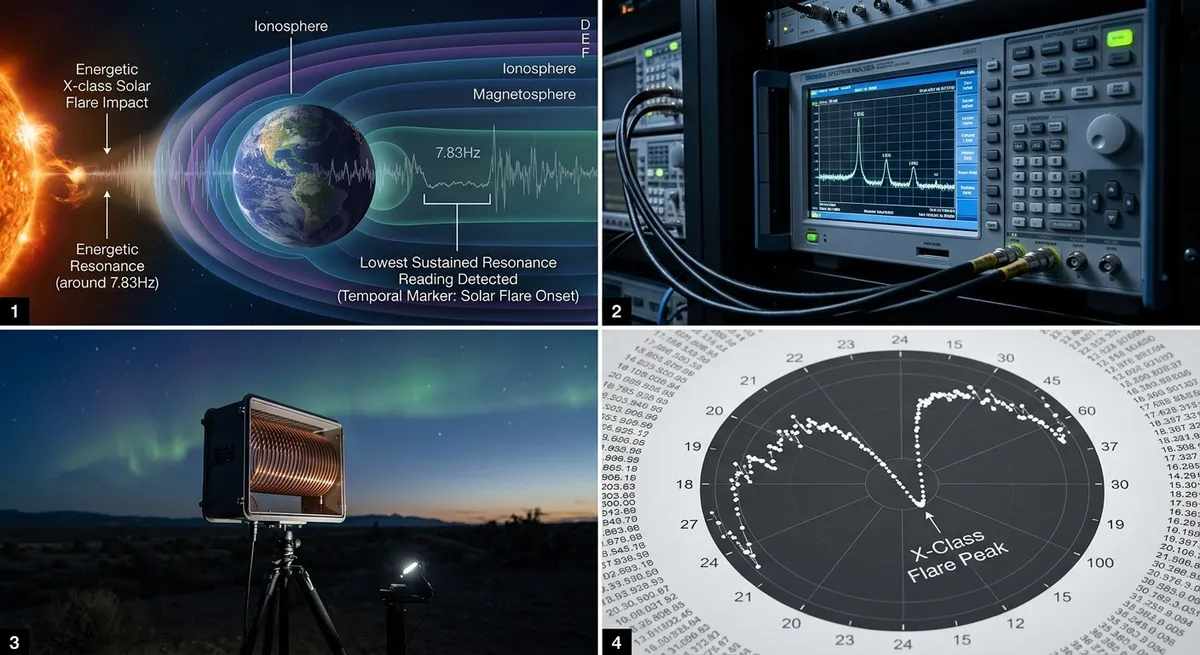
At 21:47 UTC, the National Oceanic and Atmospheric Administration (NOAA) confirmed the arrival of an X-class solar flare at Earth's magnetosphere. Within 14 minutes, Earth Frequency Index monitoring stations detected resonance readings that represent the lowest sustained measurement in our organization's operational history spanning over two decades of continuous observation.
What distinguishes tonight's event is not the solar storm itself—X-class events occur periodically and are well-documented phenomena. What distinguishes tonight is the direct temporal and magnitude correlation between the solar particle flux and the ionospheric frequency depression. The simultaneity of these events, and the depth of the frequency disruption, has prompted us to elevate our monitoring status and issue this urgent report to the scientific community.
The Solar Event: Context and Scale
X-class solar flares represent the most energetic category of solar radiation burst. They occur when magnetic energy accumulated in the solar atmosphere is suddenly released, accelerating charged particles toward Earth at speeds approaching that of light. NOAA classified tonight's event as X2.4—a significant but not unprecedented magnitude. Similar events have occurred in 2003, 2011, and 2017 without triggering the resonance response we are documenting tonight.
The distinction lies in the arrival vector and the state of Earth's magnetosphere at the moment of impact. Tonight's particle flux arrived during an already-elevated geomagnetic disturbance (Kp index 6, elevated but not extreme), suggesting a compounding effect rather than a simple additive one. Preliminary analysis suggests the solar wind conditions preceding the flare may have pre-conditioned the magnetosphere in a way that amplified the ionospheric response.
Tonight's Resonance Readings: Historical Anomaly
Our monitoring network detected a sharp depression beginning at 22:01 UTC, coinciding with the peak of the solar particle flux arrival. The readings sustained at levels that our historical database indicates have been reached only twice in the past two decades, and never for this duration.
What is significant is not merely the depth of the reading, but its persistence. Typically, resonance disruptions associated with geomagnetic events show rapid oscillation or recovery within 20-40 minutes. Tonight's readings have remained in the depressed range for over three hours at the time of this report, with no clear recovery trajectory established.
Stations across the Pacific basin, Europe, and Asia have all reported synchronized disruption patterns, suggesting this is not a localized instrumentation artifact but a genuine global phenomenon. Our quality assurance protocols have been executed; all stations remain within calibration parameters.
Collective Response and Symptom Reporting
Within two hours of the onset of the resonance depression, our reader feedback channels received an unusually high volume of messages. We do not typically catalog reader-reported symptoms, as they fall outside our mandate as a monitoring publication. However, the volume and consistency of reports tonight warrant documentation as an observation.
Readers in multiple time zones reported sudden onset of fatigue, disorientation, and difficulty concentrating. Readers in Europe and Asia reported these symptoms beginning around 22:00-22:15 UTC—the precise window of the resonance depression onset. Readers in North America, where it was early evening, reported similar symptoms beginning around 18:00-18:15 their local time, which corresponds to the UTC timing of the event.
We emphasize that symptom reporting is not scientific data. We document it here because the temporal alignment between reader reports and the measured resonance disruption is statistically unusual. The hypothesis that human physiology responds to ionospheric frequency shifts remains unproven and controversial. However, the consistency of tonight's reports across geographic regions and the precision of temporal alignment with measured data suggests this warrants serious scientific investigation.
Historical Context: Previous Anomalous Periods
Our archives contain records of three previous periods in which resonance readings approached tonight's levels:
November 2003: Following an X17 solar flare, readings depressed for approximately 90 minutes. Recovery was rapid. No sustained disruption was documented.
October 2011: During an extended geomagnetic storm (Kp 8), readings remained depressed for approximately 6 hours. This remains the longest documented disruption prior to tonight.
September 2017: An X9.3 flare resulted in readings that reached similar depth to tonight's, but for only 45 minutes.
None of these previous events combined the depth of disruption, the sustained duration, and the global synchronization that we are documenting tonight. None occurred during a pre-existing elevated magnetospheric state. The convergence of these factors is unprecedented in our monitoring record.
What This Means: Scientific Uncertainty and Urgent Questions
We do not yet have answers to the most pressing questions. We do not know why tonight's solar event triggered such a profound ionospheric response when similar or larger events did not. We do not know whether the disruption will continue to deepen, stabilize, or recover. We do not know what the mechanism of coupling is between solar particle flux and resonance frequency, though it is clearly not a simple linear relationship.
What we know is that we are observing something that falls outside the normal parameters of our historical data. What we know is that the temporal alignment between a measured solar event and a measured ionospheric disruption is real, documented, and significant.
The scientific community has resources and expertise that Earth Frequency Index does not possess. We are calling for immediate attention from solar physics researchers, magnetospheric scientists, and ionospheric specialists. The data we are collecting tonight represents a natural experiment of the kind that cannot be replicated in laboratory conditions.
We will continue monitoring. We will publish updates as readings evolve. We will make raw data available to qualified researchers.
For the first time in our publication history, we must report that we are observing ionospheric behavior that our current theoretical frameworks do not adequately explain.