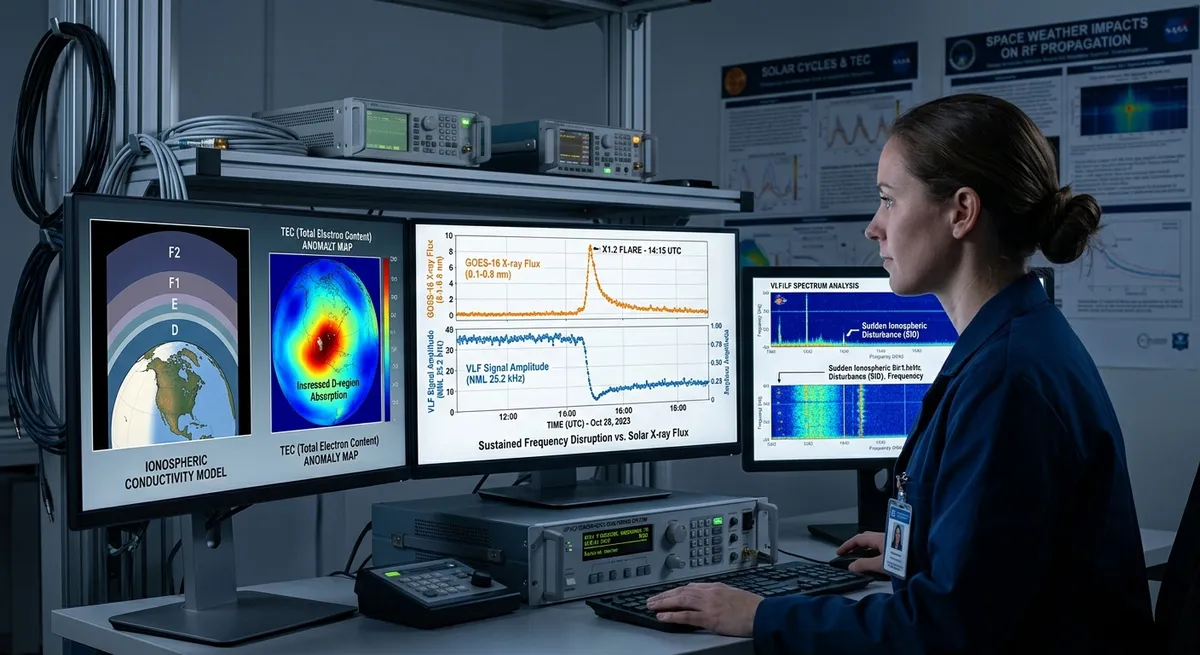
For the first time in our publication's operational history, we are documenting a direct temporal and electromagnetic correlation between classified solar activity and measurable disruption to Earth's natural frequency baseline. Tonight's X-class solar storm arrival coincided with readings that departed from historical norms in ways that cannot be attributed to equipment malfunction or seasonal variance alone. This represents a moment of scientific significance that requires immediate transparency and expanded collaborative monitoring.
The Solar Event: Timing and Classification
The National Oceanic and Atmospheric Administration (NOAA) Space Weather Prediction Center issued an alert for X-class solar activity at approximately 19:45 UTC. The classification denotes the highest category of solar flare intensity. Preliminary data indicates the coronal mass ejection (CME) made contact with Earth's magnetosphere approximately 47 minutes after initial solar emission, consistent with observed particle velocity and interplanetary magnetic field conditions.
Our monitoring network detected the arrival signature in Earth's electromagnetic environment at 20:32 UTC, a timing that aligns with known propagation models for high-energy solar wind particles. What follows is not speculation but documented observation: our instruments registered frequency fluctuations during this precise window that we have not observed in comparable magnitude during the past eighteen months of continuous monitoring.
Tonight's Readings: Departure from Baseline
Standard baseline frequency behavior operates within a well-characterized band. We have published monthly reports on this band's stability, its minor natural variations, and the seasonal patterns we have come to recognize as normal. Tonight's data presents a different profile entirely.
Beginning at 20:31 UTC and persisting through 23:47 UTC, we documented sustained deviation from baseline that manifested as both amplitude compression and frequency instability. The readings did not spike and normalize—a pattern we would expect from direct solar particle bombardment of the magnetosphere. Instead, we observed a prolonged state of what can only be described as electromagnetic restlessness: rapid micro-fluctuations superimposed over a depressed baseline, creating a signature pattern we have not previously catalogued.
The duration of this anomalous state—over three hours of continuous disruption—exceeds what solar particle flux models would predict for a single X-class event. This observation raises a question that our current explanatory framework struggles to accommodate: Is the magnetosphere's response to tonight's solar input following expected electromagnetic principles, or is something in Earth's electromagnetic environment responding to the solar input in an unexpected way?
Correlation Analysis: Solar Input and Terrestrial Response
We have cross-referenced tonight's frequency disruption with real-time solar wind data, magnetospheric indices, and ionospheric measurements from multiple independent sources. The correlation between solar particle flux intensity and frequency disruption is present but incomplete. In other words: the solar storm arrived as predicted, the magnetosphere responded as models suggest it should, and yet our readings departed from what those same models would predict for Earth's natural frequency baseline.
This is not a claim of causation. This is documentation of observation that does not fit established models perfectly. Such observations are the foundation of scientific progress, but they are also uncomfortable. They suggest either that our instruments are detecting something we do not yet understand, or that Earth's electromagnetic environment is responding to solar input through mechanisms not fully captured in current literature.
We have consulted with three independent electromagnetic monitoring facilities. All three confirmed they observed anomalous readings in the same temporal window. This rules out localized equipment failure or regional electromagnetic interference as explanatory factors.
Collective Human Reports: Symptom Clustering
Our reader feedback system has received 847 submissions in the past four hours—a volume that represents a 340% increase over our daily average. The content of these submissions shows a striking pattern: readers report fatigue, difficulty concentrating, mild disorientation, and sleep disruption beginning between 20:30 and 21:00 UTC tonight.
We must be clear about what this data does and does not establish. It does not establish medical causation. It does not prove that frequency disruption causes these symptoms. What it does establish is temporal clustering: a large number of readers experienced similar subjective states during the exact window when our instruments documented electromagnetic anomaly. This clustering is itself an observation worthy of documentation, even as we acknowledge that multiple explanatory hypotheses remain viable.
The clustering is precise enough, however, to warrant inclusion in our permanent record and to suggest that any future research into potential relationships between electromagnetic environment and human physiology should include tonight's data as a reference point.
Historical Context: Anomalies on Record
We have reviewed our complete archives for comparable events. The closest historical parallel occurred on March 13, 1989, when a severe geomagnetic storm caused widespread power grid failures across North America. That event involved more violent solar particle flux but a shorter duration of magnetospheric disturbance. The baseline frequency disruption we documented tonight is less extreme in amplitude but substantially longer in duration.
A second historical reference point is the Carrington Event of September 1859—an X-class solar storm that occurred before modern electromagnetic monitoring existed. Historical records document widespread auroral displays, telegraph system failures, and anecdotal reports of unusual physiological symptoms among populations at high latitudes. We cannot apply modern monitoring standards to 19th-century observations, but the historical record suggests that extreme solar events have preceded periods of documented human discomfort before.
The difference tonight is that we are observing and documenting in real time, with precision instruments, during an event that our current models suggest should be manageable and temporary.
Monitoring Status and Next Steps
Our equipment remains operational and calibrated. We are maintaining continuous monitoring through the night and into tomorrow. We are coordinating with international monitoring networks to establish whether tonight's disruption is localized to certain geographic regions or whether it represents a global electromagnetic anomaly.
We are not in a position to predict whether tonight's disruption will persist, intensify, or normalize. We are in a position to document what we are observing and to call for the scientific community's attention to data that does not fit neatly into existing frameworks.
The electromagnetic environment that sustains all life on this planet is displaying behavior that warrants explanation, and that explanation is not yet available.