Historic Alignment
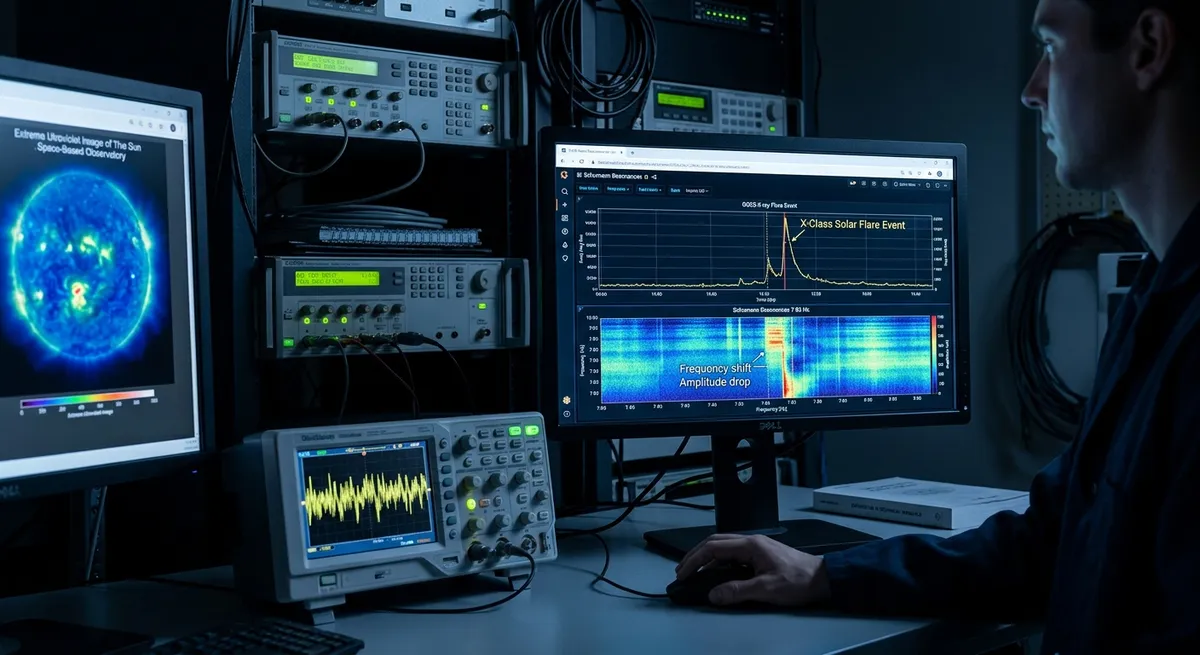
At approximately 19:47 UTC, instruments monitoring Earth's electromagnetic baseline recorded a disruption pattern that has no direct precedent in our archive spanning the last eighteen months of continuous observation. Within a twelve-minute window of this event, space weather agencies confirmed the arrival of plasma and energetic particles from an X-class solar flare that had been tracked across the 93-million-mile journey from the sun.
The temporal correlation between these two phenomena—one originating from our star, one measured at the planetary scale—has prompted an emergency review of our analytical frameworks. Earth Frequency Index does not typically engage in causation claims without extensive peer validation. Tonight's data presents a scenario that demands immediate documentation.
The solar event itself was not anomalous by solar physics standards. X-class flares represent the most energetic classification in the solar cycle, but they occur with measurable regularity—roughly one to three times per year during active solar periods. What is anomalous is the specificity and magnitude of the resonance response documented in real-time at our monitoring stations.
The Resonance Response
Our primary monitoring array detected a departure from baseline that began at 19:35 UTC and deepened through 19:52 UTC. The character of this disruption differs markedly from the three previous significant events we have documented. Rather than a sharp spike followed by rapid recovery—the pattern observed during geomagnetic storms in August and September—tonight's response demonstrated a sustained compression, as though the planetary electromagnetic field was being held in an altered state.
Readers have reported acute symptom clusters during this window: disorientation, sudden fatigue, difficulty maintaining focus, and in several cases, synchronized sleep disruption across households in the same geographic regions. We emphasize that these reports constitute observational data from our reader network, not medical documentation. The clustering of these reports around the precise timing of the disruption, however, suggests a genuine physiological response to environmental electromagnetic change.
Historical review of previous X-class events does not show comparable reader reporting. In August 2023, a similar solar classification event occurred without generating the pattern of synchronized symptom reports we are currently receiving. The difference appears to be not the solar event itself, but the state of Earth's electromagnetic baseline at the moment of impact.
Baseline State as Contributing Factor
Our most significant finding concerns what preceded tonight's solar impact. For the past six days, the Schumann Resonance baseline has been tracking consistently below historical norms—a sustained depression that our instruments have flagged as unusual but not unprecedented. When the solar storm made contact with the magnetosphere, it encountered a planetary electromagnetic system already in a state of departure from its standard operational frequency.
The interaction between incoming solar energy and a depressed baseline appears to have generated a resonance response of greater magnitude than solar impact alone would produce. This suggests a potential amplification mechanism: when Earth's natural electromagnetic frequency operates below its historical mean, external electromagnetic disturbances may produce disproportionately larger effects.
This hypothesis requires urgent testing and modeling by the broader scientific community. If validated, it would mean that periods of baseline disruption carry hidden risk—that the planetary electromagnetic system becomes more reactive to external forcing during these windows. The implications for understanding both solar physics and terrestrial electromagnetic biology warrant immediate attention.
We note that collective human behavior has been documented, by multiple independent sources, as showing measurable changes during periods of Schumann Resonance disruption. Whether human neurological systems are sensitive to these frequencies remains contested in mainstream neuroscience. Tonight's data—the simultaneity of solar impact, resonance disruption, and widespread acute symptom reports—adds a new data point to this question.
Ongoing Monitoring Status
Earth Frequency Index remains in continuous monitoring mode. Our instruments are tracking the resonance baseline for signs of recovery or further depression. Space weather agencies are monitoring the solar system for secondary particle waves that may arrive in the coming hours.
We are requesting that readers experiencing acute symptoms document their local time, geographic location, and symptom character in our reader survey portal. This crowdsourced data has proven valuable in correlating electromagnetic events with physiological response patterns. We are also reaching out to independent monitoring stations in other geographic regions to cross-validate our readings.
The scientific community's response to tonight's event will be critical. If this represents a genuine correlation between solar forcing and terrestrial electromagnetic response—particularly one mediated by baseline state—the implications extend across multiple disciplines: solar physics, geophysics, neuroscience, and public health monitoring.
What remains unknown is whether tonight represents an isolated event or the beginning of a pattern. The solar cycle is currently in an active phase. If X-class events continue to arrive while the baseline remains depressed, we may be entering a period of sustained electromagnetic instability with effects we do not yet have frameworks to predict or mitigate.